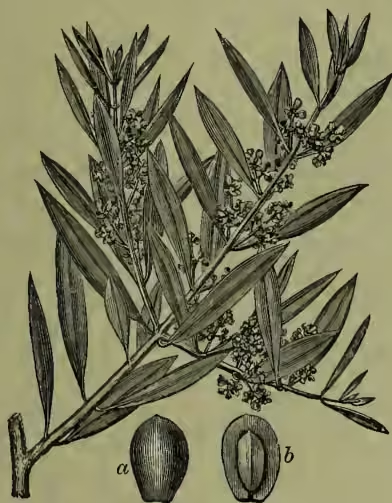
a, ripe fruit; b, section of same showing stone.
(Bentley and Trimen.)
Olive (Olea), a genus of trees and shrubs of the natural order Oleaceæ, having opposite, evergreen, leathery leaves, which are generally entire, smooth, and minutely scaly. The general character of the genus is well illustrated by the accompanying cut. The species are widely distributed in the warmer temperate parts of the globe. The Common Olive (O. Europeæ), a native of Syria and other Asiatic countries, is in its wild state a thorny shrub or small tree, but through cultivation becomes a tree of 20 to 30 feet high, destitute of spines. It attains a prodigious age; some plantations, as those at Terni, in Italy, are supposed to have existed from the time of Pliny. Some trees in Turkey are credited with an age of 1200 years. There are two varieties of the common olive, one having narrow, willow-like leaves, gray green above and silvery below. In the other the leaves are similar in all respects, only much broader. The latter has also much the larger fruit of the two, but the oil it yields is rank and coarse to the palate, and is rarely used on the Continent out of Spain, in which country it is the variety chiefly cultivated. The narrow-leaved variety is preferred by the French and Italian olive-growers, the more bland and agreeable oil from which is better appreciated, especially by the British. Olive-oil may be said to form the cream and the butter of Spain and Italy, as it takes the place of those products of milk in the cookery and table uses of those countries. Being highly nutritious, it is also regarded as more wholesome than animal fats in warm climates. The finest quality of olive-oil is obtained from Tuscany. The oil is contained in the fleshy part of the fruit—not in the stone—from which it is extracted by pressure. The fruit when ripe is crushed to a paste. It is then put into woollen bags and subjected to pressure moderately. Thus is obtained in considerable quantity the finest quality of oil, which is named 'Virgin Oil.' The pulp is then moistened with water and again pressed, the result being an oil of inferior quality, yet quite fit for table purposes. A further residue of oil is extracted from the pulp after it has been steeped in water; but it is only fit for soap-making and other manufacturing purposes (see OILS, and COTTON-SEED OIL). Unripe olives are pickled both for consumption in the countries in which they are grown and for exportation to other countries. The best pickled olives come from Genoa and Marseilles to England, but quantities are also imported from Languedoc, Leghorn, and Naples. They are eaten abroad before meals as a whet to the appetite, and in England at dessert with wine to restore the palate and as a digestive. Dried olives are also used for the same purposes, as well as pickled olives. The wood is much prized by cabinet-makers, being beautiful in colour and grain, and capable of taking a fine polish; that of the root is most in demand for the making of snuff-boxes and ornaments.
The olive has been cultivated in the East from the remotest times, is associated with much mythical lore, and has been regarded in all ages as the bounteous gift of heaven, as the emblem of peace and plenty, and the highest reward that could be given to the honourable and the brave. The area devoted to olive-culture in Italy is stated at about 2½ million acres, and the total production of olive-oil is some 90 million gallons. The olive is also largely cultivated in Turkey and the Levant, in Morocco and Tripoli, as well as Spain; and some attention is being paid to its culture in South Australia. It grows luxuriantly in Chili, whither it was brought by the Spaniards. Jesuit missionaries introduced it into Mexico in the 17th century, and into California, where it grows freely. It has also been grown in Florida and other southern states. The culture of the olive has been attempted in England, but without success. Against south walls it lives, with slight protection in winter, in the neighbourhood of London, and in the same way it produces fruit in exceptionally favourable seasons in Devonshire; but it is generally unsuited to the British climate. Even in those countries in which its culture may be profitably pursued the tree is somewhat fastidious as to soil, aspect, and position. It does not succeed well in elevated situations, prefers sloping ground facing and not far removed from the sea, and thrives best in calcareous soil. It is very generally propagated by suckers, but where great care is bestowed on it inarching is practised. It bears an abundant crop only once in several years. There are other species of Olea more remarkable for the hardness and usefulness of their timber than for their fruits. O. verrucosa, O. capensis, and O. laurifolia, natives of the Cape of Good Hope, are small trees or shrubs with wood of such density and toughness as to rival in strength and durability iron itself, and they are all named Ironwood by the colonists. The fruit of some of these is eatable. The fruit of O. americana is also eatable. The Fragrant Olive of Japan and China—O. (Osmanthus of some) fragrans—is a handsome shrub with sweet-scented flowers, which are said to be used by the Chinese for flavouring some kinds of tea. See A. T. Marvin, The Olive: its Culture in Theory and Practice (San Francisco, 1888); and United States Consular Report (1890).