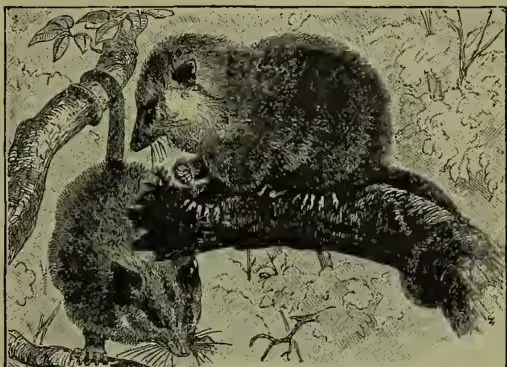
Opossum (Didelphys), a genus of Marsupialia, having ten incisors in the upper jaw, and eight in the lower, one canine tooth on each side in each jaw, three compressed premolars, and four sharply-tuberculated molars on each side—fifty teeth in all; the tail generally very long, prehensile, and in part scaly; the feet plantigrade; five toes on each foot, their claws long and sharp; but the inner toe of the right foot converted into a thumb, destitute of a claw, and opposable to the other digits. The pouch, so characteristic of marsupials, is generally absent, sometimes rudimentary, rarely complete. The unwebbed feet and non-aquatic habits distinguish this genus from Cheironectes (q.v.), also belonging to the family Didelphidae. The name opossum has also been applied to certain Australian forms, but is better restricted to the American opossums, which are the only marsupials found in America. They range from the United States to the Argentine Republic. There are altogether twenty-three distinct species, with a considerable range in size, varying from that of a large cat to that of a mouse. The best known is the Virginian Opossum (D. virginiana). Among the marsupials they are nearest allied to the Dasyuridae, from which they are doubtfully separable; if it were not for their geographical range, they would undoubtedly be placed in the same family. Although there are now no opossums found anywhere but in America, they existed formerly in Europe, as is shown by their fossil remains. The opossums are all carnivorous, one species, the Crab-eating Opossum, feeding—as its name denotes—upon crabs; in order to capture its prey it frequents marshy places. It is a native of tropical America. Merian's Opossum (D. dorsigerus) is remarkable for the fact that it carries its young on its back, their tails being twined round the tail of the mother; many other species carry the young on the back; this is due in many cases to the fact already mentioned—that there is no pouch. The Virginian Opossum is a foe to poultry-yards in the United States; but it can put up with frogs if there is nothing better to be had. The opossums, like other marsupials, have a lowly organised brain; but they are remarkably cunning in robbing poultry-yards; on the other hand, their stupidity in walking straight into the simplest and most obvious trap is more in accord with their brain structure. Hunting the opossum with dogs by night is a favourite sport in the southern states, especially in autumn, when the body has a thick layer of fat all over. The animal takes refuge in a tree, and is either shaken down or shot as it hangs by the tail. The expression 'playing possum' refers to the opossum's habit of feigning death when caught. At such times, though usually very timid, it will endure almost any amount of torture, and give no sign of its suffering.