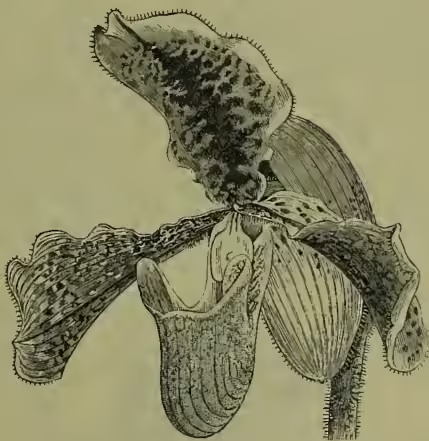
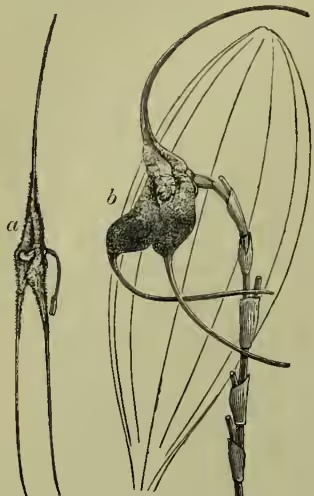
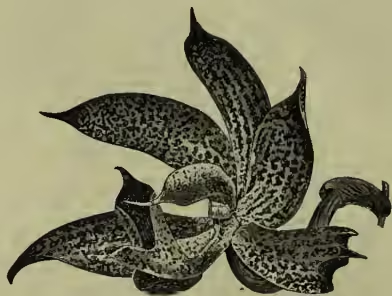
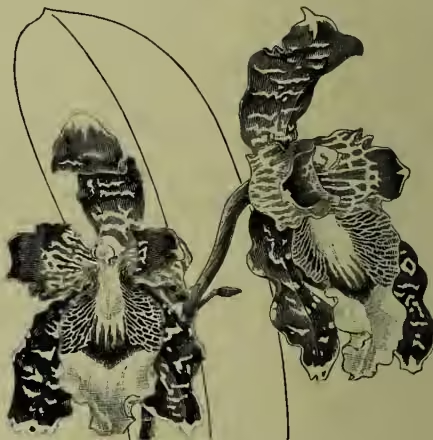
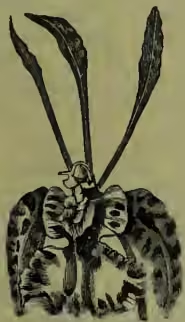
Orchids (ORCHIDÆ or ORCHIDACEÆ), a natural order of endogenous plants distinguished from all other orders in the same alliance by their irregular gynandrous flowers and parietal placentæ. The essential peculiarities of the order are due to the consolidation of the stamens and pistil into one body called the column; to the suppression of all the anthers but one in all the genera except those comprising the tribe Cyripedie, in which there are two anthers; to a peculiar condition of the pollen and the structure of the anthers containing it, and to the remarkable forms and development generally assumed by the lip (labellum)—one of the inner members of the perianth which often plays an important mechanical part in the fertilising of orchids. The species are perennial herbaceous plants or shrubs of terrestrial habit in the temperate and colder parts of the world, but in warmer countries become epiphytal, adhering to the stems and limbs of trees, or fixing themselves on rocks by their strong fasciculate roots without penetrating the structure of these, or having any direct connection with the soil. Hence they have been popularly named air plants, as those which assume the epiphytal habit derive the greater part of their nutriment from the atmosphere. Their roots are fibrous or fasciculate or fleshy and tuber-like, the latter being peculiar to the terrestrial species. Their stems are annual, herbaceous, perennial, and woody, and very often pseudo-bulbous. Their leaves are flat or round, equitant, and generally sheathing, often leathery, and having parallel nerves. The flowers are irregular, extremely variable in form, often beautifully coloured, and deliciously fragrant, and are either solitary or in spikes, racemes, or panicles. They are composed of six usually petal-like segments: the three outer ones are called sepals, and two of the inner ones, which are usually alike in form and colour, are called petals; the third inner one, which differs in shape and also generally in direction from the others, is the lip. Opposite to the lip in the axis of the flower is the column, bearing the anther or anthers with the pistil variously situated relatively to each other. The more obvious features described are well illustrated in the accompanying figures of Cyripedium (see also LADY'S SLIPPER), Mormodes, Odontoglossum, and Oncidium, in which the six segments of the perianth are so conspicuous as to reveal at a glance their structural relation to each other.
Orchids are found in almost all parts of the world, except in extremely dry climates and on the borders of the frozen regions. In Britain there are found sixteen genera and nearly forty species. In Europe, the temperate parts of Asia, in North America, and the Cape of Good Hope they are common inhabitants of groves, marshes, and meadows; and in these regions they are invariably terrestrial in habit. But in the hot damp parts of the West and East Indies, in Madagascar, and other islands in the same region, in the moist forests of Brazil, the warm parts of Central America, and western Mexico they abound in the greatest profusion, no longer dependent on the soil for their nutriment, but clinging to the trunks and branches of trees, to stones and crags, where they vegetate among ferns and other shade-loving plants, or occupy by them- selves exclusively the places which they affect. The family is a very numerous one, there being, according to the Genera Plantarum, 334 genera and about 5000 species known to botanists. Of exotic species Linnaeus knew only about a dozen a little over a century ago. About 2000 species have been introduced to cultivation. The beauty and the fragrance of the flowers, the singularity and almost endless variety of form which they exhibit, and their interesting structure botanically, along with the rarity of many of the most beautiful, place orchids among the most remarkable of the families of the vegetable kingdom. Darwin, who devoted much attention to the family, particularly in regard to their fertilisation, says of the peculiarity of the structure of the flowers of orchids that 'an examination of their many beautiful contrivances will exalt the whole vegetable kingdom in most persons' estimation,' and that 'hardly any fact has struck him so much as the endless diversities of structure—the prodigality of resources—for gaining the
same end, namely, the fertilisation of one flower with pollen from another plant.' This part of the history of orchids is, like every other point connected with them, too wide to be dealt with here in detail. Those, however, who desire to study the matter closely should see the work quoted from—The Fertilisation of Orchids, by Charles Darwin.
Since the middle of the 19th century the cultivation of orchids in Britain, on the Continent, and in America has become an absorbing pursuit with wealthy amateurs. The possession of a rare or unique species or variety is an ambition that can only be attained by the millionaire; the prices of such are quite beyond the means of those possessed only of moderate wealth. Syndicates are formed for the purpose of collecting and importing orchids from all countries in which rare or otherwise valuable species are known to exist, and private persons and several of the leading London and continental nurserymen send experts in orchid-collecting to those countries at great expense with the same object in view. There is thus considerable commerce in orchids, in connection with which large sums of money are circulated annually. The genera which are in greatest request among amateurs are Cypripedium, Dendrobium, Masdevallia, Odontoglossum, Cattleya, Laelia, Oncidium, Chysis, Cymbidium, Calanthe, Phalaenopsis, Cœlogyne, Angraecum, Vanda,
Anguloa, Epidendrum, Sophronitis, Renanthera, Saccolabium, Miltonia, Peristeria, Lycaste, and many others.
Amongst notable English collections have been those of Baron Schroeder at Egham in Surrey, and Sir Trevor Lawrence at Dorking, each of which must have cost its owner from £30,000 to £40,000 to bring together. Among large commercial collections are those of Veitch, Williams, Low, and Bull, all of London, Sander & Co. at St Albans, and in Scotland of Messrs Thomson at Clovenfords. Sales by auction, at which orchids to the value of thousands of pounds may change hands, take place frequently in London, which is the centre for the world of the trade in orchids. The prices of individual plants vary from 3s. 6d. to hundreds of pounds, the prices depending on qualities of size, form, colour of flower regulated by canons appreciable only by connoisseurs. Baron Schroeder sold a unique plant of Cypripedium Stonei, var. Platylæmium, for £365; another connoisseur paid £340 for a variety of Aerides Lawrenceæ. The ordinary form of the latter may be obtained for about two guineas per plant, and that of the preceding species for half a guinea each, simply because they are more or less plentiful, while rare or unique forms command hundreds of pounds sterling. These unique forms make their appearance very generally without any exercise of skill on the part of the fortunate possessor. They may be bought along with ordinary or typical varieties of the species to which they belong, and not having been seen in flower by the dealer, their intrinsic value is not known to him. Thus Cattleya Thomsonii originated in part of an importation of Cattleya Mossie and other species received from South America. Only one small plant appeared in a numerous batch of plants, with the unique characteristics of the one in question, which was readily bought for £200.
The cultivation of orchids is accounted a difficult branch of the gardener's art. When the value of a considerable collection of rare kinds is considered, their successful management is at least a responsible undertaking. To be successful in their treatment the cultivator should above all things be well informed regarding the conditions under which each species grows in its native habitat. The prevailing temperature and other atmospheric conditions during the periods of growth and of rest, and the amount of shade or of light to which they are exposed at those seasons, must be known to and comprehended by the cultivator before he can adapt his means to the end in view. Houses or compartments of houses are set apart for the accommodation of species which are natives of the more hot and humid parts of the world, such as tropical East India, Madagascar, and Brazil, and a similar arrangement is made for those from Mexico and Central America. The management of the atmosphere of these houses is then based on such knowledge as the cultivator possesses regarding the temperature and moisture, light and shade, that prevail in the countries the several species are natives of. The plants of truly epiphytal habit are usually cultivated on blocks of oak, teak, or other timber, with or without moss about their roots for the retention of moisture. All classes are also grown in pots or lattice-baskets, in rough fibrous peat and Sphagnum moss largely intermixed with charcoal and porous crocks, to secure abundant drainage.
Only the terrestrial species are grown in soil proper, and as there are exceedingly few of such that require the accommodation of special houses, space need not here be taken up with their requirements. The propagation of orchids is effected by division of the root-stocks, by separating the pseudo-bulbs in some cases, by cuttings in the case of Dendrobiums, and some others with similar forms of growth, and by seed in all cases when it can be obtained, which rarely occurs with cultivated plants except they have been artificially fertilised. Increased interest in orchids has in recent years been evoked by the success that has attended the efforts of hybridists to unite the desirable features of the flowers of any two species in one form. The pioneer in this branch of orchid culture was Mr Dominy of London, whose first success occurred about the year 1860. Many hybrid orchids are now in cultivation, but they all belong to very few genera; certain species of Calanthe, Cattleya, Cypripedium, Dendrobium, and Epidendrum being all that have yet yielded to the hybridist's art.
Few orchids yield products useful to man. Of these the Vanilla (q.v.) is perhaps the best known in commerce. The leaves of Angraecum fragrans, a native of the Mauritins, where it is called Fahum, and by the French Isle of Bourbon Tea, are delightfully fragrant, having the odour of Tonquin bean with the flavour of bitter almonds, and are said in infusion to promote digestion, and to allay coughs, diseases of the chest, and spasms. The roots of Helleborine (Epipactis latifolia), a British species, are said to allay arthritic pains. Those of Himantoglossum hircinum, Spiranthus autumnalis, and Platanthera bifolia are reputed to be aphrodisiac. The flowers of Gymnadenia conopsea, a native of Britain, have been administered in dysentery. In North America the tubers of Arethusa are used to stimulate indolent tumours and to allay tooth-ache. The roots of Spiranthus diuretici are much esteemed as a diuretic in Chili. The rhizomes of Cypripedium pubescens and of C. parviflorum are regarded by American practitioners as an excellent substitute for Valerian as a gentle stimulant. The tubers of Aplectrum hyemale are so viscid that they are called Putty-root in the United States, and are there used for cementing broken earthenware.
See Sander's Reichenbachia; Veitch's Manual of Orchids; The Amateur's Orchid Guide, by Britten and Gower; and Watson, Orchids: their Culture and Management (1890).
ORCHIS is a genus of Orchideæ, to which, as now restricted, ten of the British species are referred. Some of them are among the most common of British Orchideæ, adorning meadows and pastures with their flowers in summer. It is a rather numerous genus, chiefly spread over Europe, northern Asia, and a very few of the species belong to North America. The British species have mostly red or lilac flowers, sometimes white or green, and often beautifully mottled. The roots of some of the species when dried constitute the salep of commerce, which reduced to a fine powder, and mixed with boiling water, sugar, and milk, makes an excellent diet drink. O. mascula and other British species yield such an excellent fecula that it has been suggested the production of salep might be made a profitable industry in England. The accompanying figure gives an idea of the general features of the genus.