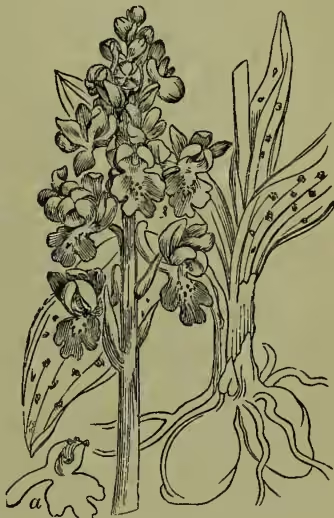
a, the lip of the perianth.
Orchomenos, an ancient city of Bœotia, the capital of the kingdom of the Minyæ, was situated at the north-western corner of Lake Copais, where it is joined by the Cephissus, and extended from the marshy edges of the lake up the face of a steep rocky hill, on which stood the acropolis. It sent thirty ships to the Trojan war, and at a later date became a member of the Bœotian confederacy. Its government was thoroughly aristocratic, and after the Peloponnesian war the jealous democratic Thebans destroyed it by fire, and sold its inhabitants as slaves. It was rebuilt in the reign of Philip of Macedon, but never recovered its position. It was famous for its musical festival in honour of the Graces, who were specially worshipped in the city. In 1880 Schliemann excavated there an old 'treasury,' or rather royal tomb or mausoleum, still larger than that at Mycenæ (q.v.). See O. Müller, Orchomenos und die Minyer (1844), and Schliemann, Orchomenos (1881).—There was a second Orchomenos in Arcadia, lying NNW. of Mantinea.