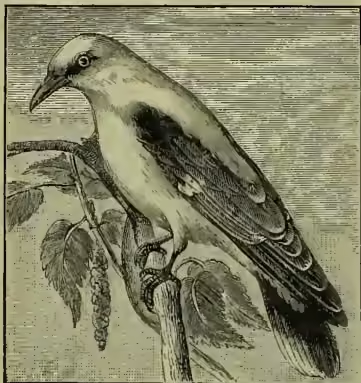
Oriole, a genus (Oriolus) and family (Oriolidae) of Passerine birds, confined entirely to the Old World, and characteristic of the Oriental and Ethiopian regions. The members of the family are generally of a bright yellow or golden colour, which is well set off by the black of the wings. Twenty-four species are enumerated under the genus. The best known is the Golden Oriole (O. galbula). The adult male is about 9 inches long. Its general colour is a rich golden yellow; the bill low, the base half of the others black, the other half yellow; legs, feet, and claws dark brown. The female is less yellow than the male, and the under parts are streaked with gray. This bird is somewhat rare in England, but it is an annual spring migrant to Cornwall and the Scilly Isles, and it has been found nesting in the south-eastern counties. In Scotland, especially in the southern districts, it has been reported several times; in Ireland it is more rare. In central and southern Europe it is common in summer in certain localities; it is abundant in Persia, and ranges eastwards through central Asia as far as to Irkutsk. It winters in South Africa, where it is found at the Cape, Dameraland, Natal, and Madagascar. In habit it is an unobtrusive bird, fond of the shade of woods, groves, and small ravines, and, although generally accounted very shy, it may be found building its nest in avenues in towns. Its food consists of insects and their larvæ, especially green caterpillars, and fruits such as currants, cherries, and mulberries. The song of the male is short, loud, clear, and flute-like; he has also a mewing call-note, and a harsh alarm-note. The nest is unlike any other European bird's; it is placed in, and suspended from, a fork in a horizontal branch, sometimes of an oak, usually of a pine, in a shady grove or thick wood, and is made of bark, wool, and grass. The eggs number four or five, and are of a glossy, white colour, blotched with reddish purple. Other orioles are distinguished by having black on the head and nape. O. kundoo partly replaces the golden oriole in Turkestan, and extends eastwards to India. O. auratus, found in Africa between the Sahara and the equator, and O. notatus, found throughout south tropical Africa, have the lesser wing-coverts yellow, not black as in the European and Indian birds. The birds called 'Orioles' in the United States belong to an entirely different family, the Icteridae. See BALTIMORE BIRD.