Ornithorhynchus, or DUCKMOLE (also called Duck-billed Platypus, the 'water-mole' of colonials), one of the lowest mammals, found in the rivers of Australia and Tasmania. Along with the Porcupine Ant-eater (Echidna, q.v.) and a neighbour genus, the duckmole is included in the sub-class Prototheria or Ornithodelphia, co-extensive with the order Monotremata. These three genera are of great interest as 'living fossils,' retaining the ancient characters of primitive mammals.
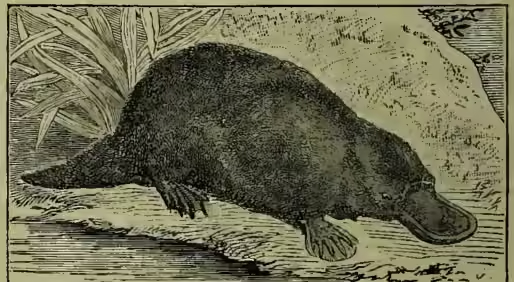
The duckmole, represented by a single species (Ornithorhynchus paradoxus or anatinus), is a flat animal, between a foot and 18 inches in length, not including the broad beaver-like tail, which measures 4-5 inches. The thick, soft fur is dark-brown above, rusty yellow below. The very short legs have webbed digits in adaptation to the swimming habits, and are also equipped with strong claws, utilised in burrowing. The 'duck-bill' is due to the anterior expansion of the premaxillæ and mandibles, is covered with a horny sheath, bears the nostrils far forward, and is provided with curious tactile structures. Behind the 'bill' is a loose, naked, sensitive collar. The eyes are very small, and there are no external ears. Within the mouth true teeth are present only in the earliest stages; their place is taken in the adults by eight horny plates, sharp-edged in front, broadened out behind. The tongue is not extensible. In the young of both sexes a curious perforated spur, associated with a gland, occurs near the heel, but this only persists in the males, which are further distinguished in being somewhat larger than their mates. The body temperature is peculiarly low. The voice resembles the growl of a small puppy. No fossil forms are known.
This lowly mammal is essentially aquatic, living in rivers and 'ponds,' swimming and diving admirably. It is lively and active, diving when alarmed, and able to remain several minutes under water.
It constricts on the bank elaborate burrows (sometimes 20 to 50 feet in length) with two entrances — one above, the other under water. Like many other defenceless animals, it is most active in the twilight. It grubs in the mud for worms, water-insects, molluscs, &c., which it can temporarily stow away in cheek-pouches. When frightened or asleep it often rolls itself up, in hedgehog fashion, into a living ball. It appears to live amicably with the water-rat, but is molested by carnivorous marsupials, and is often wantonly, though fortunately not easily, shot. The eggs—for the discredited oviparous habit has been confirmed—are laid in a rough nest within the burrow. The young appear to use their bills in breaking the tough shell. The animals have a fishy, oily smell. The flesh is eaten by the omnivorous natives, who are said especially to esteem the young forms.
Many of the enigmas about the duckmole's structure and affinities are still unsolved, but there is no doubt that along with its neighbours it links mammals back to reptilian or even amphibian types. It need hardly be stated that it has no close connection with birds. Some of the most important structural characters may be briefly summarised: The bones of the skull fuse and are polished as in birds; the halves of the lower jaw do not unite in front, and have no ascending process; the bones of the ear are in a primitive state. There are important technical peculiarities in the vertebrae, ribs, hip-girdle, &c. Epipubic bones, for instance, occur as in marsupials. The coracoids are remarkable in reaching the sternum, and the breastbone is like that of the lizard and some other reptiles. The brain is smooth, and old fashioned in having a small corpus callosum and large anterior commissure. There is a common cloaca, receiving the rectum and the urino-genital canal. The heart in its structure is like that of birds. The ureters do not open into the neck of the bladder, but farther down into the short urino-genital canal. The left ovary is larger than the right, and the testes are abdominal. The oviducts have no 'fimbriated' upper ends, are separate throughout their course, open into the urino-genital passage, and thence into the cloaca. The vasa deferentia are open separately in the same way, and have only a temporary connection with the penis, which lies attached to the wall of the cloaca. The two milk-glands open on a flat bare patch of skin. As the duckmole is oviparous, there is of course no placenta. The eggs, like those of reptiles, undergo partial segmentation.
From the above it will be seen that the duckmole not only represents the lowest extant stage of mammalian evolution, but preserves, more markedly than the higher forms, traces of the far-off pedigree of the class.
See ECHIDNA, MAMMAL, MARSUPIAL; also Gould's Mammals of Australia (3 vols. 1845-63); Huxley's Vertebrates, and text-books of Comparative Anatomy;
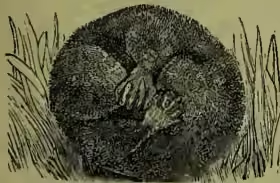
Ornithorhynchus asleep.
W. K. Parker's Mammalian Descent; Flower's Osteology of the Mammalia; Spencer, Nature, xxxi. (1884-85).