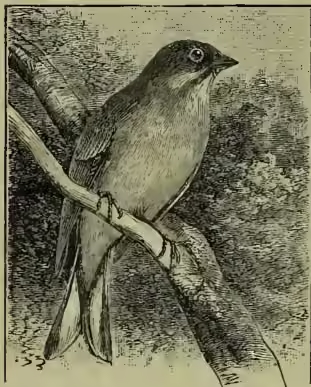
Ortolan (Emberiza hortulana), a species of Bunting (q.v.) of the Finch family Fringillidæ. The adult male is about six inches long; has the head, neck, and upper breast slate-gray suffused with yellow; bill reddish brown; chin, throat, and feathers round the eye yellow, with a narrow band of greenish gray descending from a little in front of the angle of the mouth; back, wing-coverts and secondaries fulvous brown with dark stripes; rump reddish brown. The plumage of the female is paler in colour. The ortolan in its summer migrations ranges as far north as the Arctic Circle in Scandinavia. In the south of Europe, where it is found in great numbers, and in the north of Africa, where it sometimes breeds, it is but a summer visitor. In winter it migrates as far south as to Abyssinia and North-western India, but its true winter-quarters have not yet been accurately ascertained. Though enormously abundant in certain localities on the Continent, it is rare in Britain, and many of the specimens captured have no doubt escaped from captivity, considering the large quantities imported alive from Holland and Belgium. It frequents bushy places, and builds its nest of dry grass always on the ground and generally in the open fields, though sometimes among herbage or under low bushes. It lays from four to six eggs, which vary in colour from very pale-bluish white to salmon colour, spotted with rich purple brown, with underlying spots of pale violet, not streaked as is usual with other bunttings. The note of the male is rather metallic, and his song at times is incessant and very monotonous. The food consists of beetles and other insects and seeds. Large numbers of ortolans are netted during their migrations, and confined in dark or dimly-lighted rooms, where they are fattened upon oats and millet until ready for the table. Their flesh is considered a great delicacy.