Ostrich (Struthio), a genus of birds which was once included with the cassowaries, emu, rheas, and apteryx in a distinct order, the Ratitæ, but which is probably better regarded as forming a family apart. Fürbringer thus places it; its nearest allies appear to be the rheas of South America. There seem to be two species of ostrich—viz. Struthio camelus and S. molybdophanes; the differences which distinguish them are not great. The ostrich is the largest existing bird, reaching a height of from six to eight feet. As in the other 'struthious' birds (= Ratitæ), the wings are somewhat rudimentary and quite useless as organs of flight; but the bird spreads them out when running, and they appear to act as sails. The breastbone or sternum has no keel—that is, no median ridge to which the great pectoral muscles in other birds are so largely attached; in the ostrich these pectoral muscles are but slightly developed, which fact is of course in relation to its small wing. The absence of the sternal keel was the chief reason which led to the association of all the struthious birds into one order, and the name of this order—Ratitæ—emphasised the character, signifying raft-like, as opposed to Carinataæ or keeled. The ostrich is now confined to Africa, Arabia, and Syria, but the discovery of its fossil remains in India indicate that it formerly had a much wider range.
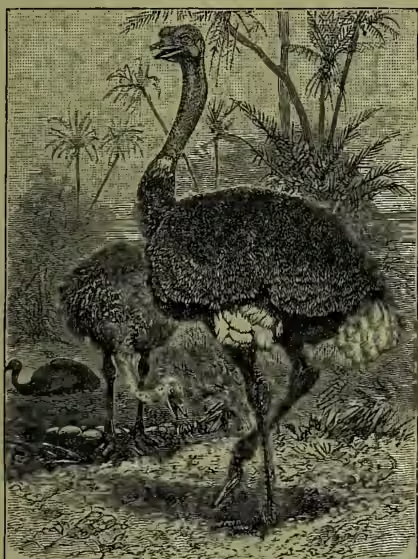
The ostrich shuns the presence of man, but is often to be seen in near proximity to herds of zebras, quaggas, giraffes, antelopes, and other quadrupeds. It is gregarious, although the flocks of ostriches are not generally very large. It is polygamous, one male usually appropriating to himself, when he can, from two to seven females, which seem to make their nest in common, scooping a mere hole in the sand for this purpose. Each female is supposed to lay about ten eggs. The eggs are all placed on end in the nest, which often contains a large number, whilst around it eggs are generally to be found scattered on the sand. Concerning these, it has been supposed that they are intended for the food of the young birds before they are able to go in quest of other food; an improbable notion, not supported by evidence. It seems at least as likely that these scattered eggs are laid by females waiting whilst the nest is occupied by another, and that they are lost to the ostriches, and no more regarded. Contrary to a very generally received opinion, the ostrich does not leave her eggs to be hatched entirely by the heat of the sun; nor is it the case, as has been alleged, that the male only incubates. Both parents give their assistance in the task of watching the eggs. The male and female sit alternately on the eggs for six weeks; the cock sitting all the night, but the female helping in the daytime.
The ostrich feeds exclusively on vegetable substances, its food consisting in great part of grasses and their seeds; so that its visits are much dreaded by the cultivators of the soil in the vicinity of its haunts, a flock of ostriches soon playing terrible havoc with a field of corn. The ostrich swallows large stones, as small birds swallow grains of sand, to aid the gizzard in the trituration of the food; and in confinement it has often been known to swallow very indiscriminately whatever came in the way—pieces of iron, bricks, glass, old shoes, copper coins, &c. Its instincts do not suffice to prevent it from swallowing very unsuitable things; copper coins were fatal in one instance, and a piece of a parasol in another.
The speed of the ostrich, when it first sets out, is supposed to be not less than sixty miles an hour; but it does not seem to be capable of keeping up this speed for a long time. It is successfully hunted by men on horseback, who take advantage of its habit of running in a curve, instead of a straight line, so that the hunter knows how to proceed in order to meet it and get within shot. It is often killed in South Africa by men who envelop themselves in ostrich-skins, and, cleverly imitating the manners of the ostrich, approach it near enough for their purpose, without exciting its alarm, and sometimes kill one after another with their poisoned arrows. The strength of the ostrich is such that it can easily carry two men on its back. Its voice is deep and hollow, not easily distinguished, except by a practised ear, from the roar of the lion; but it more frequently makes a kind of cackling, and, when enraged and striking violently at an adversary, hisses very loudly. The flesh of the ostrich is not unpalatable when it is young, but rank and tough when old. It is generally believed to have been prohibited as unclean to the Jews (Lev. xi. 16), although the name is translated owl in the English Bible. There are frequent references to it in the Old Testament.
The eggs of the ostrich, which are white or yellowish white in colour, are much esteemed as an article of food by the rude natives of Africa, and are acceptable even to European travellers and colonists. Each egg weighs about three pounds, and is thus equal to about two dozen ordinary hen's eggs. The egg is usually dressed by being set upright on a fire, and stirred about with a forked stick, inserted through a hole in the upper end. The thick and strong shell is applied to many uses, but particularly is much employed by the South African tribes for water-vessels. The reader will probably recollect the interesting plate in Livingstone's Travels of women filling ostrich-shells with water. In taking ostrich-eggs from the nest the South African is careful not to touch any with the hand, but uses a long stick to draw them out, that the birds may not detect the smell of the intruder, in which case they would forsake the nest; whilst otherwise they will return, and lay more eggs. The long plumes of the ostrich have been highly valued for ornamental purposes from very early times, and continue to be a considerable article of commerce (see below; also FEATHERS). The ostrich is often to be seen in Britain in confinement, and readily becomes quite tame and familiar, although still apt to be violent towards strangers. Great numbers were exhibited in the public spectacles by some of the Roman emperors; and the brains of many ostriches were sometimes presented in a single dish, as at the table of Heligabalus. See the articles CASSOWARY, EMU, RHEA; also ÆPYORNIS, DINORNIS.
OSTRICH-FARMING.—Although there were isolated attempts in 1864, the domestication of the ostrich in South Africa, for the sake of its plumage, dates from about 1867, and so rapidly had the industry grown that in 1880 about £8,000,000 of capital was employed, and the value of feathers exported was over £800,000. The French have also made attempts in the same direction in Algiers; feathers are exported from Tripoli; there are tame birds kept in Egypt; while birds have been imported into Australia by the Melbourne Acclimatisation Society, and a shipment was made from Capetown to Buenos Ayres in 1882. Successful experiments in ostrich-farming have also been made in several places in California. Mr Kin-
near of Beaufort-West, and Mr Arthur Douglass of
Heatherton Towers, near Grahamstown, were two
pioneers in ostrich-farming. Large fortunes were
made in the early days of the industry, when
feathers were worth £100 per lb., the plumes of
one bird sometimes fetching £25. As much as
£400 or even £500 have been paid for a good pair
of breeding birds, and chicks newly out of the egg
have fetched £10 each. As the supply became
greater than the demand a pair of ostriches might
not bring more than £12, and the plumes of an
ostrich about 30s. for one plucking. The beautiful
white plumes so highly prized by ladies all over
the world grow in the ends of the wings of the
male birds. A good bird in his prime will yield from
twenty to forty of these, besides a few black feathers
also from the wings. The tail-feathers are not
nearly so valuable nor so beautiful. The plumes of
the hen from her wing-tips are generally spotted
and flecked with gray, and are called feminines.
From 120 to 130 good feathers go to a pound: they
are always thus sold by weight. Ostrich-farmers
either may buy the young birds from the breeders
when from four to twelve months old, keep them
for the sake of their feathers, and sell them as
breeding birds when they are four years of age; or
they may give their attention to breeding birds
only, selling the young as they are hatched or when
they are a few months old; or they may breed and
farm for themselves. Where artificial incubators
are in use the eggs are removed from the nest as
soon as laid. Till a year old birds are usually
treated as chicks, and fed with 1 lb. each of
wheat, barley, or Kaffir corn; when the weather
is wet they must be put under cover. After
this age they may be put in a fenced camp,
with ten acres to each bird, and left to shift for
themselves. Still, they need to be watched for two
years, as they suffer much from parasites. There
may be a fortnightly muster, and a stock-book kept,
in which the days for cutting and pulling feathers
are noted. A five-wire fence is recommended by
some breeders, never less than 4 feet 9 inches
in height. The 'plucking-box' is a solid wooden
box, in which the ostrich has only room to stand.
The feathers are cut before the quills are quite
ripe; the stumps remain for a month or two, and
are then easily pulled out. Formerly the feathers
used to be pulled out by the roots. The first crop
of good feathers is clipped at seven or eight months;
this is repeated every eight months with like result,
till the birds take to breeding, after which it is not
desirable to deprive them of their feathers, as they
require them to cover the eggs on the nest. The
bird's plumage has reached perfection when three
years old, and at four years the birds have reached
maturity. The bony body of the ostrich yields
little or no flesh, but the thigh makes delicious
soup. The legs are brittle and easily broken, in
which case the bird has to be killed. Ostriches
may be kept in every part of Cape Colony
except in the cold mountainous tablelands, but
they thrive best in the extensive Karroo plains,
which are their natural habitat, though strong
adult birds may thrive in a good grass country.
They prefer a dry, warm, well-drained Karroo
country, and the wider the range the birds can be
allowed the better they thrive. Their best grazing
grounds are where the soil is rich in alkalies. In
1885 the export of feathers from the Cape of Good
Hope amounted to 232,119 lb., of a value of
£900,165; in 1889 to 147,486 lb., of a value of
£404,091; in 1894, to a value of £477,414.
See Mosenthal and Harting's Ostriches and Ostrich-farming (1876); Douglass, Ostrich-farming in South Africa (1881); Martin's Home Life on an Ostrich-farm (1890).