Ottawa, the capital of the Dominion of Canada, is situated upon the south bank of the Ottawa power. The Rideau Canal, which was made in 1827, passes through the centre of the city, and affords connection with the Rideau Lakes, and so with the great lakes beyond. Opposite the city, to the north-east, the Gatineau River joins the Ottawa and affords further lumbering facilities. A few miles to the east, the Du Lièvre River opens up a rich phosphate country, which is being much worked. The industries of Ottawa are mostly connected with lumber. In the winter thousands of men are engaged in cutting timber and drawing it to the streams, and in the spring the freshets carry down to the mills the rafts, on which the men who cut it live and labour during the passage. The cut of timber in the Ottawa Valley amounts in some years to over 700,000,000 cubic feet. Flour, iron wares, bricks, leather, and matches are manufactured. The exports of the city amount annually to over 3,000,000, the imports to about 2,000,000.
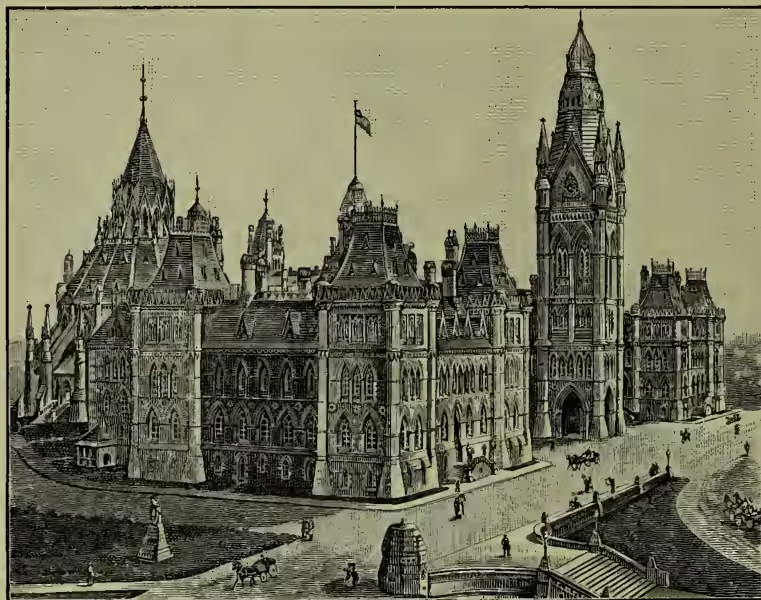
The parliamentary buildings, constructed in the Italian Gothic style after 1860, when the Prince of Wales laid the foundation-stone, are placed on a noble bluff on the bank of the Ottawa. These structures, including the handsome library building and the Victoria Tower (180 feet high), cost altogether about $8,000,000. The residence of the governor-general—an old-fashioned, ugly building, called Rideau Hall—is situated about a mile from the city. The post-office, city hall, banks, and telegraph-offices are all of stone and handsomely built. The churches are numerous, but not splendid in architecture. Ottawa is the place of residence of the bishop of Ontario (Church of England), and of the Roman Catholic bishop of Ottawa, who has a cathedral here. The Roman
Catholics have separate schools; the Protestants attend almost universally the public schools. There are a normal school and a collegiate institute, both public, and a very large college conducted by the Oblate Fathers; besides a ladies' college, a musical academy, and an art school. A well-equipped geological museum and the parliamentary library, with 140,000 volumes, add to the educational advantages of the city. There are several hospitals and a variety of homes for the poor. Besides the rivers and canals already mentioned, Ottawa stands on the Canada Pacific Railway, which runs along the north bank of the Ottawa from Montreal and crosses by a bridge into Ottawa; whilst the Grand Trunk Railway and the Canada Atlantic Railway connect the city with the Intercolonial Railway on the east, and with the
River, 120 miles from its influx into the St Lawrence at Montreal. The river Ottawa drains a vast stretch of country as far north-west as Lake Nipissing and beyond; all the lumber-products of this district, as well as all the local trade, are carried down to Ottawa, to the point at which the river forms the splendid Chaudière Falls (200 yards wide and 40 feet high). These falls, above which a suspension bridge spans the river, supply the motive-power for the numerous lumber-mills, flour-mills, factories, &c. To the east of the city the river Rideau forms a second fall, which, although inferior to the Chaudière, supplies further motive-
Canada Pacific Transcontinental line. Ottawa is governed by a mayor and corporation. The taxes are high, and the streets, partly owing to the climate, are bad; but the city is generally healthy. The city was begun in the last years of the 18th century by a settler named Wright, of Boston, Massachusetts, who built himself a residence near the Chaudière, and called the village which he founded Hull. Hull now contains 12,000 inhabitants, mainly French-Canadians, engaged in the lumber trade. The southern bank lots, on which Ottawa now stands, were sold by Wright to one Sparks, who took them reluctantly in payment for labour. In 1823 Colonel By was sent by the British government to survey the Rideau Canal. The construction of the canal (1827) stimulated the settlement, which was called Bytown. In 1854 its name was changed to Ottawa, and the town was created a city. In 1861 the population was 15,000; in 1871, 21,545; in 1881, 27,412; and in 1891 it amounted to 44,154 (about one-half Roman Catholics); to these may be added about 15,000 in adjoining villages and suburbs. In 1858 Ottawa was chosen as the administrative capital of Canada. The first parliament met here in 1865.