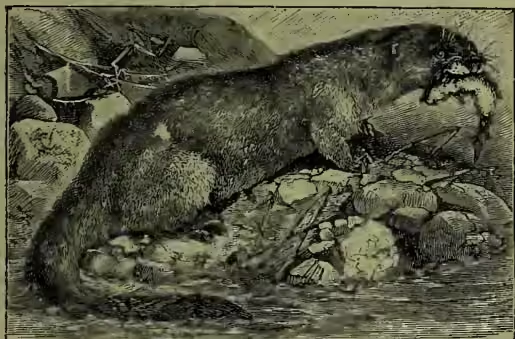
Otter (Lutra vulgaria), an aquatic carnivore in the family Mustelidæ, which also includes the badgers and weasels. It is type of a widely distributed genus with about twenty reputed species, like one another in their diving and swimming powers, in their fish-diet, in the webbing of the feet, and in the brown colour of the short, close fur. In the common species, distributed through Europe and Asia, the body may attain a length of 2½ feet, and the tail half as much; the head is broad and flat, with short, rounded ears; the blunt snout bears lateral slit-like nostrils, closed during diving; the long body is covered with beautiful chestnut fur; the legs are very short, but strong; the feet are clawed as well as webbed. The otter lives in a hole by the stream side, and feeds especially on fish, but also on small mammals, birds, frogs, crayfishes, &c. In strength and agility, keen scent and hearing, and general astuteness it deserves a high rank among mammals. Its life is solitary except at the pairing season in spring, after which the female gives birth to three or four blind young, which she guards with great care till they are able to look after themselves. Being very destructive to fishes, the otter has been much hunted, and is now rare where it once abounded. Izaak Walton gives a lively description of an otter-hunt, and tells us that the 'fish-beast will walk upon land sometimes five or six, or ten miles in a night,' that 'he devours much fish, and kills and spoils much more,' that 'he can smell a fish in the water one hundred yards from him,' that 'his skin is worth ten shillings to make gloves,' while 'his stones are good against the Falling-sickness.' The flesh is tasty, and, being for practical purposes that of a 'fish,' is allowed during fasts. The young may be tamed and used for fish-catching.
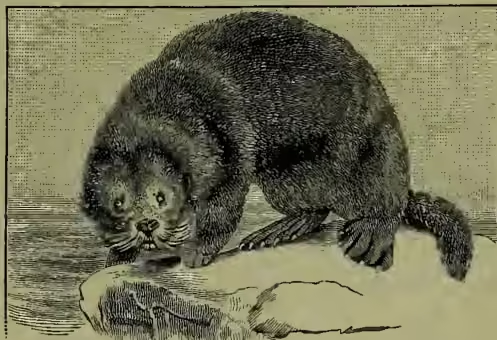
Among the other species the most remarkable is the large L. sandbachii, from Demerara and Surinam; while of related genera the most striking is the Sea-otter (Enhydra lutris), from the North Pacific. This is a powerful otter, sometimes 4 feet long and 90 lb. in weight, with massive molars, by which it is said to crush molluscs and crabs as well as fish. Its fur is valuable, and the animal is consequently becoming rare. Steller, who was shipwrecked on Behring Island in the middle of the 18th century, has beautifully pictured the life of this interesting otter, but its habits have now become much more shy and wary, and measures have had to be taken to prevent its extermination. The most common otter of North America is L. canadensis, much larger than the European species, and ranging throughout the continent, though rare in settled districts.
Otter-hunting is practised in the early morning, and at a season when all other hunting is drawing to a close. The hunters are armed with spears; and the true otter-hound, seen best in the Carlisle pack, is a bold, hardy, rough-coated dog, nearly two feet high at the shoulder. Foxhounds are sometimes used.