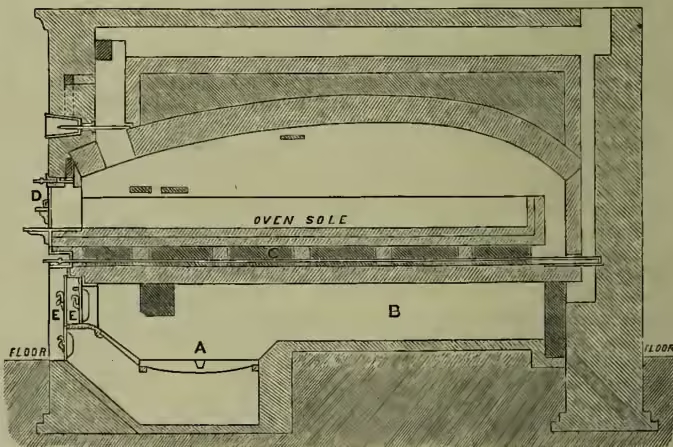
Oven. The old type of baker's oven, still very largely used, is a low arched chamber either of brick with a tile or stone sole, or built entirely of stone. A common size of sole is 11 feet 6 inches by 9 feet 6 inches (some are smaller), with sides 18 inches high, from which the crown or arch springs. The door is in front, and the dough is put in with a long wooden spade called a 'peel.' In one class of these ovens the fireplace or furnace is placed in the front corner, with an opening admitting the products of combustion directly into the oven, while there is an exit flue on the other side. This furnace is fired from the bakehouse; coke or coal is used for fuel, and any smoke is mostly cleared away during the heating up of the oven. Sometimes the plan of having a fixed fire within the oven itself is adopted, and another way is to have a movable iron furnace, called a chaffer, which can be shifted from place to place, so as to evenly heat the oven. For this inside firing wood is the best fuel. In Scotland a peculiar sort of stone is used for the construction of oven soles. It is a kind of serpentine, is of a refractory nature, and is called 'lakestone' or 'leckstone.' This rock, termed by geologists pierite, is quarried at Blackburn, near Bathgate, and two or three other places in Scot- land. It makes a better and more durable sole than tiles or bricks.
Many new forms of ovens have been introduced of late years; the Bailey-Baker, though not the newest, may serve as an illustration, and is shown in longitudinal section in the annexed figure. It can be used either as an externally or as an internally heated oven. The furnace is placed below the oven sole, and the heated gases which are generated pass, by means of flues, entirely round the oven without actually entering it, if it is to be worked solely by external heat. But by means of openings, regulated by valves or dampers, the gases from the furnace can be led into the oven, and so heat it internally. The construction of the oven is such that, even when worked in the latter way, fragments of fuel rarely get inside, so that comparatively little cleaning is necessary, and baking can go on continuously with the exception of the time required to fill and discharge the oven.
Some ovens are now heated with hermetically-sealed iron pipes containing water, which is converted by heat into superheated steam (see STEAM). The pipes are placed inside the oven, but a portion, or portions of them, project through its back wall into a furnace. Perkins was the originator of this method of heating. A recent form is known as the Weighorst steam-heated oven. It has a draw-plate, or movable sole, fixed on wheels, so that it can be drawn out in front of the oven and loaded or unloaded very quickly. With this oven there is little time required for raising the heat between the batches. Another way of heating ovens is by gas-burners. Ovens for army use in barracks or the field are generally arranged so as to be serviceable for cooking meat, roasting potatoes, coffee, &c., as well as baking bread. In those for the field portability is a main essential. For biscuit ovens, see BISCUITS. Coke-ovens are described under COKE.