Owl (Striges), a sub-order of birds, constituting with two other sub-orders—the Pandiones (ospreys) and Falcones (hawks, falcons, and eagles)—the order Accipitres or Raptors (birds of prey). The owls, generally spoken of as 'the nocturnal birds of prey,' are distinguished by many well-marked characters. In size they vary from 5 inches to 2 feet in length, the females being as a rule larger than the males. The head is very large; the skull is broad, and the cranial bones are highly pneumatic; the facial region is flattened; the beak is short, hooked, strong, and sharp, never notched; at its base are bristles covering, more or less completely, both the cere and the nostrils. The eyes are very large, directed forwards, goggle-like, only slightly movable on account of the bony sclerotic plates being fixed firmly to one another and to the orbit; the upper eyelid is very large, and is the one principally concerned in closing the eye; both eyelids are ciliated with barbed plumelets and have a broad, thin, bare margin; the third eyelid, or nictitating membrane, is conspicuous; the iris is unusually broad, and is capable of being greatly expanded and contracted; the pupil is oval with the long axis perpendicular. A disc of feathers surrounds the eye, either completely or partly, and is supported by a ruff made up of rows of small, much-curved feathers inserted into the skin by stiff shafts. The ear is peculiar and variable; it has an external meatus, unusual in birds, generally of large size, and sometimes provided with a special flap of skin or operculum. The head often bears a pair of tufts known as feathered horns. The neck appears short, sometimes extremely so. The body, though really small, is apparently full, being covered with soft downy feathers without after-shafts. The plumage is generally spotted or barred with different shades of brown and yellow. In nearly all owls two different phases of colour, a darker and a lighter, can be distinguished, the two phases being often observed in different individuals of the same brood. The wings are always broad and long and loose. The tail is usually short and even, or slightly rounded. The oil-gland is destitute of the usual circlet of plumes. The legs are not long, and are almost completely feathered. The toes are often covered with feathers, and are always terminated by strong talons; the first and fourth toes can be opposed to the second and third. The mouth is very wide; the gullet is large; there is no crop; the stomach is large, roundish, and somewhat compressed; the intestine is short, and has two wide cæca connected with it. The indigestible portions of food are regurgitated in the form of pellets as in other Accipitres.
Owls range over the whole globe, from the extreme polar regions to the remotest oceanic islands. No birds are more cosmopolitan in their distribution. In habit they are generally nocturnal; their flight is noiseless and buoyant; their eyesight is very acute, as is also their sense of hearing. They are either solitary or live in pairs, and although so often regarded with superstitious aversion and animosity, they are nearly always harmless and very useful birds. Their food consists of small mammals, birds, insects—especially nocturnal lepidoptera; and some species prey on fish, either habitually or occasionally. They pounce upon their prey noiselessly, and, striking their talons into it, kill it and carry it off. Small animals may be carried in their bill, and are swallowed whole; larger animals, torn in pieces, are eaten in morsels. The disgorged pellets of indigestible materials—bones, fur, and feathers—produce a characteristic fetid odour near the owl's abode. The examination by Dr Altam of remains found (communicated to the German Ornithologists' Society) gives a good idea of the food and utility of the three commonest species of British owls.
| No. of ejected pellets. | Bats. | Rats. | Mice. | Voles. | Shrews. | Moles. | Birds. | Beetles. | |
|---|---|---|---|---|---|---|---|---|---|
| Tawny Owl..... | 210 | .. | 6 | 42 | 296 | 33 | 43 | 18 | 43 |
| Long-eared Owl.. | 25 | .. | .. | 6 | 35 | .. | .. | 2 | .. |
| Barn-owl..... | 706 | 16 | 3 | 237 | 693 | 1590 | .. | 22 | .. |
The nesting habits of owls vary considerably. The nest is rudely made of twigs and grass, in holes of trees, crevices of rocks, dark corners of buildings, or on the ground; sometimes there is no nest at all, or only the forsaken one of some other bird. The eggs are usually white, either pure or yellow or blue tinted, and almost spherical, commonly four to six in number, but some species lay eight or ten, others not more than two. The young remain long in the nest, and are helped by their parents for some days after going abroad. Some owls are diurnal in habit, and these have more compact plumage, smaller ears, and incomplete discs; but the habits of owls in general are too little known to allow of many general statements being made regarding the adaptation of structures to particular habits. Though the small and unspecialised ear is said to characterise diurnal species, it is found in the eagle-owl, whose habits are nocturnal. Unfeathered legs are sometimes associated with fishing habits; but some feather-legged species catch fish, while other species with unfeathered legs do not. And again, feathered horns, which have sometimes been considered characters sufficiently important to serve as a basis for classification, have no known function, occur in widely-different species, vary much in size and form, and are not peculiar to either males or females. During the day nocturnal owls repose in some secluded spot, generally in a tree, but often on rocks and bushy cliffs, while some prefer the ground. If found abroad they are persecuted by other and smaller birds, being bewildered and rendered helpless by the unaccustomed glare of the daylight. When surprised, owls hiss like a cat and make a clicking noise with their bills; some have a harsh shrieking cry, others a not unmusical hoot.
The classification of the owls is at present in a very unsatisfactory state, owing to the difficulty of estimating properly the classification value of the various anatomical characters. According to the most generally received method (Sharpe's, in the Catalogue of Birds in the British Museum, vol. ii.), the sub-order Striges is subdivided into two families—(1) Strigidae, containing only the two genera Strix and Phodilus, which embrace six species; (2) Bubonidae, containing all the other owls—17 genera and about 190 species. (Newton subdivides the owls, which he reckons as a family of Accipitres, into two sub-families—(1) Aluconinae, corresponding to the Strigidae of Sharpe; and (2) Striginæ, corresponding to the Bubonidæ.) In the Strigidae the sternum has no manubrium, and its margin is entire behind; the clavicles meet to form a furcula or merrythought, which is firmly united with the keel of the sternum; the tarsus is without a bony arch over the extensor tendon of the toes; and the claw of the mid-toe has its inner margin serrate. In the Bubonidæ, on the other hand, the sternum has a distinct manubrium, and has its margin notched behind; the clavicles are small and do not form a furcula, nor are they united with the sternum; the tarsus has a bony arch or ring over the groove which contains the common extensor of the toes; and the inner margin of the middle claw is not serrate.
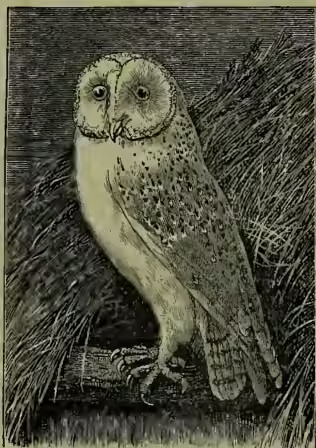
The only British representative of the family Strigidae is the Barn-owl, White Owl, Screech-owl, or Church-owl (Strix flammea of Linnaeus). This, although the commonest British owl, is really a tropical bird, not ranging more than 40° north or south of the equator, except in western Europe, where it breeds as far north as Denmark and the south of Sweden. In Scotland it is found in the Inner Hebrides, Caithness, and the Shetland Isles. The adult male is about 13 inches long; the bill is white; the claws purplish gray; the face discs, which are oval in form and complete, are white. The general colour, which is light reddish yellow, mottled with gray on the upper parts, and white with small dusky spots on the under parts, distinguishes it from all other owls. The female is larger, but differs little in colour, except that the upper parts are darker. This owl is pre-eminently nocturnal in habit. It frequents villages, homesteads, and ruins, where it carries on its depredations among rats, mice, and other animals—as many as twenty rats have been found in the nest of one, all freshly killed. It has also been known to catch fish. Its cry is a discordant scream, and it also produces a snoring and hissing noise. If a nest is made it is merely a loosely-arranged collection of twigs and straws. The eggs number two to five, and are large and smooth and white. Several broods of young may be produced annually. Phodilus, the other genus of the Strigidae, consists of only one species (P. badius), which ranges from the eastern Himalaya to Burma and Pegu, and is also found in Ceylon, Java, and Borneo. This genus possesses characters common to both families, and is really an intermediate form belonging properly to neither. A species from Madagascar, described by Alphonse Milne-Edwards under the name of Heliodilus soumagnii, has been placed in this sub-family.
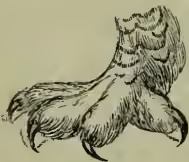
Foot of Snowy Owl.
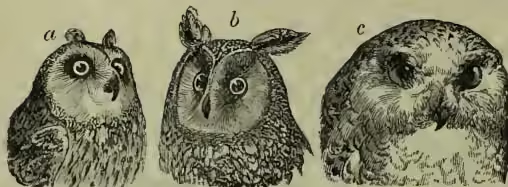
Among the Bubonidæ the Tawny Owl, Wood-owl, Ivy-owl, Brown Owl (Strix stridula or aluco, or Syrnium aluco) is a very common British species. It is found chiefly in wooded parts of England, and in the midland and southern districts of Scotland, but also as far north as Caithness and the Inner Hebrides. Its cry hoo-hoo, or tu-whit, tu-whoo at night makes it easily recognised. Although a species deserving to be preserved, it is rapidly declining in numbers. It ranges from the southern parts of Scandinavia through temperate Europe, in some parts of which, however, it is very local, to Asia Minor, Palestine, and Barbary. The Snowy Day-owl, the Harfang of the Swedes (Strix or Surnia nyctea or Nyctea scandiaca), is a circum-polar bird, breeding chiefly within the Arctic Circle, and common in parts of Greenland and Iceland. Its home is on the fjelds of Lapland, the tundras of Russia and Siberia, and the prairies of Arctic America, where it feeds on lemmings and other small rodents, sometimes on ptarmigan and willow-grouse, and even on the Arctic hare and on fish. In Shetland, where it has been known to breed, forced from its home by exceptional cold, and in other parts of the British Islands it is found generally in solitary, stony, and elevated places, preying chiefly on sandpipers. It is a diurnal bird of large size and vigorous rapid flight, with strong limbs, toes completely feathered, and large talons. Its white plumage, generally marked with dusky-brown spots, distinguishes it from every other owl. The Long-eared and Short-eared Owls of Europe, Asia, and America (Asio otus and A. accipitrinus), which are also common British species, have the ear peculiarly developed, the opening on one side looking upwards, and on the other downwards. The Long-eared owl, which frequents wooded localities, is about the size of the Barn-owl, and generally carries its horns erect; while the Short-eared, known also as the Woodcock-owl, from the coincidence of its time of appearance, prefers moors and open country, and carries its horns depressed. The specialisation of ear-structure is carried to its greatest known limit in Tengmalm's owl (Nyctala tengmalmi), a rare visitor to Britain from the northern regions; in it the bones of the head are developed differently on each side. The Eagle-owl (q.v., Bubo maximus), the Little Owl (Athene noctua), the Hawk-owl (Surnia funerea), and the very small Scops-owl (Scops gini) are the only other species recorded as found in Britain, and these are all very rare. Of foreign species belonging to this family one of the most noteworthy is the Burrowing Owl (Speotyto or Athene cunicularia) of America. On the prairies of North America it shares the burrows of the prairie-dog and other mammals, while on the pampas of South America it lives in the holes of the viscacha, armadillos, and large lizards, or makes a hole for itself, which is often invaded by rattlesnakes. Another interesting species is Pel's Fish-owl (Scotopelia peli).