Oxford, the capital of the county, the home of the university, and the seat of the bishopric of the same name, stands about the confluence of the rivers Cherwell and Thames, 52 miles (63 by rail) WNW. from London. The city, under the Act of 1889, is governed by a council, comprising a mayor, fifteen aldermen, and forty-five councillors, of whom three aldermen and nine councillors are elected by the university. Up to 1885 the city returned two members to parliament; since that date only one. Until about 1830 the area and population of the city remained almost stationary, extending only a little beyond the limit of the old city wall as reconstructed in the reign of Henry review all the chief buildings and places of interest. North runs Cornmarket Street ('the Corn'), containing the Roebuck and Clarendon Hotels, past the latter of which is the entrance to the Oxford Union Society's rooms (the club, library, and debating-hall of the undergraduates, founded in 1823). At the end of Cornmarket Street is St Michael's Church, the tower of which (c. 1070) is a characteristic specimen of Saxon masonry. Here formerly was the north gate of the city, the chambers over which (taken down in 1771) were used as a prison, and called Bocardo. From the end of Cornmarket Street, George Street runs west, containing the New Theatre (1886) and the High School for boys (1881); Broad Street runs east, containing Balliol, Trinity, and Exeter Colleges, the Ashmolean Museum, the Sheldonian (the University 'Theatre'), the Clarendon Building (used for the Clarendon Press till 1830, now as university committee-rooms), and the Indian Institute (a library, museum, &c., for natives of India and members of the Indian Civil Service studying in Oxford, opened 1884). Broad Street was the place where the Oxford martyrs were burned (Ridley and Latimer on 16th October 1555, and Cranmer on 21st March 1556). The Martyrs' Memorial, a cross in their honour, was built in 1841, at the end of Magdalen Street, the continuation of Cornmarket Street. Beaumont Street leads west from this point, past the Randolph Hotel (built 1864), the Taylor Library (for modern literatures, founded by Sir Robert Taylor, built 1845), and the University Galleries (containing the Ruskin Drawing-school, the Arundel Marbles, presented to the university in 1667, and other relics of classical antiquity, a valuable collection of paintings and engravings, and 190 original drawings by Michael Angelo and Raphael), to Worcester College. Thence northwards, by Walton Street, access is got to the University or Clarendon Press (removed to new buildings here in 1830), to St Barnabas Church (1868), to Port Meadow (an extensive flat ground beside the river, being the common of the freemen of the city), and the 'Upper River' or part of the Thames north of Oxford, and so to Godstow, a ruined nunnery, famous as the burial-place of
Fair Rosamond. Returning to the Martyrs' Memorial, the street leading north from Magdalen Street (so called from St Mary Magdalene Church), is St Giles' Street, containing St John's College and the Pusey House (a library and clergy-house, in support of Anglican principles, established 1884 in memory of Dr Pusey, and containing his library). In the Woodstock Road continuation of St Giles' Street are the church of St Aloysius (Roman Catholic), built in 1875, the Radcliffe Infirmary (1770), and the Radcliffe Observatory (1795). In the Banbury Road continuation of St Giles' Street are Somerville Hall (a ladies' college, 1879), the High School for girls (1884), and Wycliffe Hall (a Church of England theological college, in the interests of the Evangelical party, 1877). West.—Returning to Carfax, and taking another quarter of the city, Queen Street, continued by New Road, leads past the Castle (including the court-house and gaol) to the railway stations, and so along the Seven Bridges Road (across cuts from the Thames) to Cumnor.
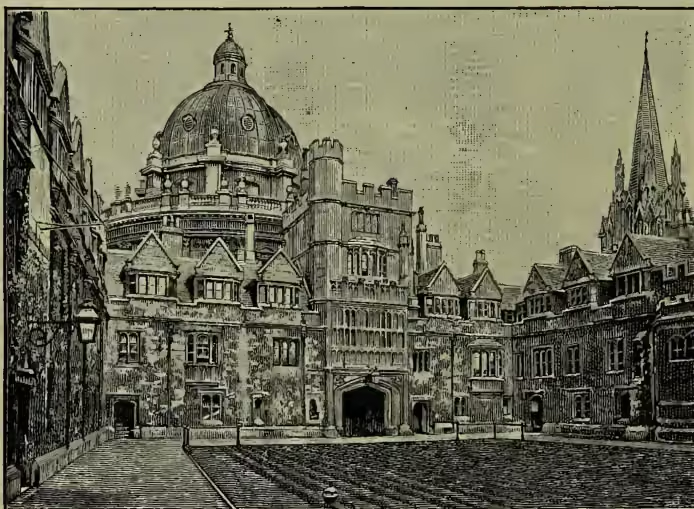
III., and very little beyond the area represented in Loggan's bird's-eye view (1675). But since then the city has grown rapidly, and the rural districts of St Giles' on the north, St Clement's on the west, Grandpont on the south, and Botley on the east have been covered with lines of close-built streets. Pop. (1801) 11,000; (1851) 27,843; (1881) 40,872; (1891) 45,742.
The topography of Oxford is simple in the extreme. The river Thames (locally called the 'Isis'), which has flowed from north to south, takes here a sharp bend to the east, and about a mile from the angle receives the Cherwell, flowing from the north, parallel with its former course. All the old part of the town stands in the rectangle thus formed by the rivers. The centre of the town is at a place called 'Carfax' (derived from quadri-furcus, 'four-forked'), from which four main streets run to the four points of the compass. From Carfax, since 1883, tram-lines run to the four points of the compass. Taking in rotation these four lines of streets, we shall be able to pass quickly in
South from Carfax runs St Aldate's Street, past the town-hall (built 1752), public library, corn exchange, and post-office (1881), St Aldate's Church (rebuilt since 1863), Pembroke College, the front of Christ Church, the entrance to Christ Church Meadow and Broad Walk, to Folly Bridge across the Thames. This bridge was rebuilt in 1815. Over the old bridge was a watch-tower (taken down in 1779) known as 'Friar Bacon's Study.' From near Folly Bridge, for about a quarter-mile along the north bank of the river, are moored the Barges (q.v.) of the university and college boat-clubs.
East from Carfax runs High Street in a graceful curve. In the High Street itself, or just off it, stand these buildings, in this order from Carfax: the city market (1773), the Mitre Hotel (extant, as Dagville's Inn, before 1470), the church of All Saints (built in 1706 from designs by Dean Aldrich), the new front of Brasenose, the University Church (St Mary the Virgin), where are preached the university sermons (including the 'Bampton Lectures,' q.v.), All Souls, University, and Queen's Colleges, the Examination Schools (1882), with the Non-collegiate Students' buildings, Magdalen College School (founded 1480), Magdalen College, and the Botanic Gardens (laid out in 1632). The street ends with Magdalen Bridge over the Cherwell. From this bridge roads lead to Cowley and Iffley, past the college cricket-grounds and the running-ground of the University Athletic Club. At Cowley is a college for army candidates, called the Oxford Military College, opened in 1876, and the barracks of the Oxford military depot. At the church of All Saints, Turl Street runs north from the High, leading to Lincoln, Jesus, and Exeter Colleges, and so into Broad Street at Trinity College. From opposite St Mary's Church, Oriel Street leads south past Oriel College and the Canterbury gate of Christ Church into Merton Street, where are Corpus Christi and Merton Colleges. From St Mary's Church, Catherine or Cat Street leads north, having on the east the Codrington Library (built about 1720 by All Souls College to receive the library of Christopher Codrington, and maintained by the college as a law library), and on the west the Radcliffe Library (built in 1737 as a library for medicine and natural science; since 1861 a reading-room in connection with the Bodleian); and farther on the Old Schools (including the Bodleian Library and the Divinity School) on the west, and Hertford College on the east. Past Hertford College a street leads to New College. Cat Street, after crossing Broad Street, is continued by Park Street, which leads northwards past Wadham College and the garden front of Trinity College to the University Museum, Keble College, and Lady Margaret Hall (a ladies' college, opened about 1880). Here are the University Parks, laid out and kept up by the university. They contain the university observatory, erected in 1874. Here are played most of the football matches (Rugby, Association, Winchester, and other varieties of the game) of the university and college clubs. Here also is the new ground of the University Cricket Club, one of the finest in itself, and in its surroundings, in England. A walk leading from the Parks, east and south, is known as 'Mesopotamia,' being between two cuts of the Cherwell.
ALL SOULS COLLEGE was founded in 1437 by Archbishop Chichele as a chantry for the souls of those who had fallen in the wars with France. It remains still a college entirely of fellows; several of the fellowships have been attached to university professorships. The front quadrangle is practically as the founder left it; the fine chapel (consecrated 1442) contains a beautiful reredos, partially destroyed in 1577 and in 1664, but restored in 1876. The hall (built in 1720) contains some good portraits of former fellows, among them those of Sir William Blackstone, Reginald Heber, Sir Christopher Wren, Thomas Tanner, John Linacre, Jeremy Taylor, and Herriek.
ASHMOLEAN MUSEUM, the earliest public museum in England, built in 1682 to receive the antiquities, &c. of Elias Ashmole (q.v.). The original collections have since 1860 been dispersed; the books and MSS. going to the Bodleian, the natural history specimens to the Museum, the anthropological (including curiosities brought home by Captain Cook) to the Pitt-Rivers collection. The museum now contains British antiquities, antiquities from Cyprus, Egypt, &c.
BALLIOL COLLEGE, founded about 1268 by Devorguilla Balliol, mother of John Balliol, king of Scotland. The buildings are chiefly modern, the hall (1877) being a favourable example of recent Oxford building. This hall contains portraits of John Wyclif the Reformer, formerly master of the college; of Archbishop Tait; of Robert Browning, honorary fellow; and of Benjamin Jowett, master. By means of the Snell and Warner exhibitions, Balliol has had since the 17th century a close connection with Scotland, including among its members Adam Smith, John Gibson Lockhart, Sir William Hamilton, Colet, Parsons the Jesuit, John Evelyn, Robert Southey, Dean Stanley, Matthew Arnold, A. C. Swinburne, and Cardinal Manning were members of the college.
BODLEIAN LIBRARY (q.v.), founded in 1602 by Sir Thomas Bodley, in a room (built about 1460) over the Divinity School for the old library of the university, augmented by Humphrey, Duke of Gloucester. Duke Humphrey's Library had been plundered by King Edward VI.'s commissioners. The library has grown to be one of the great libraries of the world; it contains more than 30,000 MSS. and 500,000 books, and now occupies the whole of the Old Schools (built 1618) of the university. The library contains a fine portrait of the founder. The picture-gallery attached is one of the finest extant examples of an 'ambulaeum,' or room for walking in, found in old great houses. On its walls hang portraits of many benefactors and famous members of the university; also many historical portraits—e.g. Lord Burleigh, Mary Queen of Scots, Prince Henry (son of James I.), James Edward the Old Pretender, &c.
BRASENOSE COLLEGE, founded in 1509 by William Smyth, Bishop of Lincoln, and Sir Richard Sutton. The gateway tower (1512) is the most striking feature of the old building. The old 'brassen nose' knocker of Brasenose Hall, on the site of which the college was built, was (it is claimed) acquired in 1890, and is now found in the hall. John Foxe, Robert Burton, Dean Milman, Barham, and F. W. Robertson were students.
CHRIST CHURCH is both the cathedral of the diocese of Oxford and a college of the university. The cathedral was instituted in 1546 by King Henry VIII. in the church of the old priory of St Frideswide (q.v.). This church contains many remains of Norman architecture (1120–80), and (it is claimed) some fragments of the older Saxon church. The college was founded by Cardinal Wolsey in 1525 as 'Cardinal College,' the priory of St Frideswide being suppressed by him; was remodelled by the king as 'King Henry VIII.'s College,' in 1532; and finally settled, as 'Christ Church,' in 1546. The hall and the kitchen (1529) are Wolsey's work, and surpass any building of the kind in Oxford, or even in England. The great quadrangle ('Tom' Quad.) begun by Wolsey was not completed till 1668. Peckwater Quadrangle was rebuilt in 1705–61. The entrance tower (finished 1682) now contains 'Great Tom,' one of the largest bells in England, being the great bell of Osney Abbey recast (see BELL, Vol. II. p. 55). The 'Broad Walk' of elms leading from the Meadow Gate to the Cherwell, planted by Dean Fell (q.v.) in 1670, was long one of the finest avenues in England; but its glories have been lessened of late years by storms, the elm being unable to outlast two centuries. The library contains a valuable collection of paintings, especially by great Italian masters, with a few of the Dutch masters. The hall contains many portraits of eminent statesmen and divines by great painters, from Holbein to Millais. Sir Philip Sidney, Camden, George Peele the dramatist, John Locke, Sir George Cornwall Lewis, Dr Liddon, Gladstone, and John Ruskin are a few of the famous names of Christ Church men.
CORPUS CHRISTI COLLEGE, founded in 1516 by Richard Fox, Bishop of Winchester, in the interests of Renaissance learning. Cardinal Pole was a student here, Richard Hooker a fellow, John Keble a scholar.
DIVINITY SCHOOL, built 1445-80, a splendid example of Perpendicular architecture. The university was too poor to finish it, portions of the work showing that the carving of the interior was designed to be much more elaborate than it is. The rich colours of the roof and the stained windows were destroyed in Edward VI.'s reign.
EXETER COLLEGE, founded in 1314 by Walter de Stapledon, Bishop of Exeter. The buildings of the college have been much extended in the present century, and are nearly all modern. The chapel (1858) is a fine example of Sir Gilbert Scott's work, and contains good specimens of modern painted glass and tapestry. Members have been Grocyn, Glanville; Bishops Bull, Prideaux, and Secker; Lyell, Maurice, and Froude.
HERTFORD COLLEGE, founded in 1874 by T. C. Baring, M.P., in the interests of the Church of England. This college was erected out of Magdalen Hall (founded 1487), which had been removed to this site in 1822 from its former site near Magdalen College. The site had previously been occupied by Hart Hall, founded about 1284, which had been erected by Dr Richard Newton into Hertford College in 1740, but dissolved in 1818 for lack of funds. The 'learned' John Selden was a member of Hart Hall; so also was Charles James Fox. William Tyndall and Clarendon were members of Magdalen Hall.
JESUS COLLEGE, founded in 1571 by Queen Elizabeth at the instance of Dr Hugh Price, and its revenues greatly augmented by Sir Leoline Jenkins, principal of the college (1661). Until the Commission of 1855 the college had an exclusively Welsh connection; this has been further broken by the Commission of 1877, but there are still several scholarships and exhibitions confined to persons of Welsh birth and education. The college contains good portraits of Queen Elizabeth, the nominal foundress, and of Charles I., a benefactor. The library possesses many valuable Welsh MSS.
KEBLE COLLEGE, founded in 1870 by subscription, in memory of John Keble and in the interests of the Anglican Church. The ornate chapel is the chief object of interest. The hall contains a portrait of Keble. In the library is Holman Hunt's picture, 'The Light of the World.' The college has a different constitution from other colleges, having no fellows and being governed from without by a council.
LINCOLN COLLEGE, founded in 1429 by Richard Fleming, Bishop of Lincoln, and refounded in 1474 by Thomas Rotheram, Archbishop of York, to check the progress of Lollardism. The chapel (1631) is a good specimen of Stuart work, containing fine cedar panelling and painted glass. Among its fellows have been Robert Sanderson, George Hickes, John Kettlewell (the non-juror), John Wesley, John Radcliffe.