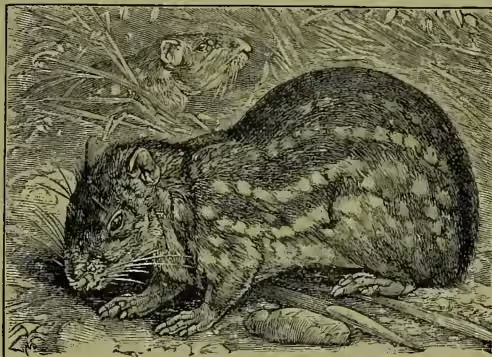
Paca (Cælogenyx, i.e. 'hollow-cheek'), a remarkable genus of rodents, allied to the Agoutis (Dasyprocta), represented by a single species (C. paca), which ranges in Central and South America from Guatemala to Paraguay, east of the Andes. Its cheek-bones are uniquely developed, the zygomatic arch being enlarged to form a great cavity on each side. Each communicates by a narrow aperture with the mouth, is lined by mucous membrane, and does not contain food as an ordinary cheek-pouch naturally does. Their function, if they have any, is unknown. The paca is large for a rodent, being about 2 feet in length. It is stout and somewhat pig-like in build, with a large blunt head, matic arch being enlarged to form a great cavity on each side. Each communicates by a narrow aperture with the mouth, is lined by mucous membrane, and does not contain food as an ordinary cheek-pouch naturally does. Their function, if they have any, is unknown. The paca is large for a rodent, being about 2 feet in length. It is stout and somewhat pig-like in build, with a large blunt head, cloven lip, small ears, stump-like tail, thick legs, five-toed feet, and rounded back. The colour is brownish yellow above, whitish below, with whitish-yellow spots or longitudinal bands along the sides. Though somewhat clumsy in form and gait, the paca runs actively, and can swim well. It lives alone or in pairs in the moist forests, especially by sides of rivers, and tends to be nocturnal in its habits. It makes burrows, which are said to have three openings. The female bears only one or two young at a birth. As a vegetable eater, the paca sometimes does damage to sugar-cane plantations and gardens. Its fat, pork-like flesh is much esteemed.