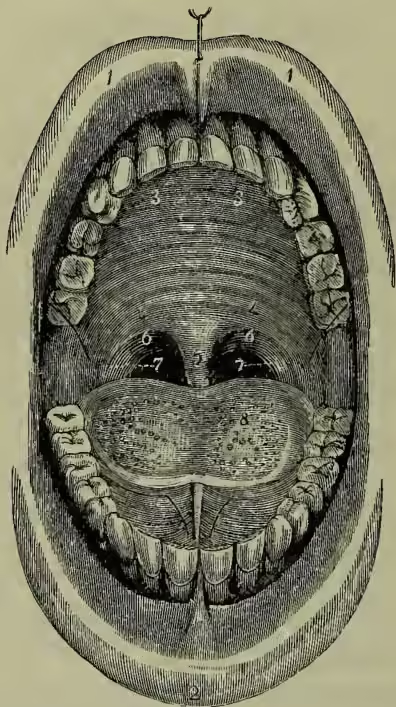
Palate, the roof of the mouth, consists of two portions, the hard palate in front and the soft palate behind. The framework of the hard palate is formed by the intermaxillary bones, the palate processes of the superior maxillary bones, and by the horizontal processes of the palate bones, and is bounded in front and at the sides by the alveolar arches and gums, and posteriorly is continuous with the soft palate. It is covered by a dense 1, 1, the upper, and 2, the lower lip; 3, 3, the hard palate; 4, 4, the soft palate; 5, the uvula; 6, 6, the arches of the soft palate; 7, 7, the tonsils; 8, the tongue. structure formed by the periosteum and mucous membrane of the mouth, which are closely adherent. Along the middle line is a linear ridge or raphe, on either side of which the mucous membrane is thick, pale, and corrugated, while behind it is thin, of a darker tint, and smooth. This membrane is covered with scaly epithelium, and is furnished with numerous follicles (the palatal glands). The soft palate is a movable fold of mucous membrane enclosing muscular fibres, and suspended from the posterior border of the hard palate so to form an incomplete septum between the mouth and the pharynx; its sides being blended with the pharynx, while its lower border is free. When occupying its usual position (that is to say, when the muscular fibres contained in it are relaxed) its anterior surface is concave; and when its muscles are called into action, as in swallowing a morsel of food, it is raised and made tense, and the food is thus prevented from passing into the posterior nares, and is at the same time directed obliquely backwards and downwards into the pharynx.
Hanging from the middle of its lower border is a small conical pendulous process, the uvula; and passing outwards from the uvula on each side are two curved folds of mucous membrane containing muscular fibres, and called the arches or pillars of the soft palate. The anterior pillar is continued downwards to the side of the base of the tongue. The posterior pillar is larger than the anterior, and runs downwards and backwards to the side of the pharynx. The anterior and posterior pillars are closely united above, but are separated below by an angular interval, in which the tonsil of either side is lodged. The tonsils (amygdalæ) are glandular organs of a rounded form, which vary considerably in size in different individuals. They are composed of an assemblage of mucous follicles, which secrete a thick grayish matter, and open on the surface of the gland by numerous (twelve to fifteen) orifices. The space left between the arches of the palate on the two sides is called the isthmus of the fauces. It is bounded above by the free margin of the palate, below by the tongue, and on each side by the pillars of the soft palate and tonsils.
As the upper lip may be fissured through imperfect development (in which case it presents the condition known as Hare-lip, q.v.), so also may there be more or less decided fissure of the palate. In the slightest form of this affection the uvula merely is fissured, while in extreme cases the cleft extends through both the soft and hard palate as far forward as the lips, and is then often combined with hare-lip. When the fissure is considerable it materially interferes with the acts of sucking and swallowing; and the infant runs a great risk of being starved; and if the child grows up its articulation is painfully indistinct. The closure of cleft palate by operation must be left in the hands of an experienced surgeon, who should be called to see the child as soon as the defect is noticed. If the separation is too great to admit of closure by operation, a plate or 'artificial palate' may be made to cover the opening.
Acute inflammation of the tonsils, popularly known as Quinsy, is treated of in a separate article. Chronic enlargement of the tonsils is very frequent in scrofulous children, and is not rare in scrofulous persons of more advanced age, and may give rise to very considerable inconvenience and distress. It may occasion difficulty in swallowing, confused and inarticulate speech, deafness in various degrees from closure of the Eustachian tubes (now often termed throat deafness), and noisy and laborious respiration, especially during sleep; and it may even cause death by suffocation, induced by the entanglement of viscid mucus between the enlarged glands. If local and constitutional remedies fail to reduce the enlarged tonsils they must be more or less removed by the surgeon, either by the knife or scissors, or by a small guillotine specially invented for the purpose.
Enlargement or relaxation of the uvula is not uncommon, and gives rise to a constant tickling cough and to expectoration, by the irritation of the larynx which it occasions. If it will not yield to local treatment it may require to be removed either in whole or in part.