Palm (Palmae or Palmaeæ), a natural order of endogenous plants, the products of which are of extreme importance and utility to man. They are arborescent, with erect stems, usually slender as compared with the extreme height to which some of the species attain, and simple or rarely branching; some are stemless, their leaves springing direct from the ground; others are sarmentose, twining about the stems and branches of neighbouring trees, by means of hooks or prickles, or trailing on the ground with stems of almost incredible length and extreme slenderness, as in the case of many of the Calami. Externally the stems are hard and horny, often coated with a siliceous deposit hard as flint, and finely polished; they frequently are armed with spines, and marked with the scars of dead leaves, or clothed in the upper part with the remains of the dead leaf-stalks enveloped in masses of fibre. The interior of the stem is generally soft and pithy, intermingled with bundles of fibre longitudinally. So soft and easily extracted is the internal substance of the stems of many palms that the outer hard case may readily be formed into a cylindrical tube. The leaves vary much in form superficially, but all the variations belong to two types—the fan-veined and the pinnate-veined. In the former the general outline is that of a fan, with veins arising from the top of the leaf-stalk and radiating like the ribs of a fan. In the other type the leaves are more or less elongated, with a distinct midrib extending to within a little of the extremity of the blade, which is always there cleft in two down to the point of the midrib, and with the veins springing from the sides of the midrib like the pinnules of a feather. Leaves of this type are sometimes entire, but more generally pinnate, and impart much elegance and grace to the figure of the particular species to which they belong. The size of palm-leaves varies extremely, some being only a few inches in length, as in some species of Malortzia, while in Manicaria succifera they attain the enormous proportions of 35 feet in length by 5 or 6 feet in breadth. The inflorescence is a simple or many-branched spadix enclosed in a spathe of one or several valves. The flowers are small individually, but numerous, usually of a yellow tint, and in some species powerfully odorous. They are unisexual, bisexual, or polygamous, the male and female flowers being borne in some species on different plants. The fruit when ripe is berry-like, drupaceous, plum-like, or, as in the cocoa-nut, nut-like.
Palms are natives chiefly of the tropical regions of the earth. A few are found in extra-tropical countries extending to N. lat. in America, N. lat. in Asia, and in Europe Chamaerops humilis, which is the only indigenous species, extends to N. lat.; no species are found beyond S. lat. Linnæus, whose knowledge of palms was limited to the more arborescent species, very appropriately named them the 'Princes of the Vegetable Kingdom.' Their stately habit, the elegant proportions of the stems, and the grace and beauty of the leaves of the majority of the larger species, coupled with the great variety and utility of the products of all, mark them as a most distinguished and valuable group of plants, gratifying the eye by their adornment of the landscape, and ministering abundantly to the necessities and the pleasures of both savage and civilised man. Their stems when young and tender are delicious and nutritious food; when old and mature those of certain species yield valuable farinaceous substances; some are valuable as timber-trees, and the terminal bud of several consists of a mass of tender mucilaginous leaves, which are esteemed a delicate and delicious vegetable. Many yield by incision or otherwise an abundance of sweet sap, from which sugar, refreshing drinks, wines, spirits, and vinegar are obtained. Their leaves are used for thatch, and for the making of mats, baskets, hats, umbrellas, thread, cord, and clothing. They yield excellent and inexhaustible materials, and they are in some cases a natural substitute for writing-paper, the records and writings of many eastern peoples being inscribed upon them.
The order comprises, according to Hooker and Bentham in Genera Plantarum, between 130 and 140 genera, and the number of species known is variously estimated by different authorities at from 600 to 1000.
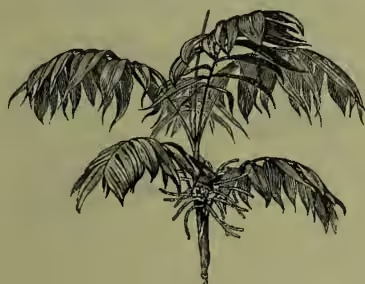
The genus Chamaedorea is composed of about sixty species, all of slender, graceful habit, their smooth stems often not exceeding an inch in diameter, though they may be twenty or more feet high. They are used in South America for making bridges, as the bamboo is in China and India. The flowers of several of the species—including those of C. aurantiaca (fig. 1)—are highly esteemed as a culinary vegetable in some of the countries of Central America, but for this purpose they must be extracted from the spathe before it bursts. The fruit of Leopoldina major, called by the natives of Brazil Jará-assu, is collected by them and burned, and the ash, after being washed, is used as a substitute for salt. It is described, however, as being bitter rather than saline. Euterpe edulis—also a native of Brazil—produces fruit in size, shape, and colour like that of the sloe. From the fruit of this species a beverage is made by infusion which is much relished. E. oleracea produces an edible and nutritious cabbage. The Nibong of the Malays of the Eastern Archipelago is Ocosperma filamentosa, the cabbage of which is more highly esteemed than that of any other palm indigenous to that region. From the fruit of Enocarpus batava a wholesome beverage called Patawa-yukissé is made on the Rio Negro. The fruit of Oreodoxa regia, an extremely handsome palm, a native of Cuba, is too acrid for human food, but is used there for fattening hogs.
Areca catechu is the Betel-nut Palm (see ARECA). The fruit enters into the masticatory of that name so much used in India. It contains gallic acid, much tannin, a principle analogous to catechu gum, a volatile oil, a red insoluble matter, a fatty substance, and some salts. A spurious kind of catechu is obtained from the nuts in two colours—one dark or black, which is extremely astringent; the other yellowish brown, which is less astringent and more pure. Besides being used as a masticatory and in medicine in cases of dysentery, the substance is employed in tanning leather and in dyeing calico. The terminal shoot of this palm furnishes an excellent cabbage, as also do several other species of Areca. But the true Cabbage Palm is A. oleracea, a noble species indigenous to the West Indies, attaining the height of 170 to 200 feet, with a diameter of stem of about 7 feet. The leaves are pinnate, about 20 feet long, the pinnules in full-sized leaves being often 3 feet in length. The terminal bud or cabbage is enclosed among many thin snow- white brittle flakes. It has the flavour of the almond, but with greater sweetness, and is boiled and eaten with meat. As its removal causes the death of the tree, it is regarded as an extravagant delicacy only rarely to be enjoyed, because of the great importance of the other products which the tree yields. The inflorescence is extracted from the spathes before they open, are pickled, and esteemed a delicate relish with meat. The nuts yield a useful oil by decoction. The shell or outer hard crust of the stem is employed in making gutters, and the pith yields a kind of sago if extracted immediately the tree is felled; but if allowed to lie and decay on the ground, it becomes the breeding ground of a peculiar grub, which is greatly esteemed as a delicate article of food in Martinique and St Domingo.
Ceroxylon (Iriartia) andicola, a native of Peru, growing at an elevation of 8000–10,000 feet above sea-level, is a handsome species rising to the height of 160 or more feet. The stem exudes from the annular cicatrices of the fallen leaves a resinous substance called by the inhabitants cera de palma. It is composed of about two parts of a yellow resin and one part of wax, the texture of which is more brittle than beeswax. A sub-resinous matter is also extracted from it named ceroxylon, which assumes the form of silky crystals, is soluble in alcohol, and phosphorescent by friction. The exudation, mixed with certain proportions of wax or tallow, is employed in candle-making. Besides the resinous exudation the trunk yields a valuable and durable timber, the leaves are excellent and durable material for thatch, and they supply a strong, useful fibre for the manufacture of ropes and cordage. The Kiziuba Palm (C. exorrhiza) is a native of Central and South America, and is a singular and interesting tree on account of its peculiar habit of growth. The roots all spring from the stem above ground, every new root emerging from a point somewhat higher on the stem than the one which preceded it. And as the old roots decay as the new are produced and penetrate the ground, a tree of some age presents the curious spectacle of being supported on three or four legs long enough and wide enough apart to enable a man to pass between them erect. The timber is used in flooring and for making umbrella-sticks, musical instruments, &c. Blowpipes (q.v.) for poisoned arrows are made from the stems of C. setigera.
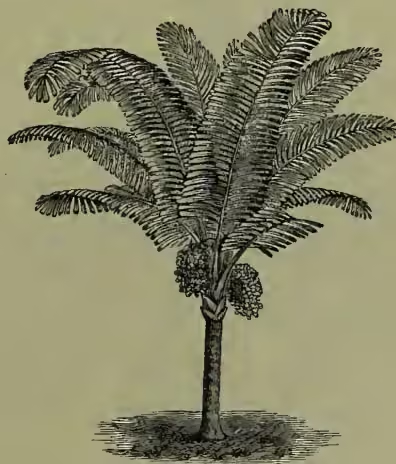
The Sugar Palm (Arenga saccharifera, see fig. 2) is a native of the Moluccas, Cochin-China, and the Indian Archipelago, and is of immense value to the natives of these countries on account of its various products. It yields an abundant sweet sap, from which a chocolate-coloured sugar named jaggery is made. The sap fermented makes an intoxicating drink variously named by the inhabitants of the different countries neroo or brum. From the pith of the stem sago is obtained in great quantity, a single stem yielding as much as from 150 to 200 lb. The leaves supply Gomuto fibre, which is celebrated for its great strength and durability when formed into cordage and ropes, and at the base of the leaves a fine woolly material, named baru, is developed in mature trees, which is employed in caulking ships, stuffing cushions, and making tinder.
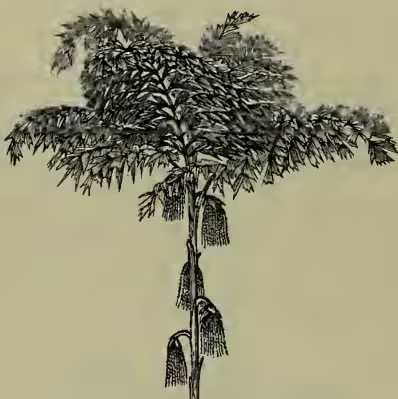
Caryota urens (see fig. 3), one of the noblest palms of India, yields some remarkable products. The flesh of the fruit, which resembles a plum in size and structure, is very acrid, and corrodes and burns the lips and mouth. From the terminal bud a sweet watery liquor is obtained, which, when boiled, yields jaggery. The terminal bud is also eaten as a cabbage. From the pith of the stem sago is obtained, which is made into bread, and prepared in various other ways, and is a valuable article of food to the natives. The tree is named Kittul in Singhalese, and the fibre called Kittul, obtained from its leaves, is most valuable to brushmakers (see FIBROUS SUBSTANCES).
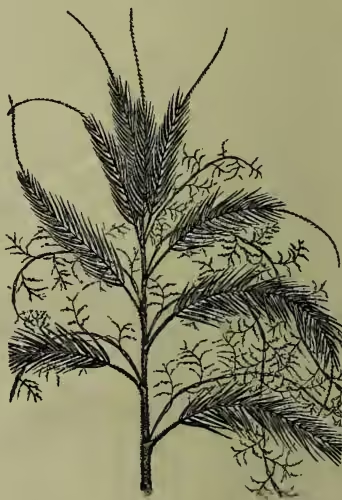
The genus Calamus and its immediate allies are regarded as forming a connecting link between the palms and the grasses, having the inflorescence and fruit of the former and in some cases the habit of the latter. Certain species—viz. C. Roxburghii, C. Royleanus, both of which are included in C. rotang by some authors, and C. viminalis and others—furnish the rattan-canes employed in making ropes and cables, chair bottoms, couches, baskets, mats, &c. The walking-sticks known as Malacca canes are made from the stems of C. scipionum, a species which grows not in Malacca, but in Sumatra, and the canes are chiefly exported from Siak in that island. The stems of the Great Rattan (C. rudentum) and others are of prodigious length, extending to hundreds of feet, clinging by hooks attached to their leaves to the trunks and boughs of neighbouring trees, or trailing on the ground. They are extremely hard externally, and usually smooth, with a dense siliceous crust on the surface. C. draco furnishes the finest quality of the resinous substance known as Dragon's Blood (q.v.), although a similar substance is obtained from various other plants. In this case it is exuded from the surface of the fruit, and is separated from it by rubbing or shaking the fruit together in a bag. An inferior quality of the same substance is also obtained from the tree by incision of the stem, and by steaming the fruit after the natural exudation has been collected. The species are very numerous, about 200 having been described, but few are more singular than C. adspersus (see fig. 4), which resembles a creeping or twining grass rather than a palm, the stems rarely exceeding in thickness stout wheat straw.—Zalacca edulis is regularly cultivated by the Burmese for the sake of its pleasantly acidulous fruit, which grows to the size of a walnut.
The succulent scaly pulp which encloses the seed is the edible part.—Raphia vinifera, a native of Guinea, yields a rather abundant sap, from which a strongly spirituous wine is obtained. One of the most beautiful and singular of palms is R. tædigera, an inhabitant of the banks of the Amazon. The trunk of the tree is short, from 6 to 10 feet high, but from the summit the leaves rise almost perpendicularly to the height of 40 feet or more, arching gracefully outward towards the apex. The footstalk of these enormous leaves alone are often 12 or 15 feet long by 4 or 5 inches in diameter. The integument of these footstalks is thin, extremely hard and elastic, and light as a quill, and, being easily split into straight strips, is made into window-blinds, baskets, &c. by the Indians.
The true sago of commerce (see SAGO) is derived from various species of the genus Sagus, although other species of palms, as has already been stated, and also plants widely different botanically, such as Cycas revoluta, also yield a kind of sago. S. Rumphii, S. lœvis, and S. farinifera are the species from which the largest quantity of true sago is obtained. S. Rumphii is a native of the Indian Archipelago, Malacca, Borneo, Sumatra, Celebes, and the Moluccas being the principal places in which it is cultivated. The tree is small, rarely exceeding 30 feet in height of stem, which consists of a hard shell about 2 inches thick enclosing a mass of spongy pith—the sago. This pith is gradually absorbed after the tree reaches maturity, leaving the stem quite hollow. The proper time to fell the trees, before the pith begins to diminish in bulk or quality by absorption, is indicated by the upper leaves becoming covered with a sort of farina or white dust. When felled the stem is cut into lengths of 6 or 7 feet, which are split, the better to remove the pith. There are various modes of extracting the fecula from the insoluble substances with which it is combined in the stem, but washing and straining are the principal features of every process. A single tree, it is said, will yield from 500 to 600 lb. of sago.—The Bache (Mauritia flexuosa), a native of Guiana, supplies the chief wants of the people wherever it grows; the stems furnish timber for building their dwellings, the leaves thatch for the same, and material for mats, couches, hammocks, &c.; the pith yields sago; the juice by fermentation gives an excellent beverage; the kernels of the fruit are ground into meal and made into bread; and the fibre is converted into cordage and clothing.—The Palmyra Palm (Borassus flabelliformis) is one of the most common of its tribe in India. In some parts of the country it grows spontaneously, and it is found as far north as ; in others it is the subject of careful cultivation. It furnishes the greater part of the palm-wine of India, which by the natives and Famuls is called Callu and Noongpoo, and by Europeans Toddy. The fruit is about the size of a child's head, somewhat triangular, and within a thick, fibrous rind contains three seeds about the size of a goose's egg. The seeds when young are eaten by the natives, being jelly-like and palatable. The toddy is obtained by wounding the spathe before the inflorescence expands. After a few days a clear, sweet liquor exudes from the wound, and is carefully collected in pots suspended under the wounded spathe. A tree yields about three quarts daily. The liquor is drunk fresh, and will only keep sweet for about three days, when it undergoes fermentation and becomes sour, and is distilled into arrack. Jaggery is also made from the juice. The young plants when a few inches high are cooked and eaten as a vegetable. The leaves, which are fan-shaped and large, are turned to the various uses alluded to in connection with species already described, and in India they are almost universally used for writing upon with an iron stylus.
The Double Cocoa-nut, or Sea Cocoa-nut as it has been called, is Lodoicea seychellarum. The nuts of this tree are seen occasionally in museums and in the cabinets of collectors of curios, often beautifully polished and carved by native workmen, and formed into caskets and other ornaments. For long their origin was shrouded in mystery. They were frequently found floating about in the ocean before the discovery of the tree, and an absurd belief was entertained by Malay and Chinese sailors that they were the fruit of some marine tree. The tree, a native of the Seychelle Islands, is very elegant, attaining a height of from 50 to 80 feet, with leaves 20 feet long supported on stalks of equal length. The fruit is one of the largest produced by any of the palms, being a foot or a foot and half in length. The kernel near the base is divided into two parts—hence the name Double Cocoa-nut—and while young part of the fleshy substance in which it is enclosed is edible. The chief products of the tree are timber and fibre for cordage, and a downy kind of fibre which envelops the young leaves is used for filling mattresses and pillows.
The Talipat Palm of Ceylon (Corypha umbra-culifera) is notable only for the variety of uses to which its leaves are put in Ceylon and other parts of India to which it is indigenous. The leaves are of immense size, and, being palmate with the leaf-stalk attached near the middle, they are readily formed into umbrellas and tents; the cane-like ribs being removed and the blades neatly stitched together, they may be folded up with great facility. They are also very much used for the books or colahs of the inhabitants. Many of these alleged to be made of Egyptian papyrus are formed of the leaves of this palm. The tree grows to the height of 100 feet, and has a very grand and imposing appearance.—A closely allied species (C. taliera) is the Talipat Palm of the Indian peninsula. It grows to about the same height as the preceding species, with leaves of a more durable kind for the purposes of thatch, but not so adaptable to more delicate and artistic uses.—Licania peltata is the Chittah-pat of Assam, the leaves of which are extensively used for making umbrellas, punkahs, and hats. The stems of L. acutifolia are made into walking-sticks, named by Europeans Penang Lawyers.—Copernicia cerifera, a native of northern
Brazil, produces an edible fruit; and from the leaves, after they have been removed from the trees and dried, is obtained an inferior kind of vegetable wax, which is used in candle-making and to adulterate beeswax.
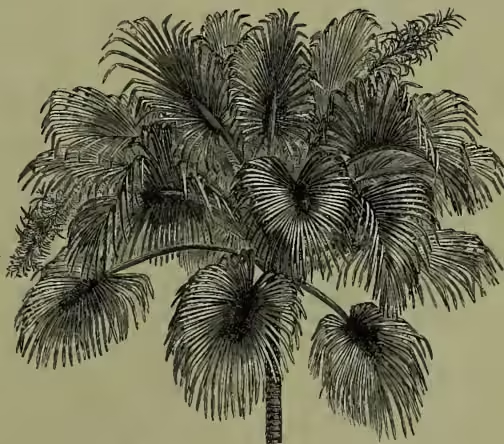
Of the American Palmetto Palm, a native of the Carolinas and Florida, the most important species is the Cabbage Palmetto (Sabal palmetto), which sometimes grows to 50 feet in height and 15 inches in diameter, with leaves 5 feet long and broad. It is found also in the Bermudas. Its products are timber and the leaves, the former being exceedingly durable, very porous (see MOULTRIE), and especially valuable for wharf-building, as it resists water and is not attacked by the teredo. The fruit is not edible.—The Palmetto of Europe is Chamaecrops humilis, which inhabits the countries on both shores of the Mediterranean, occupying great tracts. It rarely reaches 10 feet in height, and usually is much less, its growth being exceedingly slow. The leaves are fan-shaped and abound in excellent fibre, with which the Arabs, combining it with camels' hair, make tent-covers; in Spain it is made into ropes and sailcloth, and in France into carpets, named African haircloth. The French in Algeria make paper and pasteboard of it, and so well adapted is it to this purpose that its use might be more extended in other countries. The fruit is edible, and is eaten by the Arabs and the inhabitants of Sicily and Southern Italy. The plant endures the climate of London, but scarcely grows. C. Ritchiana, a native of Sind and Afghanistan, and C. excelsa, a native of China and Japan, both produce excellent fibre. The leaves of Thrinax argentea supply the material called chip, of which ladies' hats and bonnets of that name are made. The trunks of T. parviflora, a native of Jamaica, though of slender diameter, are said to be very suitable for piles and marine buildings subject to immersion, as they are impervious to the influence of water, and are not attacked by borers or worms. Sabal (Trithrinax) mauritiaeformis, a native of New Granada (fig. 5), is a low-growing but very handsome palm, not remarkable for any products of special utility.
The Piritu of Venezuela, the Paripou of Guiana, and the Papimba of the Amazon are the local names of one species of palm—Gulielma speciosa. It produces fruits somewhat triangular in shape, about the size of an apricot, and bright reddish yellow in colour. They have a peculiar oily flavour, and are eaten boiled or roasted, when they resemble chestnuts. They are also ground into meal, which is baked in cakes.—The Great Macaw tree of the West Indies (Acrocomia sclerocarpa) is a native of Jamaica, Trinidad, and the adjacent islands and continent. In Brazil it is called Macahuba, and in Guiana Macoya. The tree grows from 20 to 30 feet high, with a crown of leaves, each of which measures from 10 to 15 feet in length. The fruit yields an oil of yellow colour, sweetish taste, and having the odour of violets, which is employed by the natives as an emollient for painful affections of the joints; and in Europe it is used in the manufacture of toilet soaps. The nuts are capable of receiving a high polish, and are converted by the natives and the negroes into ornaments.—The Tucum Palm (Astrocaryum tucuma), a native of the Rio Negro and the Upper Amazon, yields a very superior fibre, the cordage from which is knitted into hammocks, which are in great demand with the Brazilians. The fleshy outer covering of the fruit is eaten by the natives.—The Murumuru Palm (A. murumuru) produces a very agreeable fruit with the fragrance of musk. Cattle eat the fruit with avidity, but evacuate the hard stony seeds undigested. In times of scarcity these seeds are carefully collected and used to feed pigs, which are very fond of them, and find no difficulty with their powerful teeth and jaws in masticating them.—Attalea funifera furnishes the whalebone-like fibre now so much used in Britain for making brooms and brushes. The tree attains the height of 20 or 30 feet. At the base of the leaves a valuable thick, dark-brown, very long fibre, Bahia bass, is obtained, sometimes 12 feet long; Para or Monkey bass, a softer, shorter kind, usually about 3 feet in length, is got from Leopoldina piassaba (see FIBROUS SUBSTANCES). The fruit of Attalea funifera is the Coquilla nut, much used in turnery for the making of knobs to walking-sticks and umbrellas, handles to bell-pulls, &c. The nuts are extremely hard and susceptible of a fine polish, and exhibit a beautifully mottled surface of light and dark brown.—The fruit of A. cohune yields from its kernel a valuable oil called Cohune Oil, which is said to be superior in quality and to burn twice as long as the best cocoa-nut oil. It is a native of Honduras and the Isthmus of Panama. The trunk, which attains the height of about 40 feet and is crowned with leaves some 30 feet long, yields by tapping a kind of palm-wine.—The Palm-oil of Africa is the product of the fruit of Elwis quineensis. The tree is cultivated now in the West Indies and tropical South America for the sake of the oil. It attains a height of 60 to 80 feet, with a spreading crown of pinnate leaves, each about 15 feet long, the footstalks of which are armed with stout hooked spines. The flowers have a strong peculiar smell, like anise and chervil in combination. The fruit forms a large head, consisting of a great number of bright orange-coloured drupes; when ripe each drupe has an oily pulp with a stone or kernel in the centre, and it is from this pulp that the oil is obtained. To extract the oil the pulp is first bruised to a paste in wooden mortars, and is then boiled in water. The oil which rises to the surface of the water is reddish or orange in colour, and has an agreeable odour of violets; it is allowed to cool, and is then skimmed off. In warm countries it retains its oily consistency, but in cooler climates it acquires the solidity of butter. It is used by the natives universally as butter is in Europe. The quantity of palm-oil now imported to Great Britain is enormous. It is employed in the manufacture of candles, toilet and common soaps, and as a lubricant of railway-carriage wheels, &c. It is composed of about thirty-one parts of stearin and sixty-nine of olein. The tree yields from its trunk abundance of palm- wine.—The Coquito of Chili is Jubæa spectabilis, a tree of about 50 feet in height, with a spreading crown of leaves. From its trunk a syrup is extracted, called miel de palma, which is much esteemed by the Chilians and Europeans in cookery in various ways. It is obtained by cutting down the tree and lopping off its crown of leaves, when the sap flows from the wound, and is carefully collected. By cutting off a fresh slice from the wound daily, or when the flow of sap becomes weak, it may be kept flowing for several months; a good tree is said to yield as much as ninety gallons of sap, which on being boiled down assumes the consistence of treacle.
Much information on palms and their products will be found in the Historiæ Palmarum, by Martins; in the Flora Brazilianis, by Drude; and A Popular History of Palms, by Seeman. See ARECA, COCOA-NUT, CHAMÆROPS, DATE PALM, DOOM PALM, FIBROUS SUBSTANCES, &c.