Palmistry, or CHIROMANCY (Gr. cheir, ‘the hand, and mantikē, ‘divination’), is the art of ‘reading the palm’—the art which professes to discover the temperament and character of any one, as well as the past and future events of his life, from an examination of the palm of his hand, and of the lines traced upon it. As a considerable body of very complicated rules and directions have been laid down by authorities, ancient and modern, to enable the student to read the palm, palmistry claims to be regarded as a ‘science,’ or at least as a branch of an interpretative science of the hand in general, to which the name Chiroscopy has been given. The other branch of this general science has been called Chirognomy, and is concerned with the interpretation of the form and character of the hand and fingers, while Chiromancy treats of the palm only (see DIVINATION).
As an art palmistry appears to be of great antiquity. Mr Nesfield, in his Report on the caste system in the North-west Provinces and Oudh (1885), tells us that there is a caste of Brahmans, called Joshi, who profess the art of fortune-telling by means of marks on the palms of the hands, the face, and the body generally; and who seem to have practised it from remote times. Palmistry has an ancient literature of its own in India; the ancient Samudriki appears to have had some acquaintance with letters, but the Joshi, his modern representative, is quite illiterate, though he generally carries about with him a manual of palmistry, of whose contents he knows nothing. There are also a number of wandering outcasts in India who tell fortunes by palmistry.
That palmistry was to some extent at least known to the ancient Greeks we have evidence in the writings of the Stagirite himself. In his
Hist. Animalium Aristotle observes (i. 15) that long-lived persons have one or two lines which extend through the whole hand; short-lived persons have two lines not extending through the whole hand. Other references to this subject occur in the doubtful works, the Problemata and the Physiognomika, attributed to him. Pliny, too, in his Natural History (xi. 114) directly asserts that Aristotle regarded numerous broken lines in the palm of the hand as a prognostic of short life.
Of the cultivation of palmistry among the Romans there is little evidence; but Juvenal, in showing up the curiosity of women and their love of prying into forbidden mysteries, describes the woman of fashion as consulting eagerly Chaldean astrologers and other diviners, while the middle-class woman 'frontemque manumque præbebit vati' (Sat. vi. 581). In the 2d century Artemidorus of Ephesus, the author of a work on the interpretation of dreams, is said to have devoted a whole treatise to the subject, which, however, is not extant.
In writers of the middle ages there is much reference to the subject, and the names of Paracelsus, Albertus Magnus, and Cardanus have been associated with it. But the most important work on chiromancy belonging to this period seems to be Die Kunst Chiromantia, of Johann Hartlieb, which was printed at Augsburg in 1475. In the 16th century we find several treatises on the subject, of which the most important seem to be those of Johann Indagine, and of Barthelémy Cocles 'de Bouloigne,' doctor of natural philosophy and of medicine. The former has been Englished by Fabian Wither (London, 1651). In the end of the 18th century palmistry found an important exponent in the celebrated Marie Anne Lenormand (1772-1843), who in her Souvenirs Prophétiques d'une Sibylle (1814) foretold the downfall of Napoleon. The chief authorities on palmistry in recent times are two Frenchmen—M. le Capitaine D'Arpentigny, and M. Adrien Desbarrolles; and it is on their works that modern English books on the subject are chiefly founded. D'Arpentigny has expounded principally chiromancy, or that branch of the interpretative science of the hand which treats of the general form of the hand and fingers. The observation of the fingers and joints of the hand is quite as important to the chiromant as that of the palm itself; but we must refer for D'Arpentigny's system to the works cited below. The thumb is generally regarded as chiromantically the most important part of the hand. The first, or upper phalange of the thumb, when well developed, shows the presence of will and decision of character; the second, according to its development, indicates more or less logical power (see A and B in diagram).
What has to be considered by the chiromant proper is the 'mounts' of the hand, with the marks on them, and the lines in the palm. The 'mounts' are the elevations at the base of the fingers and thumb and in the 'percussion' of the hand—i.e. the side of the palm which extends from the root of the little finger to the wrist: it is so called because it is used in striking. They are seven in number, and are named from the planets, by the signs of which they are also known—viz. ♀ for Venus, ♃ for Jupiter, ♄ for Saturn, ☿ for Apollo, ♂ for Mercury, ♁ for Mars, ☾ the Moon (see diagram). When well developed the mounts indicate the possession of the quality associated with the respective planets—e.g. Jupiter developed denotes pride and ambition; Saturn, fatality; Apollo, art or riches; Mercury, science or wit; Mars, courage or cruelty; Venus, love and melody; the Moon, folly or imagination. But the effect of a greatly developed mount may be modified by the lines in the palm or by other signs.
There are four principal lines—viz. the line of life, which surrounds the thumb, and which, if long, indicates a long life; the line of head, the line of heart, and the rascette or the bracelets. These last (the bracelets), if well marked, strengthen the effect of the line of life, each bracelet indicating thirty years of life. The line of heart (the linea mensalis of ancient chiromancy), if long, clear cut, and well coloured, denotes an affectionate and devoted character; and the nearer the line stretches to Jupiter the better the character. If the line end in a fork, so much the better. In actors and mimics this line ascends the mount of Mercury.
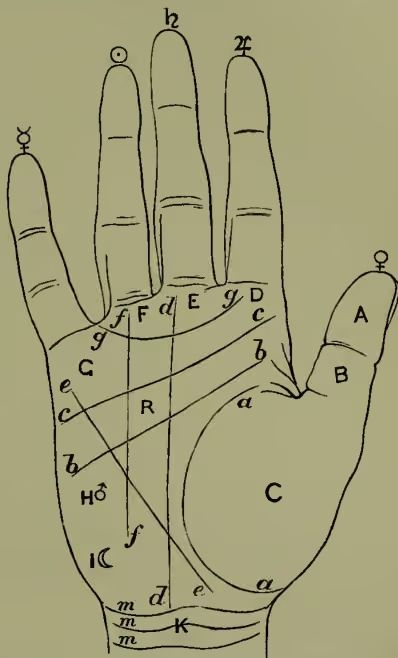
A good line of head—i.e. a clear-cut, long, unbroken line—indicates the presence of superior intellectual qualities. If the line stretch to the mount of the Moon, it indicates imagination. A winding head-line shows folly and indecision of character; a linked line (like a chain) denotes want of concentration. The other lines (which are not present in all hands) are the line of Saturn or fate (d, d), the line of Apollo (f, f), the line of liver or health (e, e), and the line of Venus (g, g). A long, clear-cut line of Saturn (see diagram) foretells a happy and prosperous life, breaks or windings in the line foretell misfortunes or obstacles; a good line of Apollo shows that its owner will be successful in art; a good liver-line promises a long and healthy life; while the Venus line (Cingulum Veneris), when present, indicates a character very liable to be influenced by the passion of love. Marks on the mounts or lines, such as stars, crosses, &c., have their respective significations. A good open space between the lines of head and heart (the quadrangle) indicates a generous and noble disposition, while a very narrow space in the quadrangle is a sign of avarice and egotism.
The best handbooks are S. D'Arpentigny, La Chiromomie (Paris, 1843); A. Desbarrolles, Les Mystères de la Main (1859), and his Révélations Complètes (1874); Beamish, The Psychonomy of the Hand (1865); A. R. Craig, The Book of the Hand (1867); H. Frith and E. Heron Allen, Chiromancy, or the Science of Palmistry (1883); Heron
Allen, Manual of Cheiroscopy (1885); L. Cotton, Palmistry and its Practical Uses (1890).