Pantagraph, or PANTOGRAPH (Gr. panta, ‘all;’ graphein, ‘to delineate’), an instrument invented for the purpose of making copies, reduced or enlarged, of drawings or plans. It is made in various forms, one of which is shown in the figure. Four rods are so hinged to one another that AE is equal to DF, and AD to EF; hence ADFE is always a parallelogram. If from a given point C on AE any straight line BH (or a, b) be drawn, cutting the other arms, the triangle
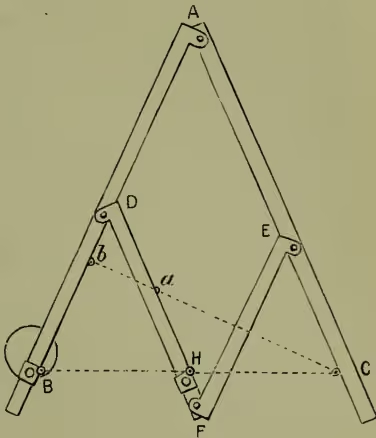
ABC will always, no matter how the arms of the instrument be moved, be equal to the triangle DBH. It follows that, if the instrument be pivoted on a point at B (usually by a weight), a pencil-point inserted at H and a tracing-point at C, and the latter traced over the lines of a drawing, the pencil-point at H will trace a reduced copy of the drawing. The proportion of the reduction will be as BH is to BC. B and H are made to slide on their respective rods, so that any proportion of reduction can be made. By changing the places of the pencil and tracing-point, an enlarged copy may be made. The instrument is fitted with little castors to facilitate its free motion. The pantagraph was invented by the Jesuit Christoph Scheiner prior to 1631, and improved by Professor W. Wallace of Edinburgh prior to 1831.
Enlargements or reductions can now be done so much more accurately by means of photography that the pantagraph is nearly obsolete. See COPYING.