Papyrus, a genus of plants of the natural order Cyperaceæ, of which there are several species, the most important being the Egyptian Papyrus or Papyrus of the ancients (P. antiquorum, Cyperus papyrus of Linnaeus)—a kind of sedge, 8 to 10 feet high, with a very strong, woody, aromatic, creeping root, long, sharp-keeled leaves, and naked, leafless, triangular, soft, and cellular stems, as thick as a man's arm at the lower part, and at their upper extremity bearing a compound umbel of extremely numerous drooping spikelets, with a general involucre of eight long filiform leaves, each spikelet containing six to thirteen florets. By the ancient Egyptians it was called papu, from which the Greek papyrus is derived, although it was also called by them byblos and deltos. The Hebrews called it gomê, a word resembling the
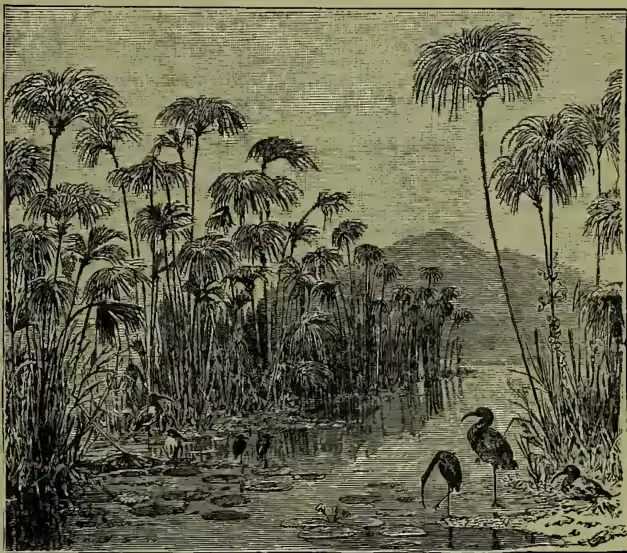
Coptic gom, or 'volume;' its modern Arabic name is berdi. The plant is nearly extinct in Lower Egypt, but is found in Nubia (whence it was probably introduced into Egypt) and Abyssinia. It still grows in the Jordan Valley, in the neighbourhood of Jaffa, and also of Sidon, in parts of the Sinai Desert, and in Sicily. It is often a conspicuous feature in African vegetation. It is represented on the oldest Egyptian monuments, and as reaching the height of about ten feet. It was grown in pools of still water, growing ten feet above the water, and two beneath it, and restricted to the districts of Sais and Sebennytus. The papyrns (not merely P. papyrus, but P. dives, which is still found in Egypt) was used for many purposes, both ornamental and useful, such as wreaths for the head, sandals, boxes, boats, and cordage, but the P. papyrus was valued principally for a kind of paper called by its name. Its pith was boiled and eaten, and its root dried for fuel. The papyrns or Paper (q.v.) of the Egyptians, made of strips of its pith in layers, was of the greatest reputation in antiquity, and it appears on the earliest monuments in the shape of long rectangular sheets, which were rolled up at one end, and on which the scribe wrote with a reed called kash, with red or black ink made of an animal carbon. When newly prepared it was white or brownish white and lissom; but in the process of time those papyri which have reached the present day have become of a light or dark brown colour, and exceedingly brittle, breaking at the touch. Papyrus was commonly used in Egypt for the purposes of writing, and was, in fact, the paper of the period; but, although mentioned by early Greek authors, it does not appear to have come into general use among the Greeks till after the time of Alexander the Great, when it was extensively exported from the Egyptian ports under the Ptolemies. It was, however, always an expensive article to the Greeks. Among the Romans it does not appear to have been in use at an early period, although the Sibylline books are said to have been written on it. It was cultivated in Calabria, Apulia, and the marshes of the Tiber, but the staple was no doubt imported from Alexandria. So extensive was the Alexandrian manufactory that Hadrian, in his visit to that city, was struck by its extent. It continued to be employed in the eastern and western empire till the 12th century, and was used amongst the Arabs in the 8th; but after that period it was quite superseded by parchment or by paper made of rags. During the later periods it was no longer employed in the shape of rolls, but cut up into square pages, and bound like modern books.
The discovery in Egypt of classical Greek authors written on papyrus began about the middle of the 19th century, and the results have been on the whole beyond expectation. The great orator Hyperides (q.v.), then only known by name, is now represented by four or five pretty complete orations; fragments of Euripides and Alcman have been added to what we possess of these authors, and early MSS. have been obtained of parts of Homer, Plato, Thucydides, Demosthenes, and Isocrates. In 1888-89 Mr Flinders Petrie found near Medinet el Fayûm papyri which were identified as fragments of Plato's Phædo, transcribed about 250 B.C., and a part of the lost Antiope of Euripides, besides quantities of letters and documents of the Ptolemaic period. In January 1891 more than 160 ancient mummies (dating from the 20th and 21st Dynasties) were found in a subterranean passage at Deir el Bahari, near Thebes; with these were many papyri, containing, as usual, many ritual passages and extracts from the Book of the Dead (q.v.); there were also 'boxes crammed with papyri.' And at the beginning of the same year the world was surprised by the announcement that papyrus rolls obtained from Egypt by the British Museum authorities had been found to contain almost the whole of a lost but famous work of Aristotle on the constitution of Athens. Of these rolls there were four, of which the longest measures seven feet, the shortest three feet. They have been written by four different copyists, are mainly in a small semi-cursive hand, and date from about the end of the 1st century A.D. There are thirty-six columns in all, of which the last six are badly mutilated. The text was edited and published in February 1891 by Mr F. G. Kenyon; a later edition was that of Mr J. E. Sandys.
See Paoli, Del Papiro (1878); also the articles Book (and works there quoted), EGYPT, PALEOGRAPHY, PAPER.