Parabola, the section of a cone by a plane which is parallel to a generating line. As a particular case, when the plane passes through the vertex of the cone, the parabola closes up into a straight line. A property of the parabola is that the distance of any point on the curve from a certain fixed point is equal to its distance from a certain fixed straight line. The fixed point is called the focus of the parabola, and the fixed line is called its directrix. In the figure, PAP' represents a parabola of which S is the focus and BC is the directrix. The point A is called the vertex of the parabola. The line ASO is the principal diameter of the curve; and any line drawn through a point such as P parallel to AO is called a diameter.
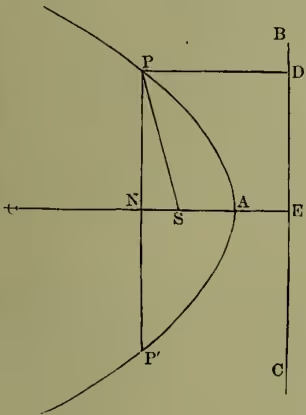
From the above property it is easy to prove that , where N is the foot of the perpendicular from P upon OA. It is obvious that the parabola is not a closed curve. The centre (corresponding to the centre of the ellipse) is situated at infinity. The tangent to the curve at P bisects the angle SPD. Hence a reflecting surface formed by the revolution of PAP' about OA as axis is such that parallel rays falling upon it in the direction of OS are reflected to S. Conversely, rays diverging from S will be reflected parallel to SO. Hence the intensity of the reflected beam of light remains constant at all distances from the source, except in so far as it is affected by absorption, and the parabolic is therefore the most perfect form of reflector (see LIGHTHOUSE, REFLECTION). If the resistance of the air were negligible, the path of a projectile would approximately be a parabola with its axis, or principal diameter, vertical, and its vertex at the highest point of the path. Let , , . The equation of the parabola referred to its vertex as origin is . All curves the equations of which are of the form are classed as parabolas. Thus, the curve represented by the equation is called the cubical parabola; and that one whose equation is is called the semi-cubical parabola.