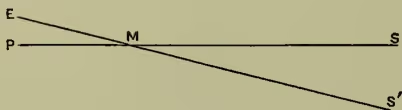
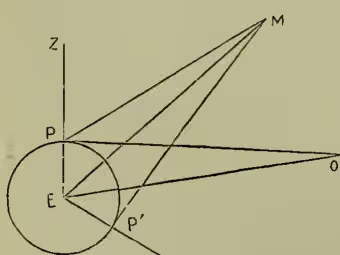
Parallax is the apparent displacement of an object caused by a change of place in the observer. When an object at M is looked at from P it appears in line with some object, S; but after the observer has moved to E, M has apparently moved to a position in line with S'; the amount of apparent motion is called parallax. The angle PME is called the 'angle of parallax,' or the 'parallactic angle,' and is the measure of the amount of parallax. To astronomers the determination of the parallax of the heavenly bodies is of the utmost importance, for two reasons—first, from the necessity of referring all observations to the earth's centre—i.e. so modifying them as to make it appear as if they had been actually made at the earth's centre; and secondly, because parallax is our only means of determining the magnitude and distance of the heavenly bodies. The geocentric or daily parallax—as the apparent displacement of a heavenly body, due to its being observed from a point on the surface of the earth instead of from its centre, is called—is determined as follows: Let let the zenith distances, ZPM and Z'P'M, be observed simultaneously, and, since the latitudes of P and P', and consequently their difference of latitude, or the angle PEP', is known, from these three the angle PMP' (the sum of the parallaxes at P and P') is at once found; and then, by a trigonometrical process, the separate angles or parallaxes PME and P'ME. When the parallax of M, as observed from P, is known, its distance from E, the centre of the earth, can be at once found. When the heavenly body is on the horizon, as at O, its parallax is at a maximum, and is known as the horizontal parallax. The geocentric parallax is of use only in determining the distances of those heavenly bodies at which the earth's radius subtends a considerable angle.
In the case of the fixed stars, at which the earth's radius subtends an infinitesimal angle, it becomes necessary to make use of a much larger base-line than the earth's radius, and, as the largest we can employ is the radius of the earth's orbit, it accordingly is made use of, and the displacement of a star, when observed from a point in the earth's orbit instead of from its centre, the sun, is called the annual or heliocentric parallax. Here the base-line, instead of being, as in the former case, 4000 miles, is about 92,000,000 miles, and the two observations necessary to determine the parallactic angle are made from two points on opposite sides of the earth's orbit, at an interval as nearly as possible of half a year. Yet, notwithstanding the enormous length of the base-line, it bears so small a proportion to the distances of the stars that only in a few cases have they been found to exhibit any parallactic motion whatever, and very rarely does the angle of parallax amount to 1" (see STARS). The geocentric horizontal parallax of the moon is about 57' 4.2"; that of the sun, about 8.8"; and of the double star, 61 Cygni, the heliocentric parallax has been determined by Bessel to be .348", equivalent to about 15 millionths of a second of geocentric horizontal parallax. See the articles STARS and SUN.