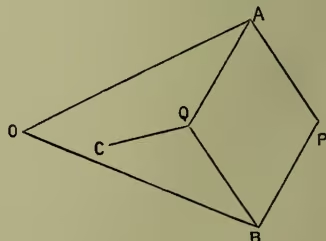
Parallel Motion, a name given to any linkage by which circular motion may be changed into straight line motion. The most familiar instance is Watt's parallel motion (see STEAM-ENGINE), which is essentially a three-bar linkage, and, although not theoretically perfect, is sufficiently good for all practical purposes. It is impossible, indeed, to obtain a straight line motion without the use of at least five bars in the linkage; and till 1874, when Hart discovered the method, even this simplest mode of obtaining a true parallel motion was not deemed possible. The Peaucellier cell, a linkage of seven bars, was, however, the earliest linkage discovered for solving the problem of how to draw a straight line. It dates from 1864, and is, perhaps, the most convenient form that has yet been devised. It is shown in the figure. The equal links AP, AQ, BP, BQ, form a rhombus; the long links OA, OB, are also equal, and have the common point O fixed. The seventh link, QC, has its end C fixed, so that Q describes a circle passing through O—i.e. QC equals the fixed distance CO. In these circumstances, when Q moves in its circle P moves in a straight line. See A. B. Kempe's How to draw a Straight Line ('Nature' series, 1877).