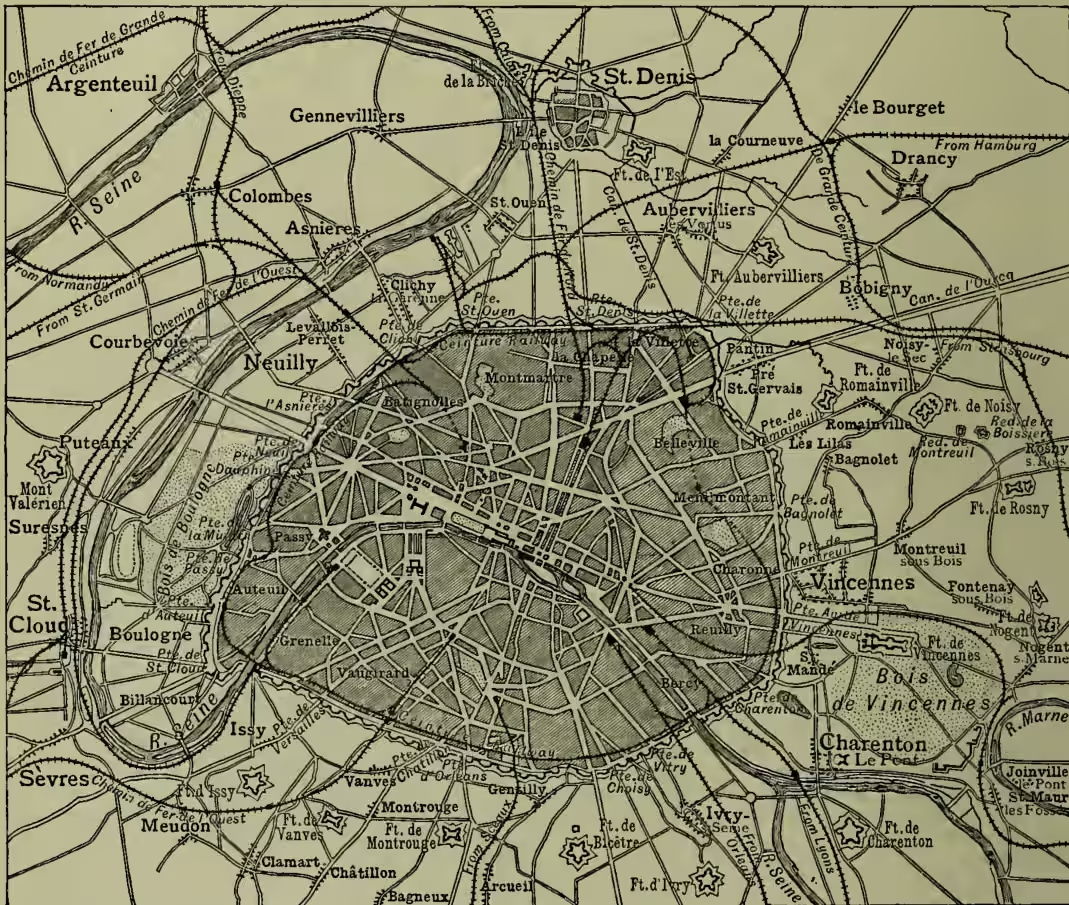
Paris, the capital of France, and the largest city in Europe after London, is situated in 48° 50' N. lat. and 2° 20' E. long., on the river Seine, about 110 miles from its mouth. It lies in the midst of the fertile plain of the Île-de-France, at a point to which converge the chief tributaries of the river, the Yonne, the Marne, and the Oise. These streams, navigable for the small vessels formerly used in commerce, gave it until recent times the advantages of a seaport, while the great trade-routes passing along their valleys connected it with all parts of France. It is still the centre of a great network of rivers, canals, roads, and railways; hence its commercial importance. Paris has occupied since Roman times a constantly increasing series of concentric circles. The present city is bounded by fortifications—a rampart upwards of 22 miles in length, begun in 1840 and completed twenty years afterwards. The extension of the city boundary to this line explains the increase of population from 1,174,346 in 1856 to 1,696,741 in 1861; subsequent pop. (1866) 1,825,274; (1881) 2,269,023; and (1891) 2,447,957. Paris has within the fortifications a mean elevation of about 120 feet, but it rises in low hills north of the Seine, Montmartre (400 feet) and Belleville (320 feet), and south of the Seine, the Montagne Sainte Geneviève (190 feet). These elevations are encircled at a distance of from two to five miles by an outer range of heights, including Villejuif, Meudon, St Cloud, and Mont-Valérien (650 feet), the highest point in the immediate vicinity of the city. The Seine, which enters Paris in the south-east at Bercy, and leaves it at Passy in the west, divides the city into two parts, and forms the two islands of La Cité and St Louis, which are both covered with buildings.
France has long been the most highly centralised country in Europe, and Paris as its heart contains a great population of government functionaries. Paris is a city of pleasure, and attracts the wealthy from all parts of the world. These wealthy inhabitants make it a city of capitalists and a great financial centre. The provincial universities of France have been deprived of their attraction by the schools of Paris, to which flock the youth of France. The publishing trade has followed the same course. Paris cannot be described as a manufacturing town. Its chief and peculiar industries produce articles which derive their value not from the cost of the material, but from the skill and taste bestowed on them by individual workmen. They include jewellery, bronzes, artistic furniture, and decorative articles known as 'articles de Paris.' In consequence of the intelligence and taste required in their trades, the Paris workmen are in many respects superior to the machine hands of manufacturing cities. The absence of extreme poverty among them and their well-to-do appearance strike the English visitor.
Before speaking in detail of the streets, boulevards, and places or squares of Paris, it is proper to mention that the private houses as well as the public buildings are built of a light-coloured limestone, quarried in the neighbourhood of the city, easily cut with the saw and carved ornamentally with the chisel. With this material they are reared in huge blocks to a height of six or seven stories, each floor constituting a distinct dwelling; access to all the floors in a tenement being gained by a common stair, which is usually placed under the charge of a porter or concierge at the entrance. Very frequently the tenements surround an open quadrangle, to which there is a spacious entry, the gate of which (the porte cochère) is kept by a porter for the whole inhabitants of the several stairs. In these respects, therefore, Paris differs entirely from London; for instead of extending rows of small brick buildings of a temporary kind over vast spaces, the plan consists of piling durable houses on the top of each other, and confining the population to a comparatively limited area. In the great new streets which were formed in the time of the Emperor Napoleon III. this general plan has been adhered to, but with this difference, that instead of being narrow and crooked they are wide and straight. Among the finest are the Rue de Rivoli, two miles in length, the Rue de la Paix, the Rue du Faubourg St Honoré, and the Rue Royale. The Boulevards, which extend in a semicircular line on the right side of the Seine, between the nucleus of the city and its surrounding quarters, present the most striking feature of Paris life. In all the better parts of the city they are lined with trees, seats, stalls, kiosques, and little towers, covered with advertisements. Restaurants, cafés, shops, and various places of amusement succeed one another for miles, their character varying from the height of luxury and elegance in the western Boulevard des Italiens to the homely simplicity of the eastern Boulevards Beaumarchais and St Denis. Among the public squares or places the most noteworthy is the Place de la Concorde, which connects the Gardens of the Tuileries with the Champs-Elysées, and embraces a magnificent view of some of the finest buildings and gardens of Paris. In the centre is the famous obelisk of Luxor, covered over its entire height of 73 feet with hieroglyphics. It was brought from Egypt to France, and in 1836 placed where it now stands. On the site of this obelisk stood the revolutionary guillotine, at which perished Louis XVI., Marie Antoinette, Philippe Egalité, Charlotte Corday, Danton, and Robespierre. Of the other squares the following are some of the finest; the Place du Carrousel, including the site of the Tuileries burned by the Commune and not restored; the Place Vendôme, with Napoleon's Column of Victory; the Place de la Bastille, where once stood that famous prison and fortress; the Place Royale, with its two fountains and a statue of Louis XIII.; the Place de l'Hôtel de Ville, formerly Place de la Grève, for many ages the scene of public executions. Triumphal arches are a feature in the architecture of Paris. The Porte St Martin and Porte St Denis were erected by Louis XIV. to commemorate his victories in the Low Countries, and are adorned with bas-reliefs representing events of these campaigns; the Arc de Triomphe de l'Étoile was begun by Napoléon in 1806, and completed in 1836 at a cost of more than £400,000. This arch, which bounds the Champs-Elysées, has a total height of 152 feet and a breadth of 137. It is profusely adorned with bas-reliefs and alto-reliefs, some of which, representing the departure and return of the Grande Armée, are masterpieces of sculpture. The great streets which radiate from the Arc de Triomphe were among the most magnificent of those constructed by Napoleon III., and make this monument of the Bonaparte family the most conspicuous in Paris. A great avenue runs east from it to the Palace of the Louvre, in the heart of the city.
The Seine in passing through Paris is spanned by twenty-eight bridges. The most celebrated and ancient are the Pont Notre Dame, erected in 1500, and the Pont-Neuf, begun in 1578, completed by Henri IV. in 1604. This bridge, which crosses the Seine at the north of the Île-de-la-Cité, is built on twelve arches, and abuts near the middle on a small peninsula, jutting out into the river, and planted with trees, that form a background to the statue of Henri IV. on horseback, placed in the central open space on the bridge. The bridges all communicate directly with spacious quays, planted with trees, which line both banks of the Seine, and which, together with the Boulevards, give special characteristic beauty to the city. During the last two centuries of the 'ancien régime' the Pont-Neuf was the centre of Paris. It was a meeting-place of showmen and charlatans, and there popular orators addressed the mob. Early in the 12th century Ogival or Gothic architecture took its rise in Paris, or the district immediately surrounding it, this event being one of the most memorable in the history of art. Unfortunately the Parisians, with an impatience of everything not in the latest fashion, long neglected their old buildings in the style they had originated. Their Gothic churches were disfigured by incongruous additions and tawdry ornaments, which make them uninteresting if not repulsive to visitors. This remark, however, does not apply to the first two churches we shall mention. They have been admirably restored, and it is now difficult to say whether their incomparable beauty is to be more attributed to mediæval builders or to the modern architects by whom they have been renovated.
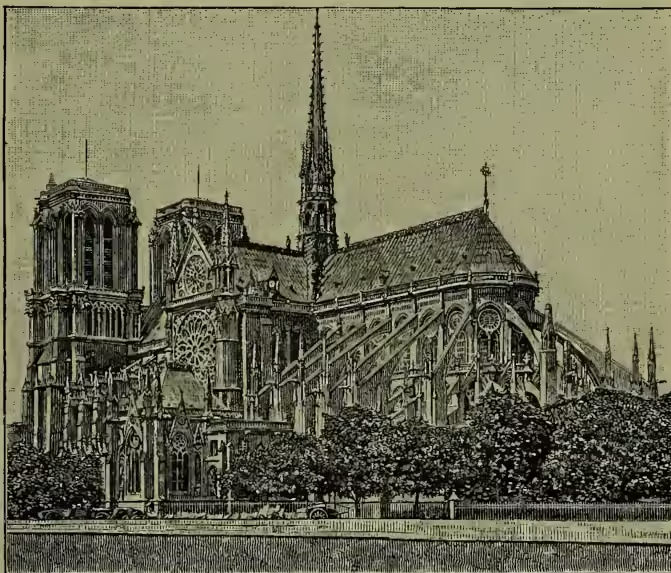
Among the parish churches of Paris (upwards of sixty in number) the grandest and most interesting, from a historical point of view, is the cathedral of Notre Dame, which stands on a site successively occupied by a pagan temple and a Christian basilica of the time of the Merovingian kings. The main building, begun in the 12th century, is 400 feet long, 150 feet wide, and 110 high. The height of two towers is 218 feet, that of the flèche 300 feet. The interior consists of a principal and two flanking naves, which are continued round the choir. It has been said that if the pillars of Notre Dame could speak they might tell the whole history of France. The kings, however, were crowned at Rheims, and the only royal coronation celebrated at Notre Dame was that of Henry VI. of England in 1431. There, too, was sung in 1436 a memorable Te Deum when Paris was retaken by the troops of Charles VII. During the French Revolution the church was mutilated in order to destroy what were supposed erroneously to be emblems of royalty. In 1793, after childish and repulsive mockeries of the ceremonies of the Roman Catholic Church, it was converted into a 'temple of reason.' In 1804 Napoleon I. at the height of his power resolved to impress Europe by an imposing ceremony—that of his coronation—in Notre Dame; and there it was that he, in presence of the pope, who never before had crossed the Alps at the bidding of king or emperor, rudely placed the crown upon his own head. In 1831 the novel of Victor Hugo, Notre Dame, made the church interesting to all Europe. In France there was a general desire for its restoration, and in 1845 this great work was undertaken by the state. Viollet-le-Duc added to the building the great flèche, a structure of oak and lead; and under the care of some of the ablest architects of France the church was converted into what is now described in Paris as the noblest of Gothic buildings. The Sainte Chapelle, built by St Louis in 1245-48, for the reception of the various relics which he had brought from the Holy Land, is perhaps the greatest existing masterpiece of Gothic art. Restored by Napoleon III. at a cost of £50,000, it was threatened by the Commune, but saved. One of the most interesting churches in Paris is St Séverin, buried in narrow streets of the Quartier Latin. A large part of it is in the English Gothic of the 15th century, showing that it was erected during the English occupation of Paris. St-Germain-des-Prés, which is probably the most ancient church in Paris, was completed in 1163; St Etienne du Mont and St Germain l'Auxerrois, both ancient, are interesting—the former for its picturesque and quaint decorations, and for containing the tomb of St Geneviève (q.v.), the patron saint of Paris; and the latter for its rich decorations and the frescoed portal, restored at the wish of Margaret of Valois. Among modern churches is the Madeleine (1806-42), built in the style of a Corinthian temple, and originally intended by Napoleon I. to be a monument to the Grande Armée. It forms an oblong building, 328 feet long by 138 wide, independently of the flights of steps. The height of the columns is 62 feet, that of the entablature 14 feet, and the entire height from the ground 116 feet. There are in all fifty-two columns. The roof is of iron and copper. The interior is elaborately decorated with gold, white marble, paintings, and sculptures; but in spite of their religious subjects the building still produces on northern eyes the impression of a pagan temple rather than of a Christian church. The Panthéon (1764) was begun as a church, but converted by the Constituent Assembly of republican France into a temple dedicated to the great men of the nation, next restored to the church by Napoleon III. and rededicated to St Geneviève, but once more, on the occasion of the funeral of Victor Hugo (1885), reconverted into a monument, with the old inscription 'Aux grands hommes la patrie reconnaissante.' The Panthéon has been spoken of as rivaling St Peter's at Rome and St Paul's in London. The frescoes of the interior are very fine. In the crypt are the tombs of Voltaire, Rousseau, and Victor Hugo. Notre Dame de Lorette, erected in 1823, is a flagrant specimen of the meretricious taste of the day; and St Vincent de Paul, completed in 1844, is somewhat less gaudy and more imposing in style. Among the few Protestant churches, l'Oratoire is the largest and the best known. For the great church of Sacré Cœur at Montmartre, see SACRED HEART.
Paris abounds in places of amusement suited to the tastes and means of every class. It has upwards of forty theatres. The leading houses are the Opéra, the Théâtre Français—chiefly devoted to classical French drama—the Opera Comique, and the Odéon, which receive a subvention from government. The new opera-house, completed in 1875, is one of the most magnificent buildings of this century, costing, exclusive of the site, £1,120,000. Cheap concerts, equestrian performances, and public balls, held in the open air in summer, supply a constant round of gaiety to the burgher and working classes at a moderate cost, and form a characteristic feature of Paris life; while, in addition to the noble gardens of the various imperial palaces, the most densely-crowded parts of the city have public gardens, shaded by trees and adorned with fountains and statues, which afford the means of health and recreation to the poor. Beyond the fortifications at the west of Paris is the Bois de Boulogne, converted by Napoleon III. from a wood covered with stunted trees into one of the most beautiful gardens in Europe. It takes the place of the London parks for the fashionable world of Paris. East of Paris is the Bois de Vincennes, an admirable recreation ground for the working-classes.
Paris has three large and twelve lesser cemeteries, of which the principal one is Père-la-Chaise (see LACHAISE), extending over 200 acres, and filled in every part with monuments erected to the memory of the countless number of celebrated persons buried there. The Morgue (q.v.) at the upper end of the Île-de-la-Cité is a building in which the bodies of unknown persons found in the Seine are placed temporarily for recognition. The southern parts of Paris are built over beds of limestone, which have been so extensively quarried as to have become a network of vast caverns. These quarries were first converted in 1784 into catacombs, in which are deposited the bones of the dead, collected from the ancient cemeteries of Paris.
It has been frequently remarked that Paris contains few important civil buildings of the middle ages, which is to some extent due to the reckless way in which improvements have been carried out. What Paris has lost in picturesque interest and architectural variety from this cause was brought home to all by the large imitations of the Tour de Nesle and other buildings erected for the exhibition of 1889. A government commission now watches over the historic monuments of Paris, so that further destruction is checked. Two most interesting civil buildings of the 15th century still exist. One is the Hôtel de Cluny (see CLUGNY), one of the finest existing monuments of the Gothic Flamboyant style. The other is the Hôtel de Sens, the old palace of the archbishops of Sens, formerly metropolitans of Paris. It is unfortunately buried among narrow streets north of the Seine and opposite the Cité. In 1890 its most interesting part was advertised 'to let for business purposes.' It had been last used as a sugar-refinery.
The Louvre, the greatest of the modern palaces of Paris, forming a square of 576 feet by 538 feet, was erected on the site of an old castle of the 13th century (see below). The first part, the south-west wing, was erected in 1541 on the plans of Pierre Lescault. It remains a masterpiece of architectural design and monumental sculpture. The principal portion of the great square was completed under Louis XIV. in the latter part of the 17th century, the physician Claud Perrault being the architect. The colonnade of the eastern façade is more admired than any other part of the building.
The Palace of the Tuileries was begun in 1566 by Catharine de Medicis, and enlarged by successive monarchs, while used as a royal residence, until it formed a structure nearly a quarter of a mile in length, running at right angles to the Seine. It was connected with the Louvre, which lay to the west, by a great picture-gallery overlooking the Seine, and 1456 feet in length. North of the picture-gallery, and between the two palaces, lay the Place du Carrousel, in the midst of the most magnificent palatial structure in the world. The Tuileries continued to be occupied as the residence of the imperial family; but the Louvre proper formed a series of great galleries filled with pictures, sculptures, and collections of Egyptian, Greek, and Roman antiquities. The Commune attempted to burn the whole pile, but only succeeded in destroying the Tuileries and a corner of the Louvre. The Place du Carrousel enclosed between them and the Louvre is now thrown into the great line of gardens stretching west to the Arc de l'Étoile. In the midst of the old palaces a statue of Gambetta, surrounded by allegorical figures, has been erected. North of the Louvre is the Palais Royal. It forms a mass of buildings, including the old palace of the Orleans family, the Théâtre Français, and a quadrangle of shops, restaurants, and cafés, enclosing a large park or garden open to the public, 700 feet long by 300 feet wide. With its avenues and parterres it was long one of the liveliest and most frequented spots in Paris. Its cafés had a world-wide reputation, which has faded, however, since the great improvements of Napoleon III. sent the current of life into other quarters. The most valuable part of the palace, fronting the Rue St Honoré, was set fire to by order of the Commune in 1871. The Palace of the Luxembourg, on the south side of the Seine, was built by Marie de Medicis in the Florentine style. It contains many magnificent rooms, and in 1879 became the meeting-place of the French senate. Close to it a gallery has been constructed for the reception of the works of living artists acquired by the state. On the north bank of the Seine, opposite the Island of the Cité, stands the Hôtel de Ville. It was burned by the Commune, but has been rebuilt and restored in the style of its predecessor, and is now one of the finest buildings in Paris. On the Island of the Cité stands the Palais de Justice, a vast pile, also set fire to by the Commune; some parts of it date from the 14th century, and others are modern. It is the seat of some of the courts of law, as the Courts of Cassation, of Appeal, and of Police. Within the precincts of this palace are the Sainte Chapelle, and the noted old prison of the Conciergerie, in which Marie Antoinette, Danton, and Robespierre were successively confined.
The Conciergerie, just mentioned, in which prisoners are lodged pending their trial, constitutes one of the eight prisons of Paris, of which the principal is La Force. The Nouveau Bicêtre is designed for convicts sentenced to penal servitude for life; St Pélagie receives political offenders, St Lazare is exclusively for women, the Madelonnettes for juvenile criminals, and Clichy for debtors.
The number of benevolent institutions is enormous. The largest of the numerous hospices or almshouses is La Salpêtrière, probably the largest asylum in the world, extending over 78 acres of land, and appropriated solely to old women; Bicêtre receives only men. The Hospice des Enfants Trouvés, or Foundling Hospital (q.v.), provides for the infants brought to it till they reach the age of maturity, and only demands payment in the event of a child being reclaimed. The Crèches (q.v.) receive the infants of poor women for the day at the cost of 20 centimes. Besides institutions for the blind, deaf and dumb, convalescents, sick children, &c., Paris has many general and special hospitals. Of these the oldest and most noted are the Hôtel Dieu, La Charité, and La Pitié.
The chief institutions connected with the University of France, and with education generally, are still situated in the Quartier Latin. The Sorbonne (q.v.), the seat of the Paris faculties of letters, science, and Protestant theology, has been rebuilt and increased in size. The new building was opened in 1889, when it was announced that a complete re-organisation of the university system of France was contemplated (see UNIVERSITY). The Sorbonne contains lecture-halls and class-rooms, and an extensive library open to the public. There gratuitous lectures are given, and degrees are granted by the University of France. Near the Sorbonne is the Collège de France, where gratuitous lectures are also delivered by eminent scholars and men of letters, as well as a large number of colleges and lycées, the great public schools of France for secondary instruction. Most of them have been recently rebuilt, filling the Quartier Latin with huge barrack-like buildings. The Scotch College stands as it did in the 17th century, five stories high, with eleven windows in a row, a good specimen of the old Paris colleges. At present, owing to the war between the republic and the Roman Catholic Church, the schools of the latter are independent of the university, and there is no faculty of Roman Catholic theology at the Sorbonne. The Ecole Polytechnique, the School of Medicine and the School of Law, the Observatory, and the Jardin des Plantes, with its great museums of natural history, partly rebuilt on a grand scale and opened in 1889, lecture-rooms, and botanical and zoological gardens are situated in the same quarter of Paris. The principal of the public libraries are those of the Rue Richelieu, now called the Bibliothèque Nationale (see LIBRARY), which originated in a small collection of books placed by Louis XI. in the Louvre. It is rivalled only by the British Museum in the number of its books and manuscripts, but its usefulness is impaired by the want of a proper cata- logue, which makes its treasures less accessible than they should be.
No city on this side of the Alps is richer than Paris in fine-art collections, and among these the museums at the Louvre stand pre-eminent. Among its chief treasures may be mentioned, in the museum of antique sculptures, the famous Venus of Milo, and in the Salon Carré the great works of the Italian, Flemish, and Spanish masters. It is impossible to do more than refer to the long succession of galleries in which are exhibited Egyptian, Assyrian, Elamitic, Greek, Roman, medieval, and Renaissance relics and works of art. The Musée Carnavalet or historical museum of the city of Paris has been specially devoted to the collection of everything interesting connected with the municipality. On the demolition of the old houses many objects were found which formed the nucleus of the collection, which is constantly receiving large additions which make it one of the most interesting of the Paris museums. The Palais des Beaux-Arts is used as an exhibition of art, manufactures, and architectural models. The Hôtel de Cluny, connected underground with the Palais des Thermes, contains curious relics of the arts and usages of the French people, from the earliest ages of their history to the Renaissance period. The potteries, sculptures, paintings, arms, furniture, and tapestries of the middle ages and of the 16th and 17th centuries are of the highest historical interest and value. The Museum of Artillery at the Hôtel des Invalides is devoted to arms and armour, flags and war dresses. The Musée Guimet, or 'National Museum of Religions,' includes objects used in religious ceremonies, savage, Indian, Chinese, &c. The Mint deserves notice for the perfection of its machinery; and the Gobelins (q.v.), or tapestry manufactory, may be included under the fine arts, as the productions of its looms are all manual, and demand great artistic skill. The Conservatoire des Arts et Métiers, in the Rue St Martin, contains a great collection of models of machinery, and class-rooms for the instruction of workmen in all departments of applied science. The great Paris exhibitions have all left behind them important buildings. The Palace of Industry, built in 1854, now forms a permanent exhibition. The spacious building in which the exhibition of 1878 took place was named Palace of the Trocadéro, and is now used for musical entertainments and as an architectural and ethnological museum. For the exhibition of 1889 was erected one of the most striking monuments of modern Paris, the Eiffel (q.v.) Tower.
Paris was surrounded, under Louis-Philippe, with fortifications costing £5,500,000 sterling, and, in addition to these, a large number of detached forts have since been erected. The walls, 37,000 yards in length, are penetrated by sixty-nine openings, fifty-six for gates, nine for railways, two for the canals of St Denis and the Ourq. Through the two remaining breaks passes the Seine. At the gates are paid the octroi or town dues, a large source of revenue to the city of Paris. On the left bank of the Seine is the Ecole Militaire, founded in 1752, and used as barracks for infantry and cavalry; it can accommodate 10,000 men and 800 horses. Near it is the Hôtel des Invalides, founded in 1670 for disabled soldiers. The crypt of the church contains the sarcophagus, hewn from a huge block of Russian granite, in which lie the remains of Napoleon, deposited there in 1840.
Paris is divided into twenty arrondissements. The prefect of the Seine is the chief of the municipal government, and is appointed by the government. There is a large municipal council, chosen by popular election. Each arrondissement has a maire and two assistant-councillors. The prefect of police is at the head of the civic guard or gens-darmes, the fire-brigade, and the sergeants de ville or city police, who are armed with swords. The cleaning, sewerage, and water-supplies of Paris are under the charge of the prefect. Paris is now abundantly supplied with pure and wholesome water; and the sewers have been greatly extended with the street improvements. The same may be said in regard to the paving of the city, and the street-lighting by gas and electricity. In 1818 public slaughter-houses, or abattoirs, were established at different suburbs, where alone animals are allowed to be slaughtered. Large cattle-markets are held near the licensed abattoirs. There are in the heart of the city numerous halles, or wholesale, and marchés, or retail markets. The principal of these is the Halles Centrales, near the church of St Eustache, covering nearly 20 acres.
History.—The earliest notice of Paris occurs in Cæsar's Commentaries, in which it is described, under the name of Lutetia, as a collection of mud huts, composing the chief settlement of the Parisii, a Gallic tribe, conquered by the Romans. Lutetia soon acquired great strategic importance, due to its lines of defence—the windings and marshes of the Seine and Marne to the east and west, and the forest-clad hills on the north and south. It lay midway between the chief enemies of Rome in Gaul, the Germans on the east and the unsubdued Celts of Armorica on the west. In 53 B.C., accordingly, Cæsar assembled there the delegates of the Gallic tribes, and it became an important Roman town. Two ruins of this period remain south of the Seine. One formed part of the Palais des Thermes, the abode of the Roman governors of Lutetia and afterwards of the Merovingian kings of France. The other ruin is that of the arènes or amphitheatre of the Roman city. The foundations and parts of the old wall were discovered in 1870, and since then excavations have laid them bare. In 1891 they were enclosed in a small park and thrown open to the public. The amphitheatre was 180 feet long by 153 feet wide. It is estimated that it could contain 10,000 spectators of the gladiatorial shows. Lutetia began in the 4th century to be known as Parisia, or Paris. In the 6th century Paris was chosen by Clovis as the seat of government; and after having fallen into decay under the Carolingian kings, who made Aix-la-Chapelle their capital, and in whose time it suffered severely from frequent invasions of the Northmen, it finally became in the 10th century the residence of Hugh Capet, and the capital of the French monarchy. From this period Paris continued rapidly to increase, and in two centuries it had doubled in size and population. The reign of Philippe-Auguste (1180–1223) is the great epoch in the mediæval history of Paris. It was then that were erected masterpieces of Gothic art, including the nave, the choir, and the chief façade of Notre Dame and the Sainte Chapelle. Then was founded the University of Paris, the great theological school of the middle ages, wielding a power over the church second only to that of Rome, and attracting from all parts of western Europe vast crowds of students, who, on returning to their homes, spread abroad a knowledge of the art and culture of Paris. Philippe-Auguste built a crenelated wall and flanking towers, one of which, the Tour de Nesle (q.v.), stood on the site of the Palace of the Institute. Outside the wall he erected the castle of the Louvre on the site of the present palace. It became the centre and stronghold of feudalism and the citadel of Paris, which was now, after Constantinople, the greatest city of Europe. In the 16th century the castle was still used as a royal residence, but after the reception of Charles V. there by Francis I. it was pulled down to make way for the new palace. Luckily the walls were not levelled to their foundations. A few years ago they were discovered to exist. Galleries have been excavated, and extensive ruins have been laid bare, which now form the most interesting sight of underground Paris.
In the middle ages Paris was divided into three distinct parts—the Cité, on the islands; the Ville, on the right bank; and the Quartier Latin, or University, on the left bank of the river, and on the Montagne St Geneviève. In 1358 broke out the first of the long series of Paris revolutions. It was headed by Étienne Marcel, the famous provost of the Paris merchants, who for a time ably ruled the town. Louis XI. did much to enlarge Paris and to efface the disastrous results of its hostile occupation by the English during the wars under Henry V. and Henry VI. of England; but its progress was again checked during the wars of the last of the Valois, when the city had to sustain several sieges. On the accession of Henri IV. of Navarre, in 1589, a new era was opened for Paris. The improvements commenced in his reign were continued under the minority of his son, Louis XIII. Louis XIV. converted the old ramparts into public walks or boulevards, organised a regular system of police, established drainage and sewerage works, founded hospitals, almshouses, public schools, scientific societies, and a library, and thus renewed the claim of Paris to be regarded as the focus of European civilisation.
The terrible days of the Revolution caused a temporary reaction; but the improvement of Paris was recommenced on a new and grander scale under the first Napoleon, when new quays, bridges, markets, streets, squares, and public gardens were created. All the treasures of art and science which conquest placed in his power were applied to the embellishment of Paris, in the restoration of which he spent more than £4,000,000 sterling in twelve years. His downfall again arrested progress, and in many respects Paris fell behind other European cities. Renovation was recommenced under Louis-Philippe; but as lately as 1834 much of the old style of things remained; the gutters ran down the middle of the streets, there was little underground drainage from the houses, oil-lamps were suspended on cords over the middle of the thoroughfares, and, except in one or two streets, there were no side-pavements. It was reserved for Napoleon III. to reconstruct Paris. When he commenced his improvements Paris still consisted, in the main, of a labyrinth of narrow, dark, and ill-ventilated streets. He resolved to pierce broad and straight thoroughfares through the midst of these—thus putting an end to the possibility of forming barricades—to preserve and connect all the finest existing squares and boulevards, especially those surrounding the monuments of the Bonaparte family, and, in lieu of the old houses pulled down in the heart of the town, to construct, in a ring outside of it, a new city in the most approved style of modern architecture. With the assistance of Baron Haussmann (q.v.), the Prefect of the Seine, his schemes were carried out with rare energy and good taste. With a fresh supply of water, trees, parterres, and fountains were introduced everywhere, and Paris ceased to produce on visitors the impression that it stands in the midst of a chalky desert. It was converted into one of the greenest and shadiest of modern cities. Two straight and wide thoroughfares, parallel to and near each other, crossed the whole width of Paris from north to south through the Cité; a still greater thoroughfare was made to run the whole length of the town, north of the Seine, from east to west. The old boulevards were completed so as to form outer and inner circles of spacious streets—the former chiefly lying along the outskirts of the old city, the latter passing through and connecting a long line of distant suburbs. In the year 1867, when the international exhibition was opened, Paris had become in all respects the most splendid city in Europe. Many further improvements were then contemplated. Financial and political difficulties were, however, at hand (see FRANCE), and these schemes had to be postponed. The siege of Paris by the Germans, which lasted from 19th September 1870 to 28th January 1871, caused much less injury to the city than might have been expected—it was reserved for a section of the Parisian population to commit an act of vandalism without a parallel in modern times. On the 18th of March the Red Republicans, who had risen against the government, took possession of Paris. On the 27th March the Commune was declared the only lawful government. Acts of pillage and wanton destruction followed. On the 15th of May the column erected to the memory of Napoleon and the Great Army, in the Place Vendôme, was solemnly pulled down as 'a monument of tyranny.' The government troops under Marshal MacMahon attacked the insurgents, and kept them from doing further mischief. The former succeeded in entering Paris on the 20th of May, and next day the Communists began systematically to set fire with petroleum to a great number of the chief buildings of Paris, public and private. The fire for a time threatened to destroy the whole city. It raged with the greatest fury on the 24th, and was not checked until property had been lost to the value of many millions sterling, and historical monuments were destroyed which never can be replaced. The horror inspired by the Commune for a time drove the wealthy classes from Paris, and it was feared that it would lose its prestige as a European capital. This, however, has not proved to be the case. By the autumn of 1873 all the private houses burned had been rebuilt, the monuments only partially injured had been restored, and the streets and public places were as splendid and gay as in the best days of the empire.
Since the establishment of the republic improvements have been executed little if at all inferior in importance to those of the second empire. New streets have been opened near the Paris Bourse de Commerce and the Post-office; the Champs de Mars, a waste of sand, has been converted into a beautiful garden, in which rises the Eiffel Tower; the museums of the Jardin des Plantes have been rebuilt; the Quartier Latin has been covered with educational buildings. In 1890-91 two great undertakings were mooted—a system of metropolitan railways to connect the great Paris stations with the heart of the city, and the conversion of Paris into a seaport by the deepening of the Seine, or the construction of a ship-canal to the Channel. The magnificent International Exhibition of 1900 did not attract the vast crowds for whom preparations had been made, and was not financially as successful as was hoped.
Somewhat conflicting opinions are expressed on the part Paris has played in the history of the world. After Athens and Rome, says one writer, it is the city that has made the deepest impression on men's minds. Paris, says another, has carried the torch of life and civilisation from century to century, and done most to spread culture and enlightenment throughout the globe. At this moment, says a third, the inhabitants are the best fed and best clad, the best educated of city populations. These views are generally accepted in France. There is, however, a reverse to the picture. The Parisians are declared to be a feeble people, dying out, and constantly recruited by immigration from Belgium, Alsace, Switzerland, and Italy. Paris is a modern Babylon; its domestic life, described in French novels, is a centre of corruption for Europe. There has been, no doubt, truth in all these views at different periods of the history of Paris. Certain it is, however, that in England it is too often forgotten that in Paris drunkenness is almost unknown, that among a large section of the population there has always been a pure domestic life, and that the profligacy of the second empire has now ceased to exist.
See the guidebooks of Murray, Baedeker, Joanne, and topographical works by Du Camp (7th ed. 6 vols. 1884), Colin (1885), Pontich (1884), and the official Annuaire Statistique (since 1883); G. A. Sala, Paris Herself Again (1879); P. G. Hamerton, Paris in Old and Present Times (1884; new ed. 1892); Piton, Comment Paris s'est Transformed; Histoire, Topographie, &c. (1891); Paris Guide par les principaux Ecrivains et Artistes de la France (introd. by Victor Hugo, and parts by Michelet, Louis Blanc, Renan, Sainte-Beuve, Taine, Quinet, Viollet-le-Duc, &c. (2 vols. 1867-68); Hoffbauer, Paris à travers les Âges (1890 et seq.); Lebeuf, Histoire de la Ville et de la Diocèse de Paris (15 vols. 1754; new ed. by Cocheris, 4 vols. 1863); Dulaure, Histoire Civile, Physique, et Morale de Paris (7 vols. 1821; new ed. by Leynadier, 1874); histories by De Gaulle (1840), Gabourd (1863-65), Arago (Paris Moderne, 2d ed. 1867); and the copious Histoire Générale de la Ville de Paris, issued, since 1866, by the municipal authorities; also histories of the university, in the middle ages by Budinssky (Berlin, 1876), and in the 17th and 18th centuries by Jourdain (Paris, 1862-66). Some account of the siege of Paris in 1870-71 is given at FRANCE, Vol. IV, p. 783. See also Du Camp, Les Convulsions de Paris (1875-79); Morin, Histoire Critique de la Commune (1871); Vinoy, Siege de Paris (1872); Viollet-le-Duc, La Defense de Paris (1872); books by Grant Allen (1897), Belloc (1900), Macdonald (1900), Whiteing (1900); see Lacombe, Bibliographie de Paris (1886).
DECLARATION OF PARIS.—In 1856 the representatives of the Powers agreed to four points in International Law (q.v.)—viz. (1) Privateering is abolished; (2) the neutral flag covers enemies' goods, excepting Contraband of War (q.v.); (3) neutral goods, with the same exception, are not liable to be seized even under an enemy's flag; (4) blockades, in order to be binding, must be effective. The United States refused to accept the first point, because the European powers declined to affirm that thereafter all private property should be exempted from capture by slips of war. See NEUTRALITY.
TREATIES OF PARIS.—The Peace of Paris of 1763 terminated the Seven Years' War (q.v.); fixed the territorial relations of Germany, France, and Spain; gave to England the French colonies in America; and rearranged the possessions of France and England in the West Indies, India, and Africa. The Treaty of 1814, concluded by the Allies soon after the abdication of Napoleon, reduced France substantially to its old limits. That of 1815, after Waterloo, did so more completely, levied a heavy contribution towards the war expenses, and reconstituted the map of Europe on the old lines. The Treaty of 1856 concluded the Crimean War (q.v.). A Treaty of 1857 arranged relations between Britain and Persia.