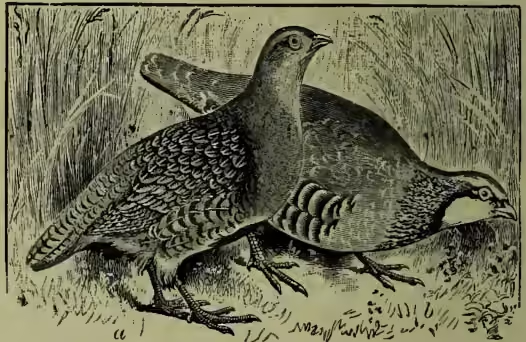
Partridge (Perdix), a genus of gallinaceous birds, of the family Tetraonidae, having a short, strong bill, naked at the base; the upper mandible convex, bent down at the tip; the wings and tail short; the tarsi as well as the toes naked, the tarsi not spurred. The Common Partridge or Gray Partridge (P. cinerea) is the most plentiful of all game-birds in Britain, and becomes increasingly plentiful as cultivation is extended, whilst the range of the moorfowl is restricted. Hence it has greatly increased during the 19th century in Britain, and, though not preserved to the same extent as are pheasants, it affords considerable sport. It is not found in the Outer Hebrides. On the continent of Europe it is abundant in almost all districts suitable to its habits, from Scandinavia to the Mediterranean, and is found also in the north of Africa, and in some parts of the west of Asia. It varies considerably in size, those found in rich arable lands being generally the largest, and about 12½ inches in entire length, whilst those which inhabit poorer and more upland districts, or where heather abounds, are rather smaller. The female is rather smaller than the male. The upper parts of both are ash-gray, finely varied with brown and black; the male has a deep chestnut crescent-shaped spot on the breast, which is almost or altogether wanting in the female. A variety called the Mountain Partridge has the plumage brown. The Partridge is seldom found far from cultivated land. It feeds on grain and other seeds, insects and their larvæ and pupæ; and the pupæ of ants are generally the food sought at first for the young. The nest is usually on the ground, among brushwood and long grass, or in fields of clover or corn, and generally contains from twelve to twenty eggs. The young run as soon as they are hatched. Both parents show a very strong attachment to their young, and great courage in repelling assailants; they have also recourse, like many other birds, to stratagem to draw off the most powerful and dangerous enemies, such as dogs, in another direction, fluttering close before them as if broken-winged, whilst the brood escape. Until the end of autumn the parent birds and their brood keep together in a covey; late in the season several coveys often unite into a pack, when it becomes much more difficult for the sportsman to approach them. The flight of the partridge is strong and rapid for a short distance, but it does not seem to be capable of a long-sustained flight. The eggs of partridges are often hatched, and the young birds reared, by the domestic hen, the chief requisite being a plentiful supply of ants when the birds are very young. Partridges thus reared become very tame, but they seldom breed in the aviary.
The Red-legged Partridge (P. rufa or Caccabis rufa, the genus or sub-genus Caccabis being distinguished by a rudimentary blunt spur on the tarsi) is a native of the south of Europe and of the Channel Islands, often called the French Partridge. It is now also plentiful in some parts of England, particularly Norfolk and Suffolk, into which it has been introduced, and whence it has largely driven out the common breed. It is said to have been brought to England from Guernsey during the reign of Charles II.; and the French Revolution of 1789, with its sudden abolition of the game-laws, is said by Carlyle to have caused 'two signs—emigrant flights of French seigneurs, emigrant winged flights of French game. The red-leg is rather larger than the common partridge, stronger on the wing, and less easily approached by the sportsman, whilst it is also less esteemed for the table. The upper parts are of a reddish-ash colour; the throat and cheeks white, bounded by a collar of black, which expands in black spots on the breast; and the sides exhibit bars of black. The plumage is smooth. Two other species, nearly allied to this, are found in some of the southern parts of Europe, and one of them is found as far east as India. In Africa there is the Barbary Partridge (P. petrosa). The habits of all the species much resemble those of the common partridge, but the P. rufa prefers heavy clay land and heaths, in which respect it greatly differs from the gray partridge.—The name is loosely used for a North American Grouse (q.v.), the Virginian Quail (q.v.), the Tinamou (q.v.), and other birds. See H. A. Macpherson, The Partridge (1893).