Peach (Amygdalus Persica of botanists, but now believed on later showing to be of Chinese origin) belongs to the order of Rosaceæ, and is of the drupaceous subdivision. This, the most delicious fruit that ripens in the open air of Britain, is nearly akin to the almond, resembling it closely in wood, leaves, and blossom, but differing widely in the character of the fruit. In the peach the stone is covered, not with a brittle husk, but a fleshy substance, juicy, melting, and of the finest flavour when matured and mellowed.
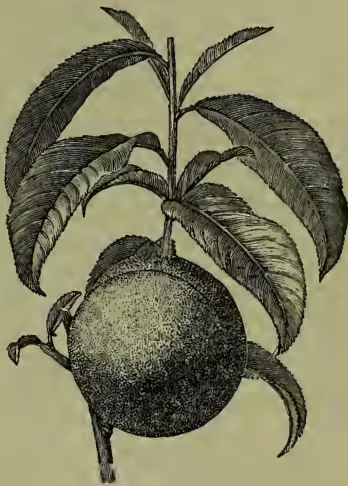
The peach-tree, like the almond, is of moderate stature, more or less spreading, according to variety, deciduous (though some are called evergreen), and, when left to itself, deep-rooted. The leaves (which contain some prussic acid) are lanceolate, on short footstalks, differ much in size, have their edges serate or crenate, and have glands near the stalk, or are glandless. The serrate leaves, as a rule, are glandless; the crenate have glands, and the glands are either globular or reniform. Gardeners know it to be the case, but as yet know not the cause of it, that mildew (both of fruit and leaf) attacks the varieties with glands leaves, while the glandlose have immunity. And for this reason Royal George (one of the finest of peaches, but having boldly serrate leaves without any glands) is seldom planted now against the open wall where mildew has paid one visit. The many varieties of the peach pass into divisions and subdivisions, according to the point regarded. There is first the decisive difference in the clothing, flesh, and flavour of the fruit, which has established the broad distinction between peach and nectarine. A very close observer is the man who can pronounce in winter, unless the trees happen to be his own, which of twain is nectarine, and which is peach. In summer there is a certain difference, perceptible, but not easily described, in the tint and cast of foliage; while the fruit on the other hand leaves no doubt, even from its first appearance, as to its proper title. Tales have been told on good authority as to the co-existence of the bald and the downy, the nectarine and peach, on the self-same twig, and even of a fruit which was peach on one side of the suture and nectarine on the other. To deny what is outside one's own experience, however large that experience may be, proves it capable of increase; but to doubt the adverse instance is permissible. The present writer has grown hundreds of thousands of peaches, and some myriads of nectarines, but has never seen either become the other, though they often grow amicably on the same branch after budding. Peaches and nectarines, while distinguished as above, pass alike into the other three divisions which have been established concerning them—to wit: (a) those which have large and those which have small blossoms; (b) those which have glandless leaves and those whose leaves are glandular; (c) those that have fruit which adheres to the stone and those whose fruit parts freely. Neither of these points affects the other two, and hence arise cross-divisions. (a) As to size of bloom, it is hard to say why, but all known peaches and nectarines have blossom either very conspicuous or almost insignificant. Other fruit trees have blossom larger or middle-sized, or small, according to variety. Some gardeners fancy that the smaller bloom suffers less from the attacks of frost; the larger petals certainly show the nips more sadly, but the internal injury is received in either case. The colour of the blossom ranges from snowy-white to pink and rose (the latter being the most usual tint), and even to bright carmine. (b) The leaves of the peach and nectarine, being as above described, furnish another classification according to the absence or presence of glands, and the form of glands when present. The gland is a small accretion or concretion upon the petiole, or at the base of the leaf itself; sometimes there is one gland at either edge, sometimes two, and at times even three. In form the glands vary from round to reniform; or even lenticular; but their function, if any, is not yet understood. Probably they take no active part, but are merely the tokens of a constitution adverse to fungoid overtures. However that may be, they afford one more division of the peach and nectarine, according as they are glandless or glandulose, the latter subdivided into those which have round and those which are gifted with long glands. (c) Again, the peach and nectarine are palpably divided (according to the inner construction of the fruit) into clingstones (or Pavies) and freestones.
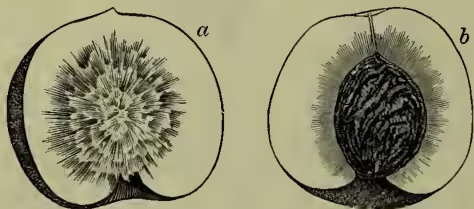
In the former the stone seems to radiate, as it were by tentacles, into the flesh, and the eatable part will not quit hold without great loss of the delicious juice. These peaches are therefore only fit to be sucked, for to quarter them fairly is impossible. And it is a sad indictment against the peaches of America that they belong mainly to the non-secable section. But the freestones, chiefly grown in Europe, part from the stone with little rupture of tissue, and melt in the mouth instead of gushing on the plate. All the above being cross-divisions, the classes of the peach grow manifold; but the cultivation is the same with all. When grown on its own roots or on peach-stock the tree is short-lived, and being treated thus in America is worn out in some twenty-five years. In France it is worked upon the almond or the plum; in England the mussel-stock is the most approved; and upon this it attains the greatest age. But grow it as we may, it is impatient of the knife, and must receive its orders at a very early date. In the southern parts of England both nectarines and peaches ripen well upon the open wall, or even on dwarf standards in fine summers, and fruit so ripened is the best of all; but the summers of recent years have much discouraged our faith in nature, which is now becoming confidence in glass.
Though many good varieties have been added lately by the skill of nurserymen, the older kinds are not yet obsolete; and the chief gain, if any, is in the lengthening of the period when ripe peaches of some sort can be gathered out of doors. American kinds, such as Alexander, Amsden's June, and Waterloo, may ripen on the open wall in July; but like other prematurity are little worth. As yet we find nothing arisen newly to surpass our ancient friends Noblesse, Galande, Grosse Mig- nonne, and the like, well known for many generations, and chiefly of French origin.
[In the United States peaches are grown profitably as far north as 40° N. lat. at least; enormous quantities are sent to the markets, and the fruit, in some form, is brought easily within the reach of all classes. The principal peach-growing states are Delaware, Maryland, Virginia, Pennsylvania, and New Jersey, in this order; but the fruit is also largely cultivated in Georgia, Florida, and Texas for the early market, from near the great lakes all down the Mississippi valley, and in California and Oregon. The canning of peaches is an important industry.]
For description of varieties, see André Leroy's Dictionnaire de Pomologie; R.H.S. Catalogue of Fruits, edited by Thompson; Dr Hogg's Fruit Manual; The Orchardist, by John Scott; The Growth of Fruit under Glass, by Thomson; and the treatises of the late Thomas Rivers.