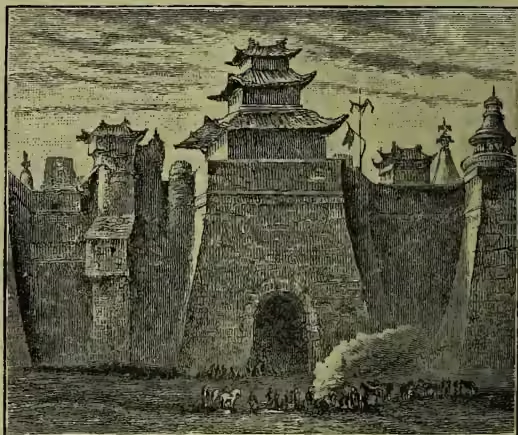
Peking, or, as now often pronounced, PEI-CHING (i.e. 'Northern Capital'), the capital of the Chinese empire, is in 39° 54' 36" N. lat. and 116° 27' E. long. It is situated in a sandy plain, and is surrounded by many-gated walls, with suburbs smaller than most other large cities in the country. The visitor coming to it from Tien-tsin is not prepared for his approach to it by villas and mansions with their parks and gardens, such as greet him in drawing near to the capitals of the West. At a turn in the road the city bursts at once on his view, standing up grand and grim, complete in itself with its lofty walls, and the loftier towers upon them. The city consists, in fact, of two cities—the Inner and the Outer—known also as the Manchu or Tartar and the Chinese, the Northern and the Southern. They are separated by a high wall common to them both, but properly belonging to the former, and giving it the appearance of nearly a square, on which the other partly rests in the form of a rectangle, its southern and northern walls longer than those of the square, but the other two shorter. The walls of the Manchu city average 50 feet in height, and are fully 60 feet wide at the bottom and 40 at the top; the dimensions of those of the Chinese city are less—30 feet in height and 25 and 15 in width. Those of the former measure 14½ miles in circuit, including its part of the cross-wall, and those of the Chinese city 10. Not counting the cross-wall, the whole circuit measures about 21 miles, including altogether an area of nearly 26 sq. m. In all Peking has sixteen gates. Over each is raised a tower about 100 feet high, and of very imposing appearance. All the gates of the Manchu city are guarded by semicircular enceintes, enclosing a yellow-tiled temple to Kwan Ti, a hero of our 2d century, now honoured as the 'god of war.'
When a stranger has entered by a gate of the Northern City, and rides or drives along the cross-wall to its central gate, he is greatly impressed by the magnificence of the walls and towers, and readily believes Peking is the grandest city in the world. Such was the feeling of the writer when he entered it in 1873; after he had passed through the gate, there stretched before him, as far as his eye could reach, a street about 200 feet across, lined with what seemed to be brilliant shops on each side, with wide spaces for foot-passengers, and between them a carriage-way, raised about two feet, on which a constant stream of vehicles, with horses, mules, camels, and donkeys, was hurrying. But by-and-by this impression of the magnificence of the city was displaced by another of the dilapidation and decay, squalor and filth, which everywhere obtruded themselves.
Peking is one of the most ancient cities of the world. On the same site stood the metropolis of the feudal state of Yen, whose history is traceable back to the 12th century B.C. In our 10th and 12th centuries two Tartar tribes which attempted to impose their sovereignty on the empire made the old metropolis of Yen their capital. The second of them, which had absorbed the other, fell before the invading Mongols in the 13th century, and Kublai, a grandson of Genghis Khan, enters the chronological line as sovereign of all China in 1280. He made Peking his capital, and there he was found by Marco Polo, who styles the city Khan-baligh, 'the city of the Khan,' a name frequently corrupted in old narratives into Cambaluc and Cambalu. Within a century the Mongols were driven out of the empire by the Chinese Ming dynasty, the founder of which at first fixed his capital at what we call Nanking (q.v.). The third Ming emperor, called from the name of his reign Yung-lo, on his accession in 1403 made preparations to transfer the seat of government back to the Kublai site. This movement was carried out in 1421. The south wall of the Inner City was carried half a mile beyond that of Kublai; and a later emperor built in 1552 the wall of the Outer City.
However, the Manchus, when they became masters of the empire in 1643, found this great city ready for them. They had only to maintain it in good condition, and for a time they did so; but for more than a century it has been allowed to go very much to decay. As Dr Williams observes, 'Peking stands to-day, like the capitals of the ancient Roman and Byzantine empires, upon the debris of centuries of buildings.' A new era in its history commenced in October 1860, when it was surrendered to the English and French allies, leading to the establishment of the various foreign legations in the Inner City, and to the reception of the ministers, though not in the Forbidden City, in June 1873 by the emperor in person.
The Manchu or Inner City is divided into three portions, the largest of which by far may be called the General City. But at the heart of it are two enclosures, into the innermost of which entrance is entirely forbidden to foreigners, and also to the Manchus and Chinese themselves, excepting such as have some official connection with the court. It is called the Purple Forbidden City, is very nearly 24 miles in circuit, and constitutes in fact the imperial residence. In it are the palaces of the emperor, his empress, and other members of the imperial family. But there are also other palaces and buildings not a few—for instance, several reception halls (tien). The one which a visitor, entering by the 'Meridian Gate,' would first approach is the T'ai Ho, or 'Hall of Grand Harmony,' built of marble on a terrace 20 feet high, and rising itself other 110 feet. Its principal apartment is about 200 feet long and 90 wide, and is furnished with a throne for the emperor, who holds his levées here on New-year's Day, his birthday, and other great occasions. Here, too, is the 'Palace of Heavenly Purity,' where the emperor meets his cabinet at dawn for the transaction of business. In this enclosure also is one of the four great 'arsenals,' or collections of the works arranged in the Chien-lung period for the Great Library; and here was the Wû-ying printing-office, burned down in 1869.
Surrounding the Forbidden City is the 'Imperial' or 'August,' an oblong rectangle, about 6 miles in circuit, and encompassed by a wall 20 feet in height. In the space between the wall on the south and that of the Forbidden City, on the right or east of the avenue from the front gate of the cross-wall, stands the great temple in which the emperor and the members of the imperial clan worship their ancestors. Opposite to it, on the west or the left of the avenue, is the altar to 'the Spirits of the Land and Grain.' In the corresponding space on the north, between the two enclosures, there is an artificial mound 150 feet high, crowned at five different points with as many Buddhist temples, and well wooded all over. It is called the King Shan, loosely translated 'Prospect Hill,' and affords the finest view of the entire city. It is separated from the Forbidden City by a moat, which is crossed by more than one marble bridge. Among the people the common name for it is 'Coal Hill,' their belief being that it was formed by stores of coal, deposited there by way of provision against a siege. The western portion of 'the August City' goes by the name of the Western Park. A principal attraction in it is an artificial lake more than a mile long, though not nearly so wide, fed by a stream brought from the hills to the west of the city, which used also to supply the moat all round the walls. The lake is crossed by a marble bridge of nine arches, and in the proper season its surface is beautiful with the large, brilliant flowers of the lotus. At the south end of the park are the summer-house, the rock-work, the gardens, and the hall for the examination of military candidates, and at the opposite end the copper statue of Maitreya (the coming Buddha, 60 feet high, with one hundred arms), the temple of 'Great Happiness,' the altar and temple dedicated to Yüan Fei (2500 B.C.), the discoverer of the uses of the silkworm, with a plantation of mulberry-trees and a cocoon-house near it. The empress annually comes here with her ladies to offer sacrifice to this Yüan Fei, to feed the silkworms, and to unwind some of the cocoons, as an example to the women of the empire.
We now come to the General City. On either side of the avenue leading from the central gate of the cross-wall to the August City are the principal offices of the government—the six boards and the Censorate. In the same neighbourhood are the observatory, the Provincial Hall for literary examinations, the Colonial Office, and the Han Lin Yüan, which we call the 'National Academy,' and to belong to which is the highest literary distinction in China. Its members are many and of various grades. All the literary work of the government may be said to pass through their hands.
In the north-eastern corner of the city is the Russian mission, and west from it the Yung Ho Kung, or 'Palace of Everlasting Harmony,' a grand lamasery, where more than a thousand Mongol and Tibetan monks dwell, and are provided for, while they study their religion under the rule of a Gegen, or 'living Buddha.' At the north end is a lofty building containing a wooden image of Maitreya, 70 feet high. A little farther to the west stands, amidst many cypresses, the temple of Confucius, under the ancient name of Kwo-tsze Chuen. In the lofty hall are the spirit-tablets of the sage and his most celebrated disciples and followers—nothing else. Close by these rises from a circlet of water the Pi Yung Kung, commonly called 'The Hall of the Classics,' from the most remarkable thing about it—182 pillared slabs of granite, reared up in two corridors, and having the text of all the classical books engraved on them, in front and behind, in large characters.
In the western side of the city are the headquarters of the T'î-tuh, or 'general-in-chief,' who has the control of the police and garrison of the city, and very much directs its civil administration. Here also are the Drum and Bell Towers, both conspicuous objects. Five great bells were cast in the Yung-lo period, early in the 15th century. One of them is here, another about 2 miles in a north-west direction from the city, in 'The Great Bell Temple.' It is indeed a monster, 14 feet high, 34 feet in circumference at the rim, and 9 inches thick, and is said to weigh 120,000 lb. (see BELL). It is covered, inside and out, with myriads of Chinese characters, from the Fah Hwa and Ling Yen, two Buddhist sutras.
Going towards the south wall, we note two great structures on our way. One is the Ti Wang Miao, or 'Temple of Emperors and Kings,' where the reigning emperor goes to worship the spirits of nearly two hundred sovereigns, who have ruled from Fú-hsi (at least 3000 years B.C.) down to the present dynasty, and with them are associated the spirits of the ablest and best of their ministers. The other structure is the great Tutelary (wall and moat) Temple of the capital, grimy, and full of fortune-tellers and other quacks, like the corresponding temples throughout the country. All the foreign legations and all the Christian missions are situated within the Inner City; conspicuous among the latter is the new Roman Catholic cathedral, a magnificent structure, completed in 1888.
The Chinese or Outer City is very sparsely populated. Much of the ground is under cultivation, large tracts are wooded, green fields show themselves, and other open spaces are occupied with artificial lakes and tanks. Where it is built over, the streets are for the most part narrow, and the people are busy and bustling. There are club-houses not a few, various temples, and charitable institutions for the poor, the aged, and for children, the latter in the shape of founding hospitals, as in the Inner City. The Tien Tan, or 'Altar to Heaven,' with its adjunct the Ch'i Kú Tan, or 'Altar of Prayer for Grain,' and the 'Altar of Agriculture,' dedicated to the ancient sovereign, Shán Nung, to whom the first teaching of husbandry (about 3000 B.C.) is ascribed, are both near the southern wall, and are reached by a 'great street,' or avenue. The first two altars are enclosed by more than three miles of wall, the space within planted with forest trees. Within a second wall is a grove of fine cypresses encompassing the buildings. The 'Altar to Heaven' stands on a splendid triple circular terrace of white marble, with steps leading from one terrace to the next, each being surrounded by a balustrade of the same marble, richly carved. On the upper terrace, which is 30 feet in diameter and about 20 feet above the ground, the emperor appears to greet the dawning sun on the day of the winter solstice, attended by his grandees and ministers. He has passed the night in the 'Fasting Palace,' which is not far off, in religious vigil. His own place at the altar, where he stands and kneels, is a large circular slab, unflawed and unstained. In front of him is a pavilion containing the tablet for the spirit of Shang-Ti, or God, and on either side, in smaller pavilions, are the tablets of his own ancestral line. The religious service that is then celebrated has been performed from time immemorial. The 'Altar of Prayer for Grain,' a similar structure, but of less dimensions, was burned down on 18th September 1889; on its upper terrace there was a triple-roofed circular building, the imposing appearance of which with the splendour of its blue tiles made it be regarded as more important than the other altar and be commonly, though erroneously, styled by foreign visitors 'The Temple of Heaven.' To this altar the emperor comes in the early spring to pray for a blessing on the labours of the year. Here also he repairs in seasons of drought to pray for rain, but without any pomp of state. He must plod his way on foot to the 'fasting place,' and there brood over his own sins and errors of government before he dares to ascend the altar. A short distance to the east stands 'the Altar of Agriculture,' in an enclosure about two miles in circumference. This contains four different altars—to the Spirits of the Sky, of the Earth, of the planet
Jupiter, and of the old Shán Nung. But all these spirits are honoured and sacrificed to, not as independent powers, but as 'servants of Shang-Ti,' doing his will for the good of men. The planet has an altar because of the connection which the period of its revolution has with the sexagenary cycle. The chief attraction of the spot is the ceremony of ploughing which takes place there in the spring. The emperor comes to it attended by certain of his great officials, and turns up a few furrows in a portion set apart for him, as an example of agricultural industry to all his people. Some of the provincial magistrates have portions assigned to them for the same purpose. The ceremony is copied and grotesquely performed by the authorities throughout the country. The principal streets of the Chinese city are more than 100 feet wide, but the side streets are mere lanes. The streets are not usually paved, and according to the state of the weather are deep in mud or in dust. In the smaller streets the houses are miserable shanties; in the main streets both private houses and shops are one-story brick edifices, the shops being gay with paint and gilding. The shops are open in front, the goods being often piled up outside; and many trades are carried on in the streets or in tents and movable shops.
Amongst places of interest to visitors are also the various government offices, the old offices for entertaining foreign embassies, and the legations where since 1861 the foreign ministers accredited to China actually reside. There are three Catholic cemeteries (Portuguese, French, and native) and a Russian one; and there are mission buildings, Russian and other, and hospitals. Free schools are not infrequent in the city. The climate of Peking is severe, the temperature in winter being from 25° to 10° F., and in summer the heat is great, the thermometer rising to 105°, though the usual summer temperature is 75° to 90°.
As to the population of Peking, Du Halde estimated it at about three millions two hundred years ago. The writer's impression is that in the last quarter of the 19th century it was under a million. No doubt it has fluctuated considerably with the fortunes of the dynasty. Dr Williams, after living in the city for years and being charged d'affaires of the American legation, says that the residents most likely to form a correct judgment put down the entire population at a million or somewhat less. 'No census returns,' he adds, 'are available to prove this figure, nor can it be stated what is the proportion of Manchus, Mongols, and Chinese, except that the last outnumber both the others.'
During the crisis in the history of the empire to which the Japanese war of 1894-95 led, Peking has witnessed various coups d'état, and was a centre of intrigue on the part of the European powers, vast railway schemes being eagerly promoted in the various competing interests. The railway from Peking to Tien-tsin (73 miles) was opened in 1897; and the lines for which, in the scramble of 1898-99, concessions were granted connect Peking with Hankow and Canton, and with the Manchurian and Siberian systems. The Chinese telegraphs were connected with Siberian lines, and so with Europe, in 1892. The events of 1900 have been recorded at CHINA, Vol. III. p. 194—the 'Boxer' troubles, the eight weeks' siege of the legations, the expedition of the European and other allies, the withdrawal of the court to Singanfoo, the relief of the legations by the entry of the allies on 14th August, the occupation of the 'Forbidden City,' and the tedious and protracted peace negotiations.
Though great Asian trade routes to Kulja and Semiretchinsk start from Peking, the commerce of the city itself is inconsiderable; provisions are very dear, and many of the people are very poor and miserable. The manufactures are unimportant. The government of the city is distinct from that of the department, and is administered by a superintendent (a high imperial functionary), a mayor, and officers in the several quarters. The police have often trouble in keeping order; some 10,000 soldiers or militia are quartered in the town. The daily Peking Gazette, a pamphlet of sixty to seventy pages, is the imperial official journal. Since 1868 there has been an imperial university with American and European professors.
As to the reproach of infanticide which has been current against the population, Dr Edkins says: 'Infanticide is almost unknown in Peking. The dead-cart which traverses the streets at early morning receives the bodies of poor children dying by ordinary causes and whose parents are not able to bury them. The mothers would rather, if not willing to keep their infants, carry them to the foundling hospitals, which are established in the Inner and Outer Cities, than take their lives. At present the people are not aware of the existence of infanticide, nor is this atrocious custom known in the surrounding country; indeed, it exists only in some provinces, four or five in number. The dead-cart is in connection with the foundling hospitals.'
See Rennie's Peking and the Pekinese (1865); Williamson's Journeys in North China, especially chapter xvi., which was contributed by Dr Edkins (1870); Martin's Chinese: their Education, Philosophy, and Letters (1881); Williams's The Middle Kingdom (revised ed. 1883); and other works cited under CHINA.