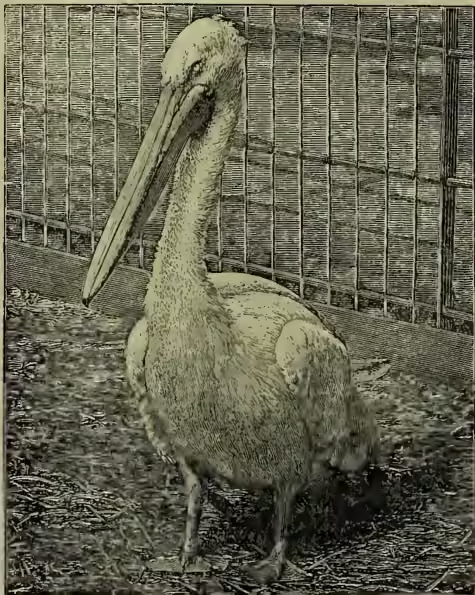
Pelican (Pelecanus), a genus of birds comprising a family, Pelecanidae, having a very long, large, flattened bill, the upper mandible terminated by a strong hook, which curves over the tip of the lower one; beneath the lower mandible a great pouch of naked skin is appended; the tongue is very short, and almost rudimentary; the face and throat are naked, the wings of moderate length, the tail rounded. The species are widely distributed, frequenting the shores of the sea, lakes, and rivers, and feeding chiefly on fish. Although birds of powerful wing, they are seldom seen at a great distance from land. All of them are birds of large size. They take their prey by hovering over the water, and plunging upon it when it appears. They often fly in large flocks, and the sudden swoop of a flock of pelicans at a shoal of fish is a striking and beautiful sight. They store up their prey in their pouch, from which they bring it out at leisure, either for their own eating or to feed their young. The pouch is capable of being wrinkled up into small size, and of being greatly distended. The Common Pelican (P. onocrotalus) is as large as a swan, white, slightly tinged with flesh colour, and, in old birds, the breast golden yellow. The quill-feathers are black, but are scarcely seen except when the wings are expanded. It is a native of the eastern parts of Europe and of many parts of Asia and Africa, and frequents both the seacoast and also rivers and lakes. It makes a nest of grass on the ground in some retired spot near the water, often on an island, and lays two or three white eggs. The parents are said to carry water to their young, as well as food, in their pouch. During the night the pelican sits with its bill resting on its breast. The nail or hook which terminates the bill is red; and it has been supposed that the fable of the pelican feeding its young with blood from its own breast originated in its habit of pressing the bill upon the breast in order the more easily to empty the pouch, when the red tip might be mistaken for blood. Another explanation is that the characteristic has been transferred to the pelican from the flamingo, which does discharge into the mouths of its young a bloody-looking secretion which it disgorges (see Notes and Queries, 1869, ii. p. 361). And long since Sir Thomas Browne in Vulgar Errors pointed out that the carvings and pictures, ecclesiastical and heraldic, of the so-called pelican feeding its young with its own blood were by no means quite like a pelican, and noted that a like tale was told by the Egyptians of the vulture. The story, which was unknown to the classical writers, seems to have originated in Egypt; and the love of the vulture for its young was proverbial there (see Academy, 1884, i. p. 97). The Rufous-necked Pelican (P. fuscus) abounds in the West Indies and in many parts of America. Other species are found in other parts of the world, and in some places the number of pelicans is prodigious, particularly in some of the most southern parts of the world. See also HERALDRY, Vol. V. p. 664.