Pelvis. This term is used to indicate one of the chief divisions of the skeleton. It consists of the sacrum, coccyx, and the innominate or haunch bones. Each of the latter originally consisted of three parts—ilium, ischium, pubis—which have become fused together. By the articulation of the pubic bones in the middle line anteriorly the innominate bones form the anterior and lateral aspects of the pelvis. Wedged in between them posteriorly are the sacrum and coccyx. Various powerful ligaments give support to and maintain the pelvic bones in position. Notwithstanding the importance of this part of the skeleton, the ancient Greek physician had no word whereby to designate it, and both Greek and Roman associated the sacrum and coccyx with the vertebral column, and the innominate bones with the lower extremities.
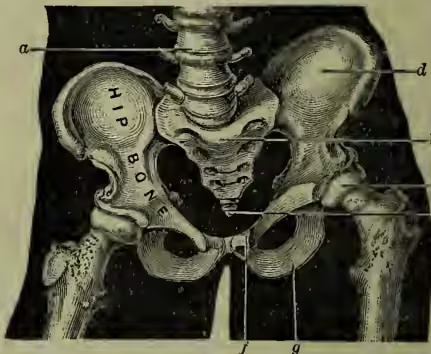
a, lumbar vertebra; b, sacrum; c, coccyx; d, ilium; e, head of femur in acetabulum; f, pubis; g, ischium.
The pelvis is divided into two parts by a plane which extends from the upper margin or promontory of the sacrum to the upper margin of the articulation between the two pubic bones—i.e. the symphysis pubis. On the inner surface of each innominate bone a line may be traced from the sacral promontory to the symphysis pubis. This is named the ilio-pectineal line, and it helps to complete the circumference of the plane which divides the pelvis into two parts. The space above this plane lies mostly between the expanded iliac bones. It belongs to the abdomen proper, and is named the false pelvis. The space below the level of the sacral promontory and ilio-pectineal lines is called the true pelvis, and certain descriptive terms are employed in connection with it. Thus the plane which separates it from the false pelvis is called the inlet or brim of the true pelvis. Its inferior circumference or outlet extends from the tip of the coccyx to the inferior border of the pubic symphysis, and from the one ischial tuberosity to the other. Between the ischial tuberosities in front and extending forwards to the symphysis there is the subpubic arch. The space between the inlet and the outlet is named the cavity of the true pelvis. The measurements of the true pelvis are made along certain definite lines which are applicable to the brim, the cavity, or the outlet. These are (1) the antero-posterior or conjugate diameter—i.e. from the mesial line in front to the mesial line behind; (2) the transverse or widest diameter; (3) the oblique diameters—right and left. These extend from the articulation between sacrum and ilium on one side to the farthest point on the opposite side of the mesial plane. In the erect attitude of the body the plane of the brim of the true pelvis forms an angle with the horizontal which varies from 60° to 65°. Thus the weight of the upper part of the body which is communicated to the sacrum is directed downwards and transmitted through the innominate bones to the heads of the femora, and so to the inferior extremities. In addition to the ligaments, muscles, blood-vessels, and nerves which constitute the soft parts of the pelvis, there are certain special organs which are present in both sexes, and others which are peculiar to each sex.
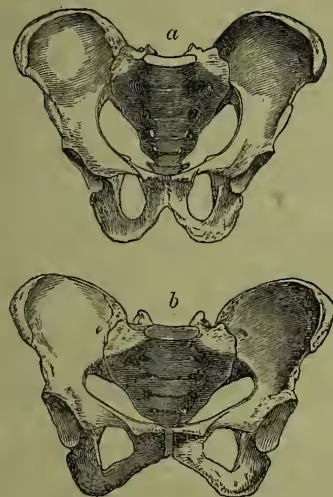
a, adult male, and b, female pelvis.
Thus, of those common to both sexes, there are the urinary bladder and the rectum. The urinary bladder is placed behind the symphysis pubis, and only rises out of the pelvis into the abdomen when considerably distended. The rectum—a name applied to that part of the alimentary canal which passes through the pelvis—is placed on the front of the sacrum and coccyx, a short distance below which it termin- ates in the anus. The lower end of the rectum is supported by two muscles—the levator ani—which surround it so completely as to form a floor or diaphragm for the pelvis. In addition to these organs there are others which are characteristic of the sexes. In the male we have the vesiculæ seminales and the prostate gland—the latter surrounding the outlet of the urinary bladder. In the female we have the uterus, ovaries, and their various appendages. The diverse functions of these organs have led to corresponding and well-marked differences in the size and form of the osseous pelvises of the sexes. In the female the bones are more slender, and the muscular impressions less distinct. The true pelvis has a greater breadth and capacity, but its perpendicular depth is less. The inlet is more nearly circular; the ischial tuberosities are wider apart, and the subpubic arch is much wider. All of these differences indicate special modifications in connection with the necessities of child-bearing. Although the depth of the cavity of the true pelvis steadily increases from childhood to puberty, yet the characteristics of the sexes are discernible even at birth.
But not only does the pelvis display features which are characteristic of sex; it also presents characters which are peculiar to individual races of mankind. In this field of study a great amount of valuable work has been contributed by Sir William Turner of Edinburgh University, and embodied in the reports of the Challenger expedition. In determining those features peculiar to race numerous measurements have been made, mostly in relation to the cavity of the true pelvis with its brim and outlet; but many of the external dimensions of the entire pelvis have also been noted, as well as the dimensions of individual bones. One of the most valuable of the external measurements is the comparison between the maximum height and breadth of the entire pelvis. A common result is obtained by the following formula, , which establishes what is called a breadth-height index. Another index of great importance is the result of a comparison between the conjugate and transverse diameters at the brim of the pelvis. This is named the pelvic or brim index, and is obtained by the formula, . The measurements are usually recorded in millimetres. As the result of numerous measurements Sir William Turner has devised a classification of pelvises based upon the relation of the conjugate and transverse diameters at the brim of the true pelvis—i.e. upon the brim index. Thus, those pelvises in which the conjugate diameter of the brim is either longer than the transverse or closely approaches it are named dolichopellic (pellis, the Greek equivalent of the Latin pelvis, 'a basin'; and dolichos, 'long'), and in these the brim index is above 95. When the transverse diameter of the brim greatly exceeds the conjugate they are named platypellic (platys, 'wide'), and the brim index is below 90. In cases where the transverse diameter is not greatly in excess of the conjugate—i.e. where the brim index varies between 90 and 95, both inclusive—the term mesatipellic (mesatutos, 'middlemost') is applied. Grouping the pelvises under these headings we find that such races as Australians, Bushmen, Hottentots, Kaffirs, Malays, Andaman Islanders, &c. are dolichopellic. Negroes, Tasmanians, New Caledonians, &c. are mesatipellic. British, French, Germans, Europeans generally, natives of India, Chinese, American Indians, &c. are platypellic. These results are obtained from the examination of male pelvises, since, as we have already seen, the female pelvis is modified in its diameters in relation to the special requirements of sex.
If now we compare the human pelvis with that of the lower mammalia, we shall find that the human pelvis is characterised by breadth and shallowness and the great capacity of the true pelvis. When, therefore, the conjugate diameter at the brim of the pelvis is longer than the transverse—i.e. when the pelvis is dolichopellic—an approach is made to the condition which prevails even to a greater extent among the lower animals, and it is 'a degraded or animalised arrangement' as compared with platypellic pelvis of Europeans.
We have seen that in man the weight of the trunk is transmitted to the lower limbs through the pelvis, whereas in quadrupeds the downward pressure of the weight of the trunk is differently disposed. Doubtless, therefore, the attitude has great influence in controlling the expansion of the pelvis in the transverse diameter when the parts are young and plastic. It may therefore be owing to the habits and mode of life of the black races in their aboriginal state that their pelvises approach the lower type. Take, for example, the aboriginal Australian who sits on the ground embracing his knees with his arms, or any of the savages whose favourite attitude is 'squatting'—i.e. sitting down with the body bent forward and the buttocks resting on the heels; or again, when in pursuit of game a stooping or crouching attitude is adopted. In all these positions the pressure upon the sacrum and pelvis is diminished, and there is a tendency to approximate the conditions to those of the anthropoid apes, while the white man on the other hand preserves the erect attitude whether standing, sitting, or walking.