Pendulum. The two chief varieties are the simple pendulum and the ordinary or complex pendulum. Examples of the latter occur in all the forms of clockwork where a balance-wheel has been dispensed with (see HOROLOGY). A small leaden or golden bullet, when suspended from a fixed point by an extremely fine thread, may represent a simple pendulum, provided it vibrates in a small circular arc. Once set in motion, this instrument will move in the same arc for ever unless interfered with, because at each swing, when descending through the first half of its circular path, it acquires energy enough to raise it to an equal height on the opposite side. In ordinary experiments the bullet will perform many thousand oscillations by itself alone, before the resistance of the air and other interferences cause the movement to subside and at last cease, by imperceptibly diminishing the length of the arc.
This long-continued and self-sustaining action is manifestly due to the attraction of the earth, the force that causes a stone to fall to the ground, because at the end of each swing of the bullet its weight tends to pull it vertically downwards, and the string constrains it to repeat its course along the circular arc. A most interesting and valuable application of the pendulum, therefore, is for measuring the acceleration of velocities of falling bodies. For that purpose it is much superior to Atwood's Machine (q.v.) or any other method which has yet been devised.
If the circular path or swing is short—not exceeding, for example, that of a clock pendulum which beats seconds—there are two results to be remembered. First, that so long as the length of thread is unchanged, it matters not how far the bullet may swing on each side, the time or duration of each oscillation is also unchanged. This 'pendulum-law' was discovered by Galileo in the church of Pisa, as he watched a lamp swinging by a chain. The quality that each swing occupies the same time is so important in horology that the introduction of the pendulum by Huygens as a time-measurer formed the principal epoch in the history of that science. The term isochronism ('equal-timeness') was invented to mark this property of the pendulum. The second law of the pendulum is that to make the bullet move faster we must shorten the thread in the following proportion: for twice as many oscillations take a quarter the length of string; for thrice as many take one-ninth the length; for four times as many take one-sixteenth the length. That law is otherwise expressed by saying the length of the thread is inversely as the square of the number of oscillations made in a given time (see CENTRE OF OSCILLATION).
These and other properties of the pendulum are wrapped up in the formula: , which mathematicians have established: where = time in seconds of one oscillation, = length (in inches) of the thread, , a well-known ratio; and = the accelerating force of gravity, or twice the space through which a heavy body falls in one second. When in that formula—i.e. when our pendulum beats seconds, a result easily attained at any part of the world—then immediately we have . In other words, multiply the length of the seconds pendulum in any latitude or longitude by the fixed number 9.8696 to find the value of . By this valuable and simple result it has been shown that the force of gravity slightly and gradually increases as we travel from the equator towards either pole, the length of the seconds pendulum diminishing in the same proportion. The poles are therefore nearer to the centre than the equator is, which is an independent proof that our planet is spheroidal, and resembles in shape an orange rather than a lemon.
The following table readily gives the length of the seconds pendulum at any of the stations by dividing the corresponding number in the third column by the fixed number 9.8696. At London, for example, feet, length of seconds pendulum. Dent's clock in the tower of the House of Commons beats once in two seconds, and must therefore have a pendulum 13.046 feet long.
The table also shows the acceleration (feet per second) due to gravity, as ascertained from observations made by means of the seconds pendulum. The results are arranged in the order of their latitude.
| Station. | Observer. | Force of Gravity. Feet. |
|---|---|---|
| Rawak (between Jilolo and New Guinea). | Freycinet. | 32.083 |
| Sierra Leone..... | Sabine. | 32.093 |
| Ascension..... | Sabine. | 32.096 |
| Jamaica..... | Sabine. | 32.105 |
| Rio de Janeiro..... | Freycinet. | 32.112 |
| Cape of Good Hope..... | Freycinet. | 32.140 |
| Bordeaux..... | Biot, Mathieu. | 32.169 |
| Paris..... | Borda. | 32.182 |
| Dunkirk..... | Biot, Mathieu. | 32.190 |
| London..... | Sabine. | 32.191 |
| Edinburgh..... | Kater. | 32.204 |
| Unst, Shetland..... | Biot, Mathieu. | 32.217 |
| Spitzbergen..... | Sabine. | 32.253 |
Since the length of the seconds pendulum is due entirely to natural causes, and can always be easily verified, it was chosen as a standard of the British measures of length. Experience has taught, however, that these are more easily known by preserving an artificial standard.
The universal application of the pendulum for time-measurement and ascertaining the local value of has been followed by some special uses of it which are of interest. Thus, Sir G. B. Airy, the late astronomer-royal, applied it to form an estimate of the earth's mean density by observations taken at a coal-pit, 1200 feet deep, near South Shields. One pendulum being stationed at the surface and another at the bottom of the pit, their oscillations were exactly compared by means of an electric wire, with the result that a clock at the mouth of the pit would gain seconds per day if removed to the bottom. From these data (Phil. Trans. 1856, p. 297) the density of the earth was estimated to be 6.565.
By the Foucault experiment the pendulum was utilised in a striking manner to prove the perpetual rotation of our planet round its axis. A globe of metal is suspended by a long wire to a lofty roof, the point of suspension being vertically over the centre of a round table; and after being drawn aside from the position of rest this pendulum is allowed to begin its vibrations, but so as to have no tendency to right or left. Students of dynamics know that it must continue swinging to and fro in the same plane unless interfered with from without. Owing to that the table beneath the pendulum, when carefully observed, is seen to revolve very slowly in a direction contrary to the hands of a watch; but since the floor and whole building revolve with the table, the observers naturally refer the relative motion to the pendulum, still swinging in its original plane. By marking twenty-four equal divisions round the edge of the table the spectators would be furnished with a good clock, the pendulum pointing out the hour at the point where it first began its oscillations, and apparently revolving in the usual direction.
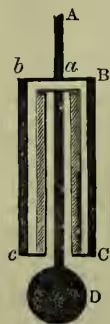
The pendulum, in Horology, is absolutely accurate as a time-keeper, if only the proper length is preserved. That is mainly done by means of a screw turning on the rod, under the 'bob' or ball, so as to push it up and therefore shorten the pendulum, or let it fall lower down and lengthen the pendulum. It was found in winter that clocks went too fast, and at mid-summer too slow, because cold shortened the metallic rod and heat lengthened it. A further refinement was therefore devised to secure a uniform length without the screw adjustment, the result being what are known as 'compensation pendulums.' Both the common methods of these depend on the same principle. (A simple and practically accurate form of pendulum is made with a wooden rod, which is less liable to expansion and contraction than metal.) The 'mercurial pendulum' carries within it a glass cylinder nearly full of mercury, so proportioned in quantity to the weight of the pendulum that when the latter expands downwards by the heat the change is counterbalanced by the upward expansion of the liquid in its jar. In winter, of course, the pendulum and the quicksilver are similarly contracted in opposite directions, to secure a good average length and mark better time. The second form of compensation pendulum is called the 'gridiron,' because it consists of several upright bars, as in the diagram. If the black bars be, for example, steel, and those between be brass or copper, then by a proper adjustment of their lengths any change of temperature will not materially affect the time-keeping property of the pendulum. Brass is much more subject to extension and contraction than steel. It is obvious from the figure that when the heat dilates the brass bars they must raise the bob D, and therefore counteract the downward extension of the steel bars, such as BC or bc and Aa. For accurate and uniform time-measurement the gridiron has, in the experience of some astronomers, proved superior to the mercurial pendulum.