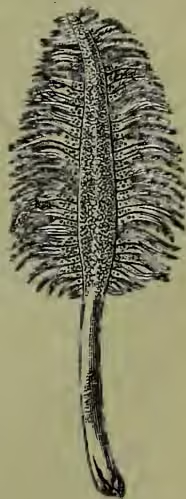
Ventral View of Pennatula phosphorea (about one-half natural size).
Pennatula, an interesting animal whose quill or feather-like appearance is suggested by the title and by the popular name Sea-pen. It is one of the Alcyonarian Actinozoa, in the same sub-class as Dead-men's Fingers, Red Coral, Gorgonia, &c. One species (P. phosphorea) is not uncommon at moderate depths (e.g. 20 fathoms) round British coasts. It consists of a basal stalk, by which the animal is probably fixed upright in the mud, and of a free axis bearing numerous polypes. The whole length is about 4-6 inches; the colour is deep red, and due to pigmented spicules of lime; the living animal is brightly phosphorescent. The stalk is really a tube, and can be somewhat inflated; the polypes are fused together in sets of a dozen or so up each side of the axis. These fused sets form a series of parallel leaves, somewhat like the bars of a feather. The median part of the axis also bears rudimentary asexual polypes ('zooids') which are not fused. The whole axis is supported by a firmly-calcified internal stem.
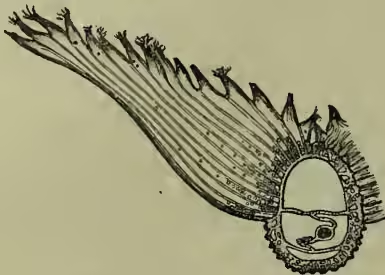
Cross section of the axis and one 'leaf' set of fused Polypes (after Marshall). The most ventral polype is longest and oldest.
The sexes are separate. Among related forms Virgularia, Funiculina, and Renilla are important. See Report on Pennatulida, by A. Milnes Marshall and W. P. Marshall (Birmingham, 1882).