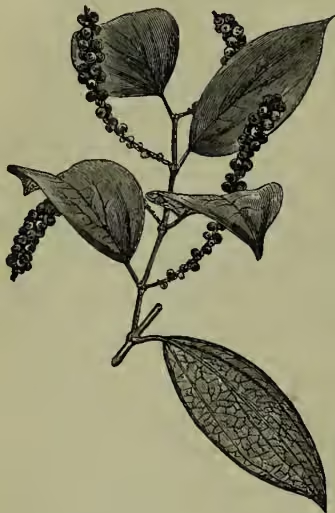
Pepper (Piper), a genus of plants of the natural order Piperaceæ (q.v.), which once included the whole of that order, but, as now limited, consists of plants with woody stems, solitary spikes opposite to the leaves, and flowers on all sides, the flowers mostly hermaphrodite. The most important species is Common or Black Pepper (P. nigrum), a native of the East Indies, now cultivated also in many tropical countries; its berry or drupe being the most common and largely used of all spices. It is a rambling and climbing shrub, with smooth and spongy stems, sometimes 12 feet in length, and broadly ovate, acuminate, leathery leaves. The fruit is about the size of a pea, of a bright-red colour when ripe, not crowded on the spike. In cultivation the pepper plant is supported by poles, or by small trees planted for the purpose, as it loves a certain degree of shade, and different kinds of trees are often planted for this purpose in India. It is propagated by cuttings or suckers, comes into bearing in three or four years after it is planted, and yields two crops annually for about twelve years. When any of the 'berries' of a spike begin to change from green to red all are gathered, as when more fully ripe they are less pungent, besides being apt to drop off. They are spread on mats to dry in the sun, and separated from the spikes by rubbing with the hands or by treading with the feet, after which they are cleaned by winnowing. The Black Pepper of commerce consists of the berries thus dried, which become wrinkled and black; White Pepper is the seed freed from the skin and fleshy part of the fruit, to effect which the dried fruit is soaked in water and then rubbed. White pepper thus prepared is of a whitish-gray colour, but not unfrequently undergoes a bleaching by chlorine, which improves its appearance at the expense of its quality. Black pepper is much more pungent than white pepper, the essential constituents of the spice being more abundant in the outer parts of the fruit than in the seed. Pepper depends for its properties chiefly on an acrid resin and volatile oil; it contains also a crystalline substance called Piperin. The fruit of Piper trioicum, a species very similar to the Common Pepper, is more pungent; and it is cultivated in some parts of India. The fruit of other species of Piperaceæ is used as pepper in their native countries. The fruit of Piper longum or Chavica Roxburghii yields the Long Pepper of commerce. They have woody climbing stems, solitary spikes opposite to the leaves, dicocious flowers, and the fruits so close together on the spikes as in ripening to become a compact mass. The spikes are gathered when unripe, and dried in the sun. They are used in pickling and for culinary purposes, also in medicine for the same purposes as common pepper. They are generally reputed to be more pungent than common pepper. C. Roxburghii is cultivated in eastern India, Ceylon, and Java. The root and thickest part of its stem are extensively used in India as a stimulant medicine.
Pepper acts on the skin as a rubefacient and vesicant, and is often used for this purpose in a powdered state, moistened with some kind of alcoholic spirit. It is also employed as a local stimulant in relaxation of the uvula, and is applied in the form of an ointment to ringworm. Taken into the stomach in small quantities it is a pleasant stimulant, but in large doses it produces great pain and irritation. The quantity used, however, by the natives of hot climates much exceeds anything known among Europeans, and the effects are evidently beneficial rather than injurious. The chief use of pepper is as a spice and condiment.
Pepper was known to the ancients; Hippocrates employed it as a medicine, and Pliny expresses his surprise that it should have come into general use, considering its want of flavour. In the middle ages pepper was one of the most costly spices, and in the 13th century a few pounds of it were reckoned a princely present. The quantity now imported into Europe is immense. The average annual imports into the United Kingdom are about 29 million lb., of which about 7 million lb. are taken for consumption; the quantity imported into the United States is of course even larger. Malabar black pepper is considered the best kind, and the Telli-cherry and Penang the finest varieties of the white.
The name pepper is popularly given to substances possessing a pungency resembling that of pepper, although produced by very different plants. Thus, Cayenne Pepper is the produce of species of Capiscum (q.v.), of the natural order Solanaceæ; Jamaica Pepper, or Pimento (q.v.), of species of Eugenia, of the natural order Myrtaceæ; and Guinea Pepper (q.v.), or Maleguetta Pepper, is Amomum, Ethiopian Pepper Xylopia Ethiopica, and Benin Pepper Cubeba Clusii.