Perch (Perca), a genus of spiny-finned or acanthopterous fishes, well represented by the Fresh-water Perch (P. fluviatilis). The members of the large family (Percidae) to which the perch belongs are carnivorous fishes, frequenting the fresh waters and coasts of temperate and tropical regions. The body is somewhat compressed; the spinous dorsal fin is well developed; the ventral fins are thoracic in position; the teeth are simple and conical; there are no barbels. These characters are possessed by many perch-like fishes, some of which are discussed in separate articles—e.g. the Bass (Labrax); the Perch (Lates) of the Nile, Ganges, &c.; the Pike-perch (Luciopera); the Sea-perch (Serranus); the Murray Cod and Hapuku (Oligorus); the Growler (Grystes), &c. Of American Percidae the 'glass-eye' or 'yellow pike' (Stizostedion vitreum) is largest and most important, while the dwarf-perches or darters (Microperea, Percina, &c.) are among the minutest fishes, Microperea punctulata measuring only an inch and a half.
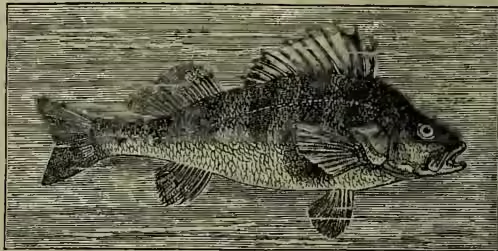
The fresh-water perch is widely distributed in lakes, ponds, and rivers in Europe, North Asia, and North America, and is common in many parts of Britain. It is of a greenish-brown colour above and golden yellow on the under parts, with six or seven indistinct dark bands on the back. In length it measures about 18 inches, and its height is about a third of this. It sometimes weighs from three to five pounds, and a prize of nine pounds has been recorded. Among its characteristics may be noted the small villiform backward-turned teeth, their presence on the palatines and vomer, their absence from the tongue, the two dorsal fins, of which the first has thirteen or fourteen spines, and the small scales on the body. The perch loves still waters, and thrives well in ponds, at the cost, however, of smaller fishes. It also feeds on insects, worms, &c. It can endure removal from the water for a considerable time. The eggs are laid in spring, and are attached in long viscoid strings to water-weeds. The number of eggs in one spawn may exceed a million. As an edible fish the perch has a good reputation, eating best with lemon-juice and cayenne-pepper, but the American variety is less esteemed. Of species distinct from P. fluviatilis, little is known.—The so-called Climbing Perch (q.v.) is separately treated.