Perpetual Motion. Formerly the attempts made to 'square the circle' led to an enormous waste of time till mathematicians proved, by repeated and unassailable methods, that the circular area cannot possibly be expressed in terms of the diameter or radius. It logically follows from the definition of a circle that it is a plane figure which does not admit of being squared. In the same way, to all who have understood the words force and motion, it follows from the definition of a machine that it does not admit of being 'perpetual,' or self-moved. Every machine is constructed to transmit motion or force. The machine, further, modifies the transmitted force, so as to overcome certain resistances, some 'useful' and some 'prejudicial.' In every instance the motion of the machine is derived from without, and the energy so conveyed is to be at once referred to muscular action, or the weight of falling water, or a current of air, or the expansive force of steam, or some other natural power. Some such force is at once implied by the action of any machine, whether the motion is only commencing or has continued for an indefinite time. In an ordinary clock, for example, action is due to the muscular force expended in coiling a spring or raising a weight. The sight of motion in wheels or levers compels us to believe that force has been exerted upon them, and that they are merely vehicles for transmitting it. The machine has gained so much motion and energy, but only at the expense of some exterior agent. The quantity of force in existence being fixed, no new stock can be created, and therefore a self-moving machine is absurd even in name. The practical engineer knows that the force of his steam-engine is exactly in proportion to the amount of coal burned per hour—i.e. the work depends on the consumption of heat. If the mechanical force produced is in excess, however small, of its equivalent (measured by the coal burned), then perpetual motion would be at last found, because then the engine would be generating force—i.e. end of the 14th century to the middle of the 16th century, and was thus contemporary with the Flamboyant style in France. These styles have giving out more than was derived from the heat of the coal. This, of course, is impossible; it is from the inexhaustible stores of nature alone, such as fire, water, wind, chemical action, and electricity, that force is derived to give motion to any machine whatever. Instead of producing more force than it has received, and so laying up a stock of energy which might render it 'perpetual,' every machine must in its results show less energy than has been transmitted to it. Some of the machine's work is always spent on friction and the atmospheric resistance, so that it cannot give out all the force that was put in.
A 'simple pendulum' swinging in an exhausted receiver, or a top spinning there, might illustrate the term Perpetual Motion, if friction could be avoided. Neither of these, however, could be called a perpetual machine. Give the top some work to do by putting it in gear, say, with a wheel or a crank, and speedily its motion slackens; which proves that, for a 'machine,' new force is constantly required from without, especially if anything more than mere motion is required. In the words of the French Academy (Histoire, 1775): 'Neglecting friction and resistance (of the air), a body to which motion has been given will retain it for ever, but only on condition that it does not act on other bodies; and the only perpetual motion possible, even on this hypothesis, would be useless for the purpose of the devisers. . . . Numerous mechanics who might have been of great service have wasted (on this kind of research) their means, time, and talents.'
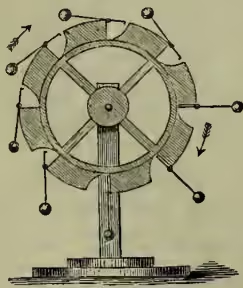
The mere enumeration of all the chief attempts made in various countries to contrive a self-moving machine would be tedious. We shall only note some typical cases in each class. In one class of so-called perpetual machines the essential part was a wheel revolving on a horizontal axis, with several movable weights so distributed round the rim as apparently to act always more on one side than the other, and thus continue the revolution. One of these was by the ingenious Marquis of Worcester, and is described in his Century of Inventions as having been tried in the Tower before the king and court. On the same principle was Jackson's machine shown in fig. 1. In other attempts of this class the side of the wheel was divided symmetrically into cells with curved sides, each cell holding a ball which rolled about as the
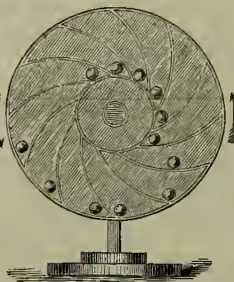
revolution took place, so that the balls should, by being further from the centre, act more on one side than on the other, as shown in fig. 2. A foreign instance, described in a letter to Newton as an undoubted success, was that of Orffyreus, consisting of a large wheel covered with canvas. When set in motion the speed increased till it reached a rate of twenty-five revolutions a minute; and when sealed up by the Elector of Cassel it was found at the end of two months to be moving as rapidly as ever. We must of course assume the existence of some imposition in this and more recent cases.
In another class of self-moving machines water or mercury became the prime motor, and was sometimes used in defiance of the most elementary laws of hydrostatics. One of these consisted essentially of a large vessel having a curved tube leading from the bottom up one side and bending over the brim. The inventor actually concluded that the great weight of the liquid in the vessel when full, or nearly so, must force the liquid in the tube up higher than the edge of the vessel, and thus cause a perpetual circulation.
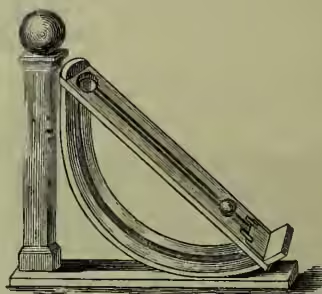
Another class depended on magnetic action, such as Bishop Wilkins's inclined plane up which an iron ball was drawn in a groove by the attraction of a loadstone fixed at the top (fig. 3). Before reaching the loadstone the ball was ingeniously intended to fall through a hole in its path on to a curving incline beneath, and thus be conveyed by a second groove to the foot of the first inclined plane, in order to recommence its upward journey under exactly similar circumstances. The bishop overlooked the fact that the magnetic action would also tend to prevent a fall; but for that fallacy, he had come
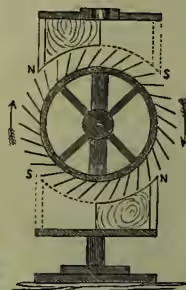
as near success as the laws of nature permit. In Addeley's perpetual motion the wheel was surrounded by a set of magnets, projecting like teeth in a slanting direction, and having the S poles all towards the centre (fig. 4). Four larger fixed magnets were disposed outside the wheel, two of which at opposite points of the circumference presented their S poles to attract the revolving magnets, while half-way between them the other two presented their N poles to retard them. All the four magnets, however, acted against the inventor's purpose, as well as in the direction which he intended. In fact, if magnetic action or gravity could be temporarily nullified in a particular direction (as light is by interposing an opaque body) the problem of perpetual motion could immediately be solved.
Innumerable patents have been taken out for magnetic and electric machines, but in the principle of each some fallacy lurks, due to a misconception of the laws of force-transmission. A typical case is an electric machine driven by a gas-engine where the latter is heated by the decomposition of water by the electricity produced; just as if a steam-engine, for example, could be heated by the friction of certain bodies set in motion by itself.
Some intelligent and practical proposals have from time to time been made to utilise the rise and fall of tides as the motive power of machines. These, however, should not be classed, as is sometimes done, under those named 'perpetual,' since the supply of power is obviously derived from a natural source—the moon's attraction combined with the earth's daily rotation. A tide-mill, exactly as a water-mill or wind-mill, is entirely dependent on an outward supply of power, and can in no sense be termed self-moving or 'perpetual.' Ultimately, of course, all the forms of natural energy are to be referred to the sun, the source of planetary force as well as life, whatever be their modifications. See H. Dircks, Perpetuum Mobile: Search for Self-motive Power (2d series, 1861-70).