Perspective (Lat. perspicio, 'I look through') is the art of representing natural objects upon a plane surface in such a manner that the representation shall affect the eye in the same way as the objects themselves. The distance and position of objects affect both their distinctness and apparent form, giving rise to a subdivision of perspective into linear perspective, which, as its name denotes, considers exclusively the effect produced by the position and distance of the observer upon the apparent form and grouping of objects; while aerial perspective confines itself to their distinctness, as modified by distance and light. The necessity of attending to the principles of perspective in all pictorial drawing is apparent when we consider, for instance, that a circle when seen obliquely appears to be not a circle but an ellipse, with its shortest diameter in line with the spectator, and its longest at right angles to this. A square, when looked at from a position opposite the middle of one of its sides, appears as a trapezoid, the sides which are perpendicular to the direction of vision appearing to be parallel, while the other two appear to converge to a point in front of the spectator, &c. For the same reason two rows of parallel pillars of equal height, seen from a point between and equidistant from each row, appear not only to converge at the further end, but to become gradually smaller and smaller.
An excellent idea of a perspective plan can be easily obtained by interposing a vertical transparent plane (as of glass—a window, for instance) between the observer and the objects of his vision, and supposing that the objects he sees are not seen through the glass, but painted on it. A sketch made on a glass plane in this position by following with a pencil all the lines and shades of the objects seen through it, the eye being all the time kept quite steady, would form a picture in perfect perspective. In practice, however, it is found unfortunately that glass is not a suitable material for sketching on, and that the vertical position is not the most convenient; it is therefore preferable to make a careful study of the effects produced by change of position and distance on the appearance of objects in nature, and from the results of this to compile a body of rules, by the observance of which painters may be enabled to produce an effect true to nature. After the 'scope' (i.e. the number of objects to be introduced, and the distance at which they are to be viewed) of the picture has been determined, and before the design is commenced, it is necessary to draw upon the perspective plan three lines: (1) The base line, or ground line, limits the sketch towards the operator, and is the base line of the picture. (2) The horizontal line represents the ordinary position of the sensible horizon. The height of the horizontal line is about one-third of the height of the picture, when the sketcher is placed at or little above the level of the horizon; but it may rise in a degree corresponding to his increase of elevation till it reaches near to the top of the perspective plan. The general rule is to have a high horizontal line when the view is taken, or supposed to be taken, from an eminence; but when the station is on a level, either actual or assumed, as is the case when a statue or a mountainous landscape is figured, the horizontal line must be low. The horizontal line in nearly all cases is supposed to be level with the spectator's eye. (3) The vertical line is drawn from the supposed position of the sketcher, perpendicular to the ground and horizontal lines, meeting the latter in a point which is called the point of sight, or centre of the picture. The vertical line has no representative in nature, and is merely a mechanical adjunct to the construction of the picture, all vertical lines in nature being parallel to it in the picture. The point of sight, being the point directly opposite to the observer, is properly placed in the centre of the picture, for it is most natural that the view should lie symmetrically on each side of the principal visual line; but this is not by any means a universal rule, for we very frequently find it on the right or left side, but always, of course, on the horizontal line. All lines which in nature are perpendicular to the ground line, or to a vertical plane which is raised upon it as a base, meet in the point of sight, which is thus their vanishing point (see the line of the tops and bottoms of the pillars in fig. 1). The points of distance are two points in the horizontal line on each side of the point of sight, and in a 'direct' sketch are at a distance from it equal to the horizontal distance of the sketcher's eye from the ground line. The equality of distance of these points from the point of sight is not, however, necessary, as it occurs only in those cases where the lines, of which the points of distance are the vanishing points, are inclined (in nature) at an angle of to the base line; but in all cases the two points of distance are
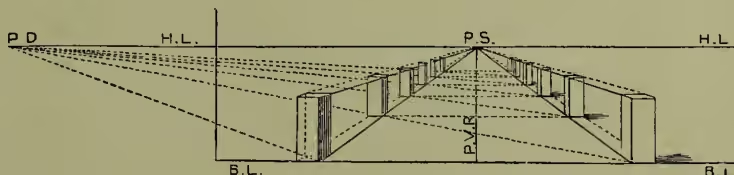
Illustrating the more important points and lines; PVR is the principal visual ray. about twice as far apart as the eye is from the picture. One important use of the points of distance is to define the distance of objects in a row (fig. 1) from each other. For this purpose two points of distance are not necessary, as when the position of one pillar is found, that of the one opposite is at once obtained by drawing a line parallel to the base or ground line. We have seen that the point of sight is the vanishing point of all level lines which meet the ground line or a vertical plane on it at right angles, and that the points of distance (in a direct picture) are the vanishing points of all lines which cut the ground line at an angle of ; but there are many other groups of parallel lines in a picture which have different situations, and therefore different vanishing points. Such lines with their vanishing points (called for distinction's sake accidental points) are represented in fig. 2. If the accidental point is above the horizontal line, it is called the accidental point aerial; if below, the accidental point terrestrial; and a little consideration makes it evident that these points may or may not be situated within the plane of the picture. Such are the points and lines necessary for the construction of a plan in true perspective; and from the above explanation we may deduce the two general principles: (1) that all parallel straight lines in nature are no longer parallel when projected on the perspective plane, but meet in a point which is called the vanishing point, and is some one of the three above described, unless these lines happen to be also parallel to the ground line or the vertical line, in which case they remain parallel when transferred to the picture; and (2) that, since the bodies drawn below the horizontal line are seen as if from above, those above as if from below, and those to the right and left of the point of sight as if observed from the left and right, it follows that straight lines which in the picture are above the horizontal line lower themselves, those below raise themselves to it, whilst those to the left, following the same law, direct themselves to the right, and vice versa.
Aerial perspective consists in a modulation of the brightness and colours of objects in accordance with the state of the atmosphere, the depth of the body in the perspective plane (i.e. distance in nature from the ground line), and other accidents of place and time. As the distance of objects increases, their illuminated parts are made less brilliant and their shaded parts more feeble. The bluish tint imparted by a large mass of the atmosphere to the bodies seen through it is frequently imitated by the mixing of a slight tint of blue with the colours to be applied; a yellow object thus assumes a greenish tint, a red one a violet tint, &c. The air when charged with vapour is represented by a diminution of the brightness of colours, and by the grayish tint imparted to them. But in this part of the subject rules are of little
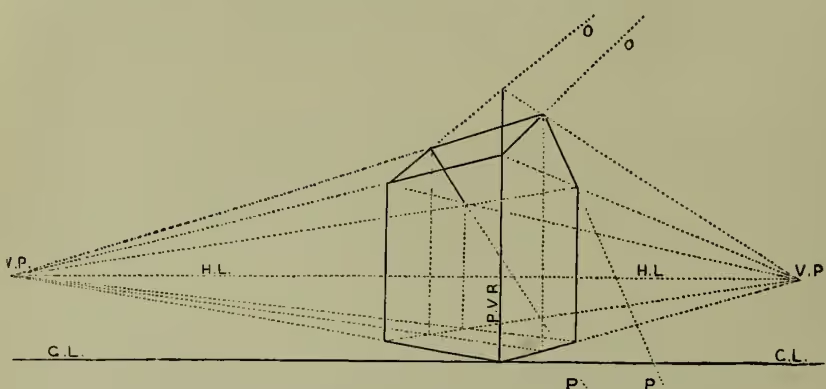
The lines O, O converge to the accidental point aerial, and P, P to the accidental point terrestrial. avail, for experience alone can guide the painter in faithfully copying the myriad aspects presented by nature.
A thorough knowledge of perspective is a sine qua non to the painter or designer, and though many are inclined to think it a superfluity, and that the sketcher has only to make use of his eyes and copy justly, the very fact that such is their opinion shows that they have never made the attempt; for it is impossible for the painter, and much more so for the designer, to execute a copy of nature with sufficient accuracy by the sole aid of the eye and hand, a fact that is unfortunately much too frequently proved by many of the sketches exhibited in fine-art collections. Perspective was known to the ancients, but seems to have become extinct during the disturbances that convulsed Italy, and was revived by Albert Dürer and Bramantino of Milan (c. 1470-1535), whose body of rules was extended and completed by Peruzzi and Ubaldi about 1600. Dr Brook Taylor in 1715 and 1719 was the first Englishman who discussed the subject scientifically.
There are works on perspective by Tyrwhitt (1868), Humphris (1869), Collins (1872), Dennis (1877), Pellegrin (New York, 1874), Burchett (1881), Miller (1887), and James (1888).