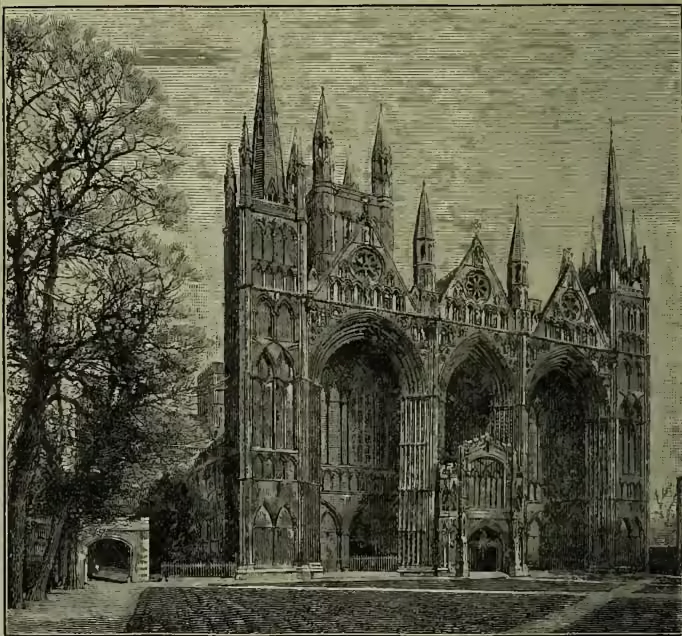
Peterborough, a city partly in Huntingdonshire, but chiefly in Northamptonshire, the latter portion being on the left or north bank of the river Nen, at the edge of the fen-country, 76 miles N. of London and 42 NE. of Northampton. Here, at Medeshamstede, in 655, the Mercian thane Saxulf founded the great Benedictine abbey of SS. Peter, Paul, and Andrew, which, destroyed by the Danes in 870, was restored in 966, plundered by Hereward in 1069, and again burned down in 1116. Its noble church, the cathe- dral since 1541 of a new diocese carved out of that of Lincoln, was built between 1118 and 1528, and thus, whilst essentially Norman, offers every variety of architecture down to the Perpendicular. It is 471 feet long, by 202 across the transept, and 81 high. The Early English west front (c. 1200-22) consists of three mighty arches, and 'is perhaps,' says Freeman, 'the grandest conception for a single feature which mediæval architecture has produced, a Greek portico translated into Gothic language.' Noteworthy also are the flat painted wooden ceilings of the 12th century, the portrait of 'Old Scarlett' the sexton (1496-1594), the blue slab inscribed 'Queen Catharine, A.D. 1536,' and the grave for twenty-five years (1587-1612) of Mary Queen of Scots. In 1643 Cromwell and his troopers did hideous havoc to monuments, stained glass, and cloisters. In 1883 the fine central tower was condemned as unsafe; but it has been lovingly rebuilt, and in 1890 the cathedral was reopened after restoration. Of the abbots may be mentioned Ernulf, Bishop of Rochester (1115); and of the twenty-seven bishops, Lloyd and White the non-jurors, Richard Cumberland, Archbishop Magee of York, and Mandell Creighton the historian. Paley was a native. Two ancient gateways, the bishop's palace and the deanery (once the abbot's and prior's houses), and the chancel of a Becket chapel (now a museum) make up the remaining objects of interest. A training-college for schoolmasters (1864), a grammar-school, the town-hall (1671), the corn exchange (1848), a cattle-market of five acres (1867), and the bridge over the Nen (dating from 1140, but in its present form from only 1872) may be mentioned. Peterborough is an important railway centre, has manufactures of agricultural implements, and carries on a large trade in malt, coal, farm-produce, &c. Incorporated as a municipal borough in 1874, it has returned two members to parliament from 1547 till 1885, and since then one. Pop. (1841) 6959; (1881) 22,394; (1891) 25,172.
See works by Gunton (1686; new ed. 1825), Britton (1828), F. A. Paley (1849), Davys (3d ed. 1863), Sweeting (1869), and Poole (1881).