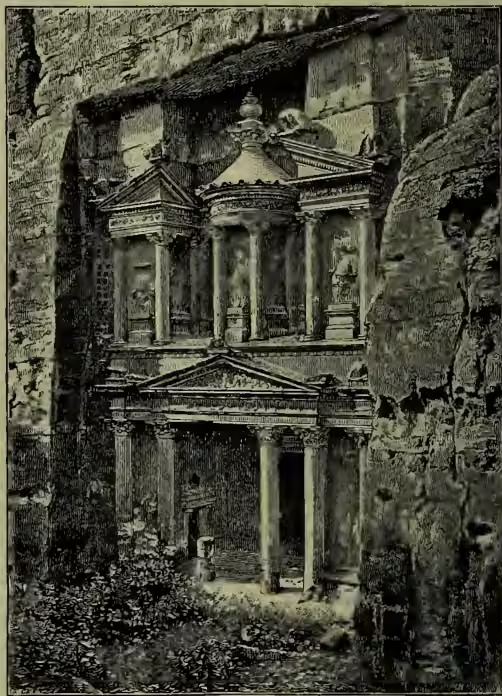
Petra (the Greek equivalent of the Heb. SELA, both names signifying 'Rock'), anciently the stronghold and treasure-city of the Nabataeans (q.v.), was situated in the 'desert of Edom' in northern Arabia, near the points of intersection of great caravan-routes from Palmyra, Gaza, Egypt, and the Persian Gulf, four days' journey from the Mediterranean and five from the Red Sea. It was approached by a chasm or ravine, which in some places is only 12 feet wide, while the rocky walls of red sandstone tower more than 100 feet above. Along this ravine are the most famous ruin of Petra, the Khusna or 'treasury of Pharaoh,' and a theatre, both shaped out of the solid walls. All along the face of the rocks that overlook the valley are rows of cave-dwellings hewn out of the solid stone, and ornamented with façades. The floor of the valley, about two miles across, is strewn with ruins. The earliest name was probably Rekem; hence Petra has been identified with Kadesh Barnea, and as the place where Moses struck the rock so that water flowed out. The little stream that descends the ravine, flowing eastwards, has its origin in a spring called at the present day the Fountain of Moses. Petra was captured by the Romans in 105 A.D., and thereafter decayed, its place as a commercial centre being taken by Palmyra (q.v.). Nevertheless it continued to exist as a town; most of the ruined edifices belong probably to the first century of its decay.—It is from Petra, and not from the Greek word petra, that Arabia Petrea gets its name.
See De Luynes, Voyage d'Exploration (1875); Laborde and Dinant, Arabie Petrée (1830-34); Palmer, Desert of the Exodus (1871); Stanley, Sinai and Palestine (1866); and other works cited at EDM.