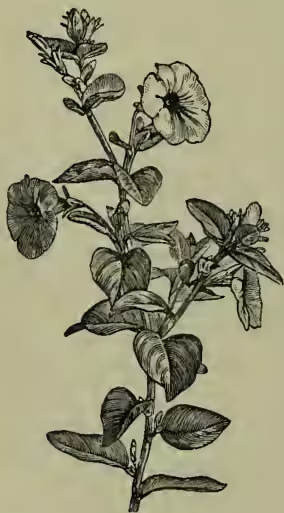
(Petunia nyctagyniflora).
Petunia, a genus of plants of the natural order Solanaceæ, natives of the warmer parts of America. They are herbaceous plants, very nearly allied to Tobacco, and with a certain similarity to it in the general appearance of the foliage, which has also a slight viscosity, and emits when handled a disagreeable smell; but the flowers are very beautiful, and varieties improved by cultivation are amongst the favourite ornaments of British greenhouses and flower-borders. The petunias, although perennial, are very often treated as annuals, sown on a hotbed in spring, and planted out in summer, in which way they succeed very well even in Scotland. They are tall plants, with branching weak stems, and may readily be made to cover a trellis. Though, when treated as greenhouse plants, they become half-shrubby, they live only two or three years. The name is from the Brazilian Petun. The first petunia was introduced into Britain in 1831. There are now many garden varieties with double flowers, individually more durable than the single-flowered kinds.