Pews (anciently pues; Old Fr. puys; Dutch puyes; Lat. podium, 'anything on which to lean'—s'appuyer), enclosed seats in churches. Church-seats were in use in England some time before the Reformation, as is proved by numerous examples still extant, the carving on some of which is as early as the Decorated Period—i.e. before 1400 A.D.; and records as old as 1450 speak of such seats by the name of pues. They were originally benches, usually facing east, with partitions of wainscoting about three feet high, and ends of the width of the seat, panelled or carved; these ends often rising above the wainscoting, and ending in fleurs-de-lis or 'poppy-heads,' as shown in the illustration.
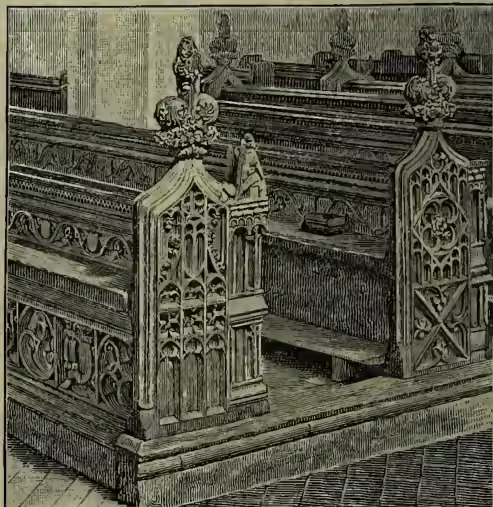
The benches here are in Fressingfield Church, Harleston, Suffolk, and date from the later half of the 15th century. The back of the one in the engraving is quite a 'poor man's Bible,' being carved with the cublems of the Passion, from the cock crowing to the seamless coat. In later times pews grew into large and high enclosures, containing two or more seats, lined with baize, and fitted with doors, desks, and cushions; but these will soon have all been swept away in England under the influence of the restoration movement and of the Free and Open Church Association founded in 1865 for the abolition of appropriated seats. Pews were early assigned to particular owners, but at first only to the patrons of churches. A canon made at Exeter, in 1287, rebukes quarrelling for a seat in church, and decrees that none shall claim a seat as his own except noblemen and the patrons. Gradually, however, the system of appropriation was extended to other inhabitants of the parish, to the injury of the poor, and the multiplication of disputes.
The law of pews in England is briefly this. All church-seats are at the disposal of the bishop, and may be assigned by him, by faculty, to persons owning property in the parish. Long occupation may give an owner of property a prescriptive title to a pew. Subject to rights acquired by faculty or prescription, the churchwardens are required to find seats for the parishioners, according to their degree; they may assign a pew to a parishioner, but the right thus conferred may at any time be recalled. In new churches pews may be assigned and pew-rents levied under several acts of parliament. See Dale's Clergyman's Handbook. It appears that by common law every parishioner has a right to a seat in the church, and the churchwardens are bound to place each one as best they can. The practice of letting pews, except under the church-building acts or special local acts of parliament, and, much more, of selling them, has been declared illegal.
In Scotland pews in the parish churches are assigned by the Heritors (q. v.) to the parishioners, who have accordingly the preferable claim on them; in towns the practice is to let them annually. As is well known, pews in dissenting churches are rented as a means of revenue to sustain general charges. In some parts of the United States pews in churches are a matter of annual competition, and bring large sums. Latterly, in England, there has been some discussion as to the injuriously exclusive character of the 'pew system,' and in many churches the open seats or chairs are unappropriated and free to all. In a good many Ritualistic churches the sexes are divided, as in some country churches has been the case with the peasantry since pre-Reformation days. In the Roman Catholic churches on the Continent pews are seldom to be seen.