Pheasant (Phasianus), a genus of gallinaceous birds of the family Phasianidæ; having a rather short strong bill, a little curved; the cheeks and skin surrounding the eyes destitute of feathers, and warty; the wings short; the tail long, its feathers so placed as to slope down, roof-like, on either side, the middle feathers longest; the tarsus of the male furnished with a spur. The males of all the species are birds of splendid plumage; the females have shorter tails and dull or sombre colours. There are numerous species, natives of the warm and temperate parts of Asia. The Common Pheasant (P. colchicus) is said to have been brought from the banks of the Phasis, in Colchis, to the south of Europe at a very remote period, its introduction being ascribed in classic legend to the Argonauts. From the Phasis it derived its Greek name Phasianos, the origin of its name in English and other modern languages. It was soon natural- ised in Europe, and is now diffused over almost all the temperate parts of it. The date of its introduction into Britain is not known, but was certainly earlier than 1199, when King John granted William Brewer a license 'to hunt the hare, fox, cat, and wolf, throughout all Devonshire, and to have free warren throughout all his own lands for hares, pheasants, and partridges' (Dugdale's Baronage, vol. i. p. 701). Strangely, however, the pheasant seems never to be mentioned as a royal dish till 1689. It has long been plentiful in plantations and game-preserves, and has been introduced into almost every part of the country suitable to its habits. The abundance of pheasants in Britain, however, is to be ascribed chiefly to careful game-preservation, without which the race would in all probability soon be extirpated. No kind of game falls so easy a prey to the poacher, for in its present method of rearing it is semi-domesticated, though we can hardly include it amongst our domestic fowls.
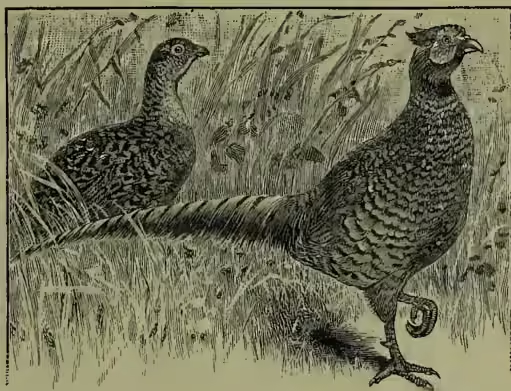
A minute description of the common pheasant is unnecessary. The feathers on the upper part of the head are brownish green, with edgings of yellow; the neck has variations of green and blue, with reddish orange below; the breast and sides are brownish yellow, each feather tipped with purplish blue; the back and belly are variegated, the rump deep red with green and grayish reflections; the tail is dull greenish yellow, with yellowish gray, and bars of black, and a band of dull red on each side. The whole length of a male pheasant is about 3 feet, of which the tail measures about 18 inches. The entire length of the female is a little more than 2 feet, principally in that the tail is much shorter than in the male. The general colour of the female is pale grayish brown and yellow, varied with darker brown, the sides of the neck tinged with red and green. The ordinary weight of a pheasant is about two pounds and a half; but when pheasants are abundantly supplied with food, and kept undisturbed, they are sometimes four pounds or four pounds and a half in weight. The pheasant, unlike the partridge, is polygamous.
The nest of the pheasant is on the ground, and is a rude heap of leaves and grasses, in which eleven or twelve olive-brown eggs are laid. But in the half-domesticated state in which it exists in many English preserves the pheasant does not pay that attention to its eggs and young which it does when more wild, and not unfrequently continues to lay eggs for a considerable time, like the domestic fowl; the eggs being removed by the gamekeeper, and hatched by hens, along with eggs from nests found among clover and hay in the season of mowing. In fact, where pheasants are reared in large numbers nearly all the birds are hatched by either common hens or incubators, which are being largely employed for the purpose. In the former method coops are employed, in front of which are runs formed by wire netting, and in this way a large number can be attended to at one time. Very young pheasants must be carefully supplied with ants' eggs, maggots, gentles, &c., and the whole difficulty of rearing them is in their earliest stage. The difficulty of rearing birds bred in confinement has led to the introduction of various forms of artificial food, several of which are excellent. Custard is largely employed, and when given fresh is eaten with avidity, and brings on the young birds rapidly. Canary-seed is good also at first. Pheasants feed very indiscriminately on berries, seeds, roots, young shoots of plants, worms, insects, &c. Beans, peas, corn, and buckwheat are frequently thrown for them in open places in woods; and they scrape up bulbous and tuberous roots in winter. They roost in trees at no great height from the ground, and poachers sometimes capture them by burning sulphur below them. During the moulting season they do not ascend trees to roost, but spend the night on the ground, when they fall a ready prey to foxes. They are fond of woods with a thick undergrowth, in which, when disturbed, they naturally seek shelter, running whilst it is possible, rather than taking flight. The male pheasant takes flight much more readily than the female, which, apparently trusting to her brown colour to escape observation, often remains still until the sportsman is almost upon her. The males and females do not associate together except during the breeding season, but small numbers of one sex are often found in company. The 'short crow' of the males begins to be heard in March. In England and Scotland pheasant-shooting legally begins on the 1st of October, and ends on the 3d of February. The pheasants turned out from the gamekeeper's breeding-yard into a preserve are in general supplied with abundance of food during winter, and come to the accustomed call as readily as any kind of poultry, so that the sportsmanship of a Battue (q.v.), in which they are killed by scores or hundreds, is of the lowest kind. Maize is one of the best foods, but barley, peas, wheat, and oats, with the usual green food, are all employed. Some pheasant rearers use chopped meat, boiled potatoes, decayed apples, raisins, and similar dainties. It is scarcely necessary to mention that the flesh of the pheasant is in very high esteem for the table.
The female pheasant, as is the case with most other birds, in old age, or when from any cause incapable of the functions of reproduction, sometimes assumes the plumage of the male. The pheasant exhibits a remarkable readiness to hybridise with other gallinaceous birds. A hybrid between it and the common fowl is not unfrequent, and is called a Pero. Hybrids between the pheasant and black grouse have also occurred; and hybrids are supposed to have been produced between the pheasant and guinea-fowl, and the pheasant and turkey. None of these hybrids, however, have ever been known to be fertile, except with one of the original species. On the contrary, the offspring of the common pheasant and the Chinese or Ring-necked Pheasant (P. torquatus) is perfectly fertile, a circumstance which is urged in argument by those who regard them as mere varieties of one species. The ring-necked pheasant is now almost as plentiful in Britain as the common pheasant; it is a native of the forests of India and China, and is said not to breed with the common pheasant in a truly wild state, but in Britain they readily intermix. It is distinguished by a white ring almost surrounding the neck, and is of smaller size than the common pheasant, somewhat different in markings, and has a shorter tail. It is the common pheasant of the Celestial Empire. There is also the Ringless Chinese Pheasant (P. decollatus), and others scarcely known here. The Bohemian Pheasant is another variety of a creamy colour, and it is much more homely in appearance. White pheasants are of not very unfrequent occurrence, and often appear spontaneously from the common variety. Pied pheasants may be bred from crossing the white and common varieties. Of other species of pheasant may be mentioned Diard's Pheasant (P. versicolor), a native of Japan, in which the prevailing colour is brilliant green; Soemmering's Pheasant (P. soemmeringii), also from Japan, one of the most beautiful pheasants known, but terribly pugnacious; and Reeves's Pheasant (P. reevesii), a native of the north of China, in which white is the prevailing colour, and the tail is of extraordinary length, so that a bird not larger than the common pheasant measures eight feet in entire length. Of somewhat different type, and more nearly approaching to the common fowl, are the Golden Pheasant (P. pictus, or Thaumalia picta) and the Silver Pheasant (P. or Euplocamus nycthemerus), both natives of China, and hardy birds, the introduction of which into British preserves has been attempted with decided success. Both have long been kept in a state of domestication by the Chinese. The golden pheasant is one of the most splendid of the tribe. It has a fine crest, and a ruff of orange and black, capable of being erected at pleasure. The tail is very long. The crest and ruff are held in great estimation by anglers for making artificial flies. Lady Amherst's Pheasant (P. or Thaumalia amherstiae) is a native of China, resembling the golden pheasant, and with an extremely long tail. The silver pheasant is one of the largest and most powerful of the tribe, and very combative, driving the common pheasant from preserves into which it is introduced. The prevailing colour of the upper parts and tail of the male is white, finely pencilled with black, the breast and belly purplish black. The Eared Pheasant (Crossoptilon mantchuricum) has a sombre brown body, a vaulted beak, red face, and white throat and ears, the feathers on which stand up above the head. The Argus Pheasant (Argus giganteus), found in Malacca and Siam, is separately discussed (see ARGUS). The latter series of pheasants are chiefly kept in aviaries as ornamental fowls, for which purpose they are well adapted. A recent introduction, the Prince of Wales Pheasant (P. principalis), was discovered on the Afghan frontier of India, and is distinguished from all other pheasants in that the greater part of its wings are white, though it is somewhat different in its markings and the arrangement of its colours.
See D. G. Elliot, Phasianidae (1870-72), Tegetmeier, Pheasants (1873); Price, Pheasant-rearing (1888); Macpherson and others, The Pheasant (1895).