Philadelphia, the chief city of Pennsylvania and the third city of the United States, is situated on the Delaware River, about 100 miles by ship-channel (via Delaware Bay and River) from the Atlantic Ocean, 90 miles by rail SW. of New York City and 136 miles NE. of Washington. Co-extensive with the county of Philadelphia, the city lies along the Delaware from the mouth of the Schuylkill River at League Island, northward, for about 15 miles, and has an average breadth of some 8 miles. Its total area embraces nearly 130 sq. m., about one-eighth of which is comprised within the limits of the thickly built up portions of the city, while the rural sections consist of towns and villages which, though within the city limits, are locally known by the names they bore prior to their annexation to the city. Philadelphia is notably 'a city of homes.' Its inhabitants are largely composed of the well-to-do middle class, and it has within its limits more comfortable single residences than any other city in the world.
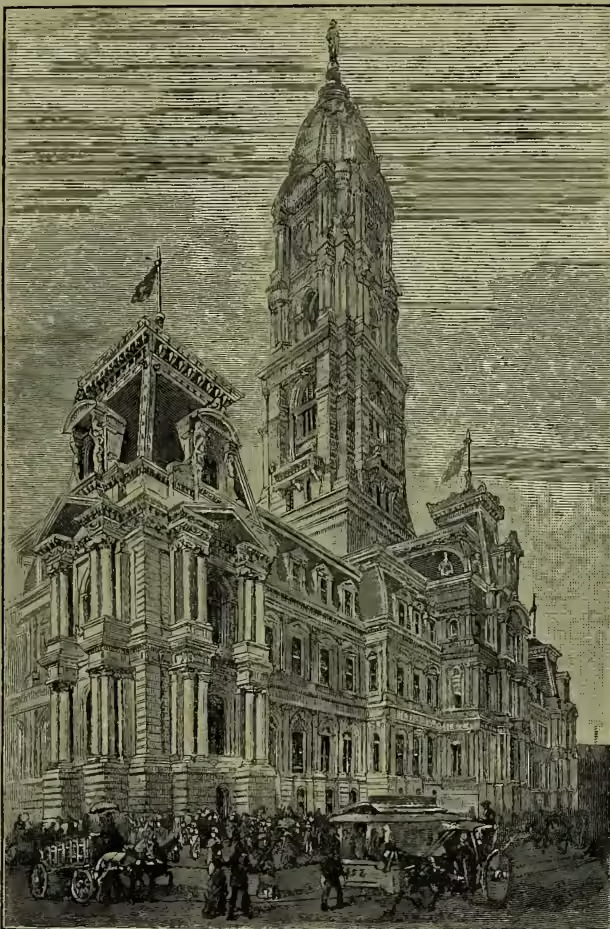
The dominant architecture of the older sections of the city is of the severely plain, substantial style which characterised its Quaker founders, and which until the second half of the 19th century held undisputed sway, its outstanding features being uniformity of design and a general employment of red brick as building material. A marked departure has, however, lately taken place in the style of both the public and the private buildings of Philadelphia, among the former of which the city hall (1871 et seq.), built of white marble upon a granite base, and covering an area of 486 by 470 feet, affords a striking instance. The height of the tower and dome is 537 ft. 4½ in.; or 573 ft. 4½ in. with the colossal figure of Penn (36 ft.), to surmount the whole, the structure being thus the second highest in the world. Over 500 rooms (mostly offices for city officials) are comprised in this edifice, and more than 14,000,000 had by 1891 been expended upon it; the entire cost, when completely furnished for occupancy, is estimated at 20,000,000. Other buildings worthy of note architecturally are the Masonic Temple, of granite, erected at a cost of over 1,500,000; a United States government building of granite—containing the Post-office, United States court-rooms, and other offices of the general government—which cost about 8,000,000; a custom-house of marble, modelled after the Parthenon at Athens; a naval asylum; the United States Mint; the Academy of Fine Arts; the Academy of Natural Science, a massive Gothic structure with an extensive scientific library and a museum of a million or more specimens; the Academy of Music; and the buildings of the University of Pennsylvania.
Nearly every street of importance is traversed by tramways, either horse, steam, cable, or electric. There are numerous well-shaded commons in the older portion of the city, some of which were laid out by William Penn at the foundation of his 'great towne' in 1682-83; while the Fairmount Park, some 3000 acres in extent, and bisected through its entire length of 10 miles or more by the Schuylkill River and its affluent the Wissahickon, stands without a rival among the pleasure-grounds of the great cities of the New World. In this park in 1876 was held the Centennial Exhibition; and in its environs are the Zoological Garden, the Fairmount Water-works, which supply to the city 100,000,000 gallons of water daily, the beautiful Horticultural Hall and Memorial Hall—remains of the Centennial Exhibition—the Laurel Hill Cemetery, &c. Among the statues in Philadelphia there are bronze equestrian figures of Generals Meade, McClellan, and Reynolds; and there is a monument at Germantown to the Union soldiers, and another in the grounds of Girard College to those of its former pupils who fell in the civil war.
The churches include the old Swedes Church (1700), Christ Church (Episcopal, 1727-54), where Washington's pew is preserved, and a Roman Catholic cathedral. There are some 75 Baptist churches in the city, 90 Episcopal, 40 Lutheran, 100 Methodist, 100 Presbyterian, 15 Quaker, 60 Roman Catholic, and a number of others. Philadelphia has almost from its foundation been noted for its benevolent institutions, but these have been greatly increased within recent years: prominent among such institutions are the Pennsylvania Hospital (1751), with suburban departments for the insane; Episcopal, Presbyterian, and Methodist hospitals, and the St Joseph's and St Agnes' hospitals; the hospitals in connection with the university and the several medical schools, &c.
The educational facilities of Philadelphia are very great. At the public schools, which are maintained at an annual cost of 2,600,000, there are 2700 teachers and 130,000 pupils, some 2000 of the latter belonging to the high and normal schools. In the Roman Catholic schools 30,000 children are enrolled. Besides the Girard (q.v.) College, the city contains the Drexel Industrial Institute (endowed with 2,000,000) and the Cahill Roman Catholic High School; and in Philadelphia or its immediate environs are the Williamson Free School of Mechanical Trades (endowed with some $2,200,000), state institutions for the blind and deaf and dumb, the Franklin Institute (1824, for the mechanic arts), Spring Garden Institute (for drawing, painting, and mechanical handiwork), the Episcopal Academy (1785), several Catholic colleges and convents, and Episcopal, Lutheran, and Roman Catholic theological seminaries. Crowning all these is the University of Pennsylvania, which began as an academy chartered by the sons of William Penn, became a college in 1755, and a university in 1779. At present it has over 1600 students and 75 professors and instructors, and embraces faculties of arts, science, architecture, natural history, and finance and economy (475 students), of medicine (680), dentistry (200), veterinary medicine (70), law (175), and physical education. The Jefferson Medical College (1825), with nearly 600 students, is one of the most famous medical schools of the United States; and others here are the Hahnemann
Medical College (1869), the Medico-Chirurgical College (1880), the Woman's Medical College (1850), and the Philadelphia Polyclinic and College for Graduates in Medicine.
Manufactures, Commerce, &c.—Though in its early history noted for its extensive shipping interests, as compared with those of its sister cities, it is rather as a manufacturing than as a commercial city that Philadelphia holds a present prominence. Here are immense establishments covering acres of ground, from which millions of dollars worth of products are issued annually for the home and foreign markets, besides smaller concerns innumerable. The aggregate capital employed in manufacturing is estimated at 300,000,000, the number of hands employed at 250,000, and the value of the annual product at 600,000,000.
Among the prominent industries of this class are the building of locomotives, of which 10,000,000 worth are constructed annually, employing some 5000 men; the manufacture of carpets, at which about 30,000 hands are employed, producing annually goods valued at about 50,000,000; woollen and worsted goods, employing 35,000 hands, and valued at 45,000,000; upholstery goods, valued at 25,000,000; cotton goods, 15,000,000, &c. General iron and steel products are computed to employ 40,000 hands, whose product reaches 75,000,000 in value—the single article of saws, principally made by one firm, giving employment to 5000 workmen, and amounting in value to $2,500,000. There are several extensive sugar-refineries, the out-put of which reaches 20,000 barrels of refined sugar daily, and gives direct employment to 2500 hands; oil-refineries, whose receipts of crude petroleum by railways and pipelines from the oil-fields of western Pennsylvania reach 6,000,000 barrels per annum; nearly 100 breweries; and several great chemical works.
The value of the exports for the fiscal year 1869-70 was 16,927,610; for 1879-80, 49,649,693; for 1889-90, 37,410,683. The imports for 1869-70 were valued at 14,483,211; for 1879-80, 35,944,500; for 1889-90, 53,936,317. In 1897 the total value of the foreign trade of Philadelphia was $95,406,642, including exports and imports; in the same year 5906 vessels entered and 5904 cleared the port.
Eminent Philadelphians have been: Kane the explorer; General McClellan; Dr Morton, of anæsthetic fame; the actors Edwin Forrest, Joseph Jefferson, and Hermann Vezin; Henry George; Charles Hodge; C. G. Leland; Kate Wiggins; and Frank Stockton.
The city government is almost entirely administered by the mayor through various departments—of public works and of public safety, each administered by a director who is appointed by him; of receiver of taxes, of city treasurer, of city controller, and of law, whose heads are elected for three years; a department of education governed by a board of 35 members (one from each city ward), who are appointed by the judges of the courts, and who serve without compensation; a department of charities and correction, whose officials are appointed by the mayor, and who serve without compensation; and a sinking fund commission. The legislative branch of the city government consists of a chamber of select council of thirty-five members (one from each ward) who are elected for three years, and a chamber of common council of 117 members who are elected for two years, all of whom serve without pay. The judiciary of the city and county consists of twelve judges of the Courts of Common Pleas and four judges of the Orphans' Court, all of whom are elected for ten years. There are besides twenty-eight magistrates elected for five years.
Founded in 1682 (see PENN), Philadelphia the year after was made the capital of Pennsylvania, and soon became a place of importance. It was the central point in the war of independence, and the city still preserves the Carpenters' Hall (1770), where the first congress met (4th September 1774), and the old State House (1735), with its Liberty Bell, where the Declaration of Independence (see INDEPENDENCE DAY) was adopted in 1776, and which has since been famous as Independence Hall. At Philadelphia, moreover, the federal union was signed, in 1778; and here, too, the constitution was framed, in 1787. An interest of another kind attaches to the fact that the Protestant Episcopal Church of North America was organised here in 1786. From 1790 to 1800 Philadelphia was the federal capital; and the first mint was established here in 1792. Later events have been the holding of the Centennial Exhibition, in 1876, and the commemoration of Penn's visit, in 1882. Pop. (1700) 4500; (1800) 70,287; (1860) 568,034; (1880) 847,170; (1890) 1,046,964.
See Scharf and Thompson's History of Philadelphia (3 vols. 1884); Philadelphia and its Environs (Lippincott, 1890); and works by Hazard (1879), Westcott (1877), Cook (1882), Woolsey (1888), and Agnes Repplier (1899).