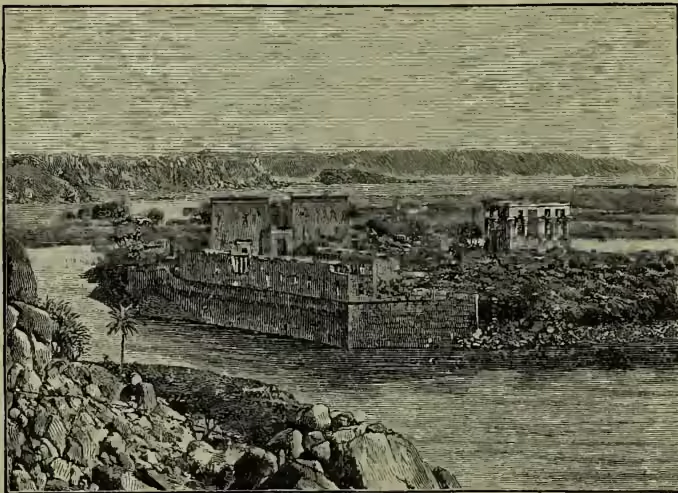
Philæ (Gr. Philai, Egyptian Pālek), an island in the Nile, near Assouan and south of Syene, in Nubia. It is a small granite rock, fringed with rich verdure, about 1200 feet long and 450 broad, almost covered with ancient buildings of great architectural beauty and interest, though not of very ancient date. That to the east, a hypæthral or roofless hall, commonly called 'Pharaoh's bed,' belongs to the Greek and Roman period, and consists of fourteen great columns with capitals of various patterns, connected at the lower part by solid walls; the length is 63 feet, the width 48. The great temple of Isis, to whom the island was sacred, was mainly built by Ptolemy Epiphanes, and continued by his successors, especially by Ptolemy III., Energetes. The processions of pilgrims approached the island from the south, were received by the priests at a flight of steps at the south-west corner, and then passed into a court with a colonnade to right and left, erected by Tiberius and later Roman emperors. To the north stood the great propylon or gateway, 60 feet high and over 120 wide. This is the oldest part of the temple, and bears the name of Nectanebes II. (about 361 B.C.). Beyond was another court with several chambers and a small chapel. Another smaller pylon gave entrance to the temple proper, at the northern extremity of the irregular complex of buildings. The temple proper was converted into a Christian church in 577. The plan for a great irrigation dam here, adopted in 1898, does not submerge or injure the ruins.