Phrenology (Gr., 'a discourse on the mind') was the name given about 1815 to the theory of mental philosophy founded on the observation and discovery of the functions of the brain concerned in intellectual and emotional phenomena, as formulated by Gall (q.v.). In Britain the system was amply expounded by Gall's pupil Spurzheim (q.v.), by George and Andrew Combe (q.v.), and by Dr Elliotson, founder and first president of the Phrenological Society; and in America by Dr Charles Caldwell of Kentucky, the brothers Fowler, and S. R. Wells. The connection of mind and brain was an old theory, and a kind of localisation of mental function in the brain had at various times been attempted from the days of Albertus Magnus downwards; but the first full-fledged system of empirical craniology or phrenology must be attributed to Gall, who established his scheme by inspecting the exterior of the heads of a considerable number of persons of different characters; and believing himself to find portions of the scalp corresponding to their mental and moral faculties, marked out on a model of the head the areas which were prominent in proportion to the strength of the various faculties. These faculties were by Spurzheim divided into two orders—Feelings and Intellect, or Affective and Intellectual Faculties. The Feelings were divided into two genera—the Propensities and the Sentiments; while the Intellectual embraced the Percptive or Knowing and the Reflective Faculties. Various modifications of Gall's scheme of localising the faculties were made by his pupils. American phrenologists (the Fowlers and S. R. Wells) increased the number of the faculties to forty-three; dividing the affective series into the domestic, selfish, moral, and self-perfecting groups, and the intellectual into the perceptive and reflective groups. The following is a representation of the human head from four points of view, showing the positions of the cerebral organs, according to Spurzheim and Combe:
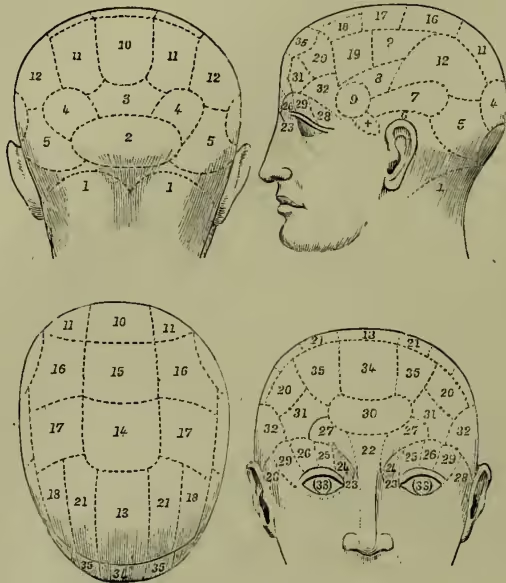
- 1. Amativeness.
- 2. Philoprogenitiveness.
- 3. Inhabitiveness or Concentrativeness.
- 4. Adhesiveness.
- 5. Combativeness.
- 6. Destructiveness and Alimentiveness.
- 7. Secretiveness.
- 8. Acquisitiveness.
- 9. Constructiveness.
- 10. Self-esteem.
- 11. Love of Approbation.
- 12. Cautiousness.
- 13. Benevolence.
- 14. Veneration.
- 15. Firmness.
- 16. Conscientiousness.
- 17. Hope.
- 18. Wonder.
- 19. Ideality.
- 20. Wit.
- 21. Imitation.
- 22. Individuality.
- 23. Form.
- 24. Size.
- 25. Weight.
- 26. Colouring.
- 27. Locality.
- 28. Number.
- 29. Order.
- 30. Eventuality.
- 31. Time.
- 32. Tune.
- 33. Language.
- 34. Comparison.
- 35. Causality.
The new science made many converts and became popular in most European countries. By 1832 there were about thirty phrenological societies, and several journals published in the interests of the system, which was supported by Macnish, Laycock, and Archbishop Whately. On the other hand, it was strongly controverted by Sir Charles Bell, Sir William Hamilton, Jeffrey, Brougham, Thomas Brown, and others; and their strictures and the progress of the scientific study of brain and mind in their various relations have to a large extent rendered it obsolete as a scheme. There is doubtless a large amount of truth in many of the generalisations. But anatomy and physiology have proved that the exterior surface of the brain is by no means an index to mental processes or characters; still less is such a guide furnished by the minute variations in the shape of the skull, which in a general way correspond to the exterior surface of the brain. Size of brain does not correspond directly to mental power or activity; nor is the superficial conforma- tion the most important feature of the brain. Parts of the external surface are known to have functions other than those attributed by phrenologists; the frontal sinus of the skull is sometimes large enough to occupy the region allotted to four or five phrenological organs; and there are many osteological differences in the various bones of the skull which obviously have nothing to do with brain-functions or mental processes. An outline of what is known as to the localisation of brain-functions will be found at BRAIN, Vol. II. p. 391. For craniological characters, see SKULL, ETHNOLOGY; and see also PHYSIOGNOMY, PSYCHOLOGY.
See the phrenological works cited at GALL, SPURZHEIM, COMBE; Broussais, Cours de Phrénologie (1836); Flourens, Examen de la Phrénologie (1842); O. S. Fowler, Practical Phrenology (1846); Laycock, Mind and Brain (1860); Professor Bain, On the Study of Character, including an Estimate of Phrenology (1861); the Phrenological Journal (1823-47); Carus, Grundzüge einer neuen Kranioskopie (1841), and Atlas der Kranioskopie (2d ed. 1864); Willich, Physiognomie und Phrenologie (1870); Scheve, Katechismus der Phrenologie (7th ed. 1884).