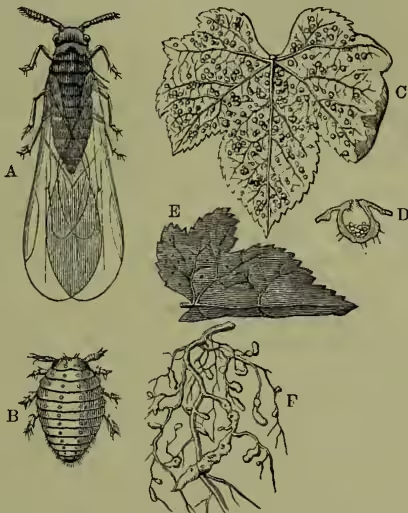
Phylloxera (Gr. phyllon, 'a leaf,' and xêros, 'dry'), a genus of insects belonging to a family (Phylloxerinae) nearly related to aphides and coccus insects, and included within the sub-order Homoptera in the order Hemiptera or Rhynchota. Two or three species occur in Europe, living like many related forms as parasites on plants. Most important is P. vastatrix, which ravages the vine, and has cost France alone a pecuniary loss far exceeding that of the Franco-German war. It seems to have been discovered in North America in 1854, and in all likelihood was carried thence to Europe, where it appeared about 1863. It now occurs in all vine-growing countries. In some of its features it is like a little aphid, measuring about th of an inch in one of its stages, or only a fourth of that in others, varying from yellow to reddish brown in colour. The antennæ are thick, with three joints; the legs are short and thick; there is no trace of the 'honey-tubes' characteristic of aphides; the winged forms, which are all parthenogenetic females, have four wings. As in the nearly related genus Chermes—a destructive parasite of conifers—the life-history is exceedingly complex.
Let us begin with the winged females, which in Europe appear from August to October. Each lays about four parthenogenetic ova on the under surface of the vine-leaves. These ova develop in late autumn into males and females—wingless and without the characteristic piercing and sucking mouth-organs—which migrate to the stem of the vine. There each female lays a single egg under the bark. This egg lies dormant throughout the winter, and develops in April or May into a wingless but voracious 'vine-louse.' This form may pass to the leaves, on which it lays parthenogenetic eggs, and forms galls; but in Europe it attacks the roots, and lays its eggs there. From these in about eight days young develop, which become mature females in about twenty days, and lay more eggs in the roots. Half a dozen or more of these parthenogenetic generations follow in rapid succession throughout the summer. The roots become knotted and deformed; the whole plant suffers, and, though it may survive for several seasons, eventually dies. In midsummer, among the subterranean forms, a generation is born whose members, after four, instead of the usual three, moultings associated with adolescence, become the larger winged females with which we began.
The destruction of this scourge of the grapevine, without also injuring or destroying the plants, has hitherto proved impracticable, owing to the difficulty experienced in reaching its subterranean haunts without disturbing or destroying the roots. Water, wherever it can be applied to the soil so as to saturate and keep it saturated for a time, has proved a safe and effectual destroyer, because the insect cannot live in a medium saturated with water for long. Chemical remedies, such as bisulphide of carbon, have been employed experimentally with success, but are found to be too expensive for general application on a large scale, even were the practical difficulty of conveying them into all depths of the soil and diffusing them in it surmountable. Several cases of attacks of phylloxera on vines in vineyards in England have occurred since 1865. These attacks have been usually met by the process of 'stamping out.' The vines were destroyed by burning, the earth in which they grew was wholly removed, the walls of the vineyard and the floor of the border on which the earth rested were thoroughly cleansed with salts or corrosives, and a fresh start was made with new earth and new vines; but while practicable to this limited extent, the remedy is obviously inapplicable to vineyards in districts collectively covering thousands of acres. In some of the French vineyards grafting the cultivated vines on certain of the native vines of America has been tried with some success. Although the insect seems to feed on the roots of these vines, the greater vigour of the American stocks appears to enable them to resist the injuries inflicted on them. Other chemicals—petroleum, tar, &c.—have been occasionally found helpful. Another method tried is the cherishing and multiplication of natural enemies of the phylloxera: these are numerous, and include Hophlophora arctata, Polycenus lagurus, Thrips, Aphidius, &c. The extent of the disease in France is noted at FRANCE, Vol. IV. p. 774. The devastations were not serious in Austria and Portugal till 1872, in Germany till 1881; but France has suffered by far the most. Other species, including perhaps some varieties, occur on the oak, the hickory, the chestnut, and the willow.
See M. Cornu, Études sur le Phylloxera vastatrix (1879); J. Lichtenstein, Histoire du Phylloxera (1878); C. V. Riley, Sixth Annual Report of the State Entomologist of Missouri (1874); and L. Dreyfus, Ueber Phylloxerinen (1889).