Pianoforte (Ital. piano, 'soft,' and forte, 'loud'), a stringed musical instrument, played by keys, developed out of the clavichord and Harpsichord (q.v.), from which the pianoforte differs principally in the introduction of hammers, to put the strings in vibration, connected with the keys by a mechanism that enables the player to modify at will the intensity of the sounds; whence the name of the instrument. The invention of the pianoforte must be accredited to Bartolomeo Cristofali, a native of Padua, who produced his instrument in 1714. Other claimants to the honour are a German organist of the name of Schröter, and Marius, a French harpsi- chord maker. The first pianoforte seen in England was made at Rome by Father Wood, an English monk there. In Germany the invention met with more rapid encouragement and development than in Italy. The Silbermanns in Strasburg and Stein of Augsburg improved the discoveries of their countryman Schröter, and many Germans are found to maintain that the pianoforte is an independent invention indigenous to the Fatherland. In England the manufacture of the instrument was at first chiefly in the hands of foreigners, principally Italians. Italian pianoforte-makers opened many shops, but the English makers ultimately rivalled and surpassed them. The English pianoforte has been brought to its present state of perfection by Broadwood, Collard, Brinsmead, and others. Erard made many improvements in France; Germany has long been famous for its pianos, including those of Bechstein; and the American pianos of Steinway and Chickering are well known.
The compass of the early pianoforte was, like that of the harpsichord, four to five octaves, and has gradually increased to seven octaves, or occasionally more. The most natural of the various forms which the instrument assumes is that of the grand pianoforte, derived from the harpsichord, with the strings placed horizontally, and parallel to the keys. The strings are stretched across a compound frame of wood and metal, composed of bars, rods, and strengtheners of various kinds—appliances necessary to resist the enormous tension. This framework includes a wooden sound-board. The mechanism by which hammers are connected with the keys is called the action of the instrument. In the earliest pianofortes the hammer was raised from below by a button attached to an upright wire fixed on the back-end of the key. The impulse given to the hammer caused it to strike the string, after which it immediately fell back on the button, leaving the string free to vibrate. This was called the single action. As the hammer, when resting on the button with the key pressed down, was thus necessarily at a little distance from the string, the effectual working of this action required that a certain impetus should be communicated to the hammer to enable it to touch the string. Hence it was impossible to play very piano, and it was found that, if the hammer was adjusted so as to be too close to the string when resting on the button, it was apt not to leave the string till after the blow had been given, thereby deadening the sound. This defect was remedied by a jointed upright piece called the hopper, attached to the back-end of the key, in place of the wire and button. When the key was pressed down the hopper, engaging in a notch in the lower side of the hammer, lifted it so close to the hammer that the lightest possible pressure caused it to strike; and at this moment, when the key was still pressed down, the jointed part of the hopper, coming in contact with a fixed button as it rose, escaped from the notch, and let the hammer fall clear away from the string. To prevent the hammer from rebounding on the string a projection called the check was fixed on the end of the key, which caught the edge of the hammer as it fell, and held it firmly enough to prevent it from rising. A necessary part of the action is the damper, which limits the duration of each particular note, so as to cause it to cease to sound as soon as the pressure is removed from the key. It consists of a piece of leather resting on the top of the string and connected with the back-part of the key by a vertical wire. When any key is pressed down its damper is raised off the string, so as to allow the sound produced to be clear and open; but immediately on the finger being lifted off the key the damper-wire falls, and the damper again presses on the string, muffling and stopping the vibration. The pianoforte possesses two pedals, the loud and the soft. By the former the dampers are raised, the result of which is to prolong the sound of the notes and cause them to run into one another. The employment of this pedal is designated by the word ped. written below the treble staff, while an asterisk is used to denote its cessation. The soft pedal, on the contrary, diminishes the sound, by removing a string from the impact of each of the hammers. Its employment in the music is denoted by the words una corda. One further frequent and important addition to the action may be alluded to. In the mechanism above described the key must rise to its position of rest before the hopper will again engage in the notch of the hammer for another stroke; hence a note cannot be repeated until time has been allowed for the full rise of the key. The repetition action is a contrivance, varying in different instruments, for getting rid of this defect by holding up the hammer at a certain height while the key is returning.
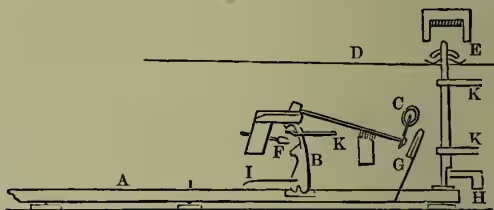
Great difference of detail exists in the actions of different makers. Some are more complicated than others; but in all are to be found the same essential parts, only modified in shape and arrangement. The subjoined figure represents one of the simplest grand pianoforte actions now in use. A is the key; B, the lever which raises the hammer; C, the hammer; D, the string; and E, the damper: F is the button which catches the lever after it has struck the hammer; G, the check; H, the damper pedal-lifter; I, the spring; and K, K, K are rails and sockets. Formerly the strings of the pianoforte were all of thin wire; now the bass-strings are very thick, and coated with a fine coil of copper-wire; and the thickness, strength, and tension of the strings all diminish from the lower to the upper notes. A grand pianoforte has three strings to each of the upper and middle notes, and now, generally, only two to the lower notes, and one to the lowest octave. When the soft pedal is pressed down the hammers are shifted sideways, so as to strike only two strings instead of three, or one string instead of two.
Besides the full or concert grand, there is the semi-grand or square piano with curtailed keyboard, now superseded by the cottage piano, of which the upright grand is merely a larger form. In the cottage piano the strings run vertically from top to bottom of the instrument; and the difference in form necessitates alterations in the details of the action, but the general principle is the same. The pianette, a small form of the cottage, has also come into great favour. The pianoforte has attained a widespread popularity, owing chiefly to the fact that it can render harmony; though the violin is proving a serious rival to it in domestic circles. In England the manufacturers who have for some time past enjoyed the highest repute are Messrs Broadwood, Brinsmead, and Kirkman. Messrs Brinsmead have lately introduced a patent pianoforte called the Sostenente, in which, by a number of hammers playing consecutively on a string, and so closely as to cause no interruption in the sound, any note may be sustained (whence the name sostenente) for an indefinite length of time, and the same solemn and majestic effect may be produced upon the pianoforte which has heretofore been confined exclusively to the organ. The latest development to which the pianoforte has been carried is that introduced by an Austrian of the name of Janko. A great number of his pianos are now being made. Recognising the complete change which has passed over pianoforte music since the days when Mozart and Haydn wrote and, so to speak, created the literature of the instrument, Herr Janko has endeavoured to adapt the piano to the long stretches, chords, and difficult arpeggios which are the characteristics of modern playing, and were utterly unknown, or rather unemployed, in the days of the classical writers. Accordingly, he constructs his pianos with six keyboards, which rise in tiers above one another in the manner of an organ. The notes are so grasped that tenths and twelfths can be easily spanned by reaching a finger to a keyboard above or below that on which the hand is travelling; and, with a sweep of the wrist, which would scarcely cover more than two octaves on the old keyboard, an arpeggio can be executed through the whole compass of the piano's notes. The objections to Herr Janko's improvement come mainly not from the public but from the music publishers; for, while to a beginner on the instrument it is immaterial what system of fingering be adopted, publishers are naturally jealous of a new pianoforte which would render useless and compel complete remodelling not only of all the fingering, but perhaps of the staff.
Music for the pianoforte is written in two staves, and with the treble and bass clefs. Many of the most eminent musicians have devoted themselves to composing for the pianoforte, and some composers of note, as Hummel, Chopin, Thalberg, and Heller, have almost entirely confined themselves to that instrument. Amongst the greatest modern pianists have been Madame Schumann, Liszt, and Rubinstein. See Rimbault, The Pianoforte (1860); Grove's Dictionary of Music and Musicians; and the histories of music and of musical instruments (such as Hopkins's Musical Instruments, 1887).