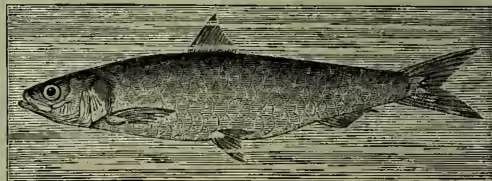
Pilchard (Clupea pilchardus, or Alosa sardina), an important fish of the family Clupeidæ. The pilchard is nearly equal in size to the herring, but rather thicker, and the lines of the back and belly are straighter; the scales are also larger and fewer; and the dorsal fin is rather farther forward. The mouth is small, and in the adult fish destitute of teeth; the under-jaw is longer than the upper. The upper part of the body is bluish green, the sides and belly silvery white, the cheeks and gill-covers tinged with golden yellow, and marked with radiating striæ, the dorsal fin and tail dusky. The pilchard is an inhabitant of more southern seas than the herring. In British seas it is abundant off the coasts of Devon and Cornwall, and the south and south-west coasts of Ireland; towards the east end of the English Channel it becomes scarce, and off the more northern coasts of the British Isles it is only taken occasionally in small numbers. It extends in abundance throughout the Bay of Biscay, along the west coast of Portugal, and the shores of the Mediterranean; its southern limit is Madeira. In France this fish is known as la sardine. It is true that the sardines in oil imported into Great Britain are smaller than the majority of English pilchards, but they are of the same species. The English pilchard is usually about 10 inches long. The French sardine is said by Moreau to be from 12 to 20 cm. in length—i.e. 5 to 8 inches—sometimes reaching 25 cm. or 10 inches. The fish used for preserving in France are certainly young and not full grown. Pilchards are now prepared in oil in the same way as French sardines, at Mevagissey in Cornwall, and have an extensive sale; so are Sprats (q.v.) at Deal. The fish are captured both by drift-nets and seines; the former method is pursued along the south coast of Devon and Cornwall, while the principal seat of the seine-fishery is St Ives. The drift-net fishing begins in August and continues with fluctuations until the following April, the largest number being landed in November, December, and January. The drift-nets are each 120 yards in length, and a fleet consists of twelve to fifteen, fastened together, and extending to nearly a mile. They are 6 fathoms in depth, and the meshes are usually thirty-six to thirty-eight to the yard. The mesh of the nets used on the French coast is much smaller, not exceeding ths of an inch square. The smallest seines used at St Ives are 160 fathoms long, with a depth of 8 fathoms at the centre, and 6 fathoms at the wings; the meshes are ths of an inch square. In the seine the fish are not meshed; if they were they would cause the net to sink. There are only six 'stations' or places fit for hauling the seine at St Ives, and over two hundred seines. The nets are therefore divided into groups, and each net has to await its turn at the station to which it belongs. The regulations of the fishery are contained in the Sea-fisheries Act, 1868, 31 and 32 Vict. chap. 45, sect. 68. The seine-fishery is carried on principally between August and Christmas. Most of the pilchards landed in Devon and Cornwall are salted for the Mediterranean market, especially Italy. They were formerly cured dry, the fish being piled in heaps with salt on a floor, and the brine and oil draining away from them constantly. After remaining thus about a month the fish were sifted from the salt, washed, packed in barrels, and subjected to pressure which forced more oil from them. But at present the salting is carried out in watertight vats, so that the brine formed rises over the fish, and they are kept steeped in the liquid for several weeks or months. They are then washed, packed, and pressed as before, the oil being collected and sold principally for the use of leather-dressers. This wet process produces much cleaner and brighter-looking fish than the old dry process. Twelve thousand to fifteen thousand hogs-heads of these cured pilchards are annually exported to the Mediterranean, each hogshead containing from 2500 to 3000 fish, and weighing 476 lb. gross. A large number of pilchards are also used as bait for long-line and hand-line fishing, and a good many are eaten fresh locally or in distant markets.
Unlike herrings, the pilchards which are captured are not in breeding condition, but are fat, with small reproductive organs. In fact the habits of the pilchard are the direct converse of those of the herring. The pilchard is found feeding near shore in more or less abundance for nine months of the year, but in June, July, and August, when as a rule none are being caught near shore, spawning pilchards are found at some distance, 10 to 50 miles or more, from the land. At this season a few are occasionally taken in mackerel nets, in which the largest ones are meshed in consequence of their swollen condition. The ova, unlike those of the herring, are quite transparent, and buoyant like those of the cod and mackerel; they pass through their development while suspended separately in the sea-water. Like the herring, the pilchard feeds upon minute crustacea and other animals, some adult, some larval, which swarm in the sea.
The principal foreign fisheries are at Concarneau and other places in the Bay of Biscay, the month of the Tagus in Portugal, and Marseilles, Nice, and other ports in the Mediterranean. In Scotland the pilchard is known as the Gypsy Herring, Garvie Herring (the sprat being Garvie), or Crue Herring.