Pillar, a detached support like a column; but its section may be of any shape, whereas the column is always round. Pillars have been used in all styles of architecture, and their forms and ornaments are usually amongst the most characteristic features of the style. The Greek and Roman pillars (or columns) are the distinguishing elements in the various orders. In Gothic architecture, also, the pillars or piers are of different forms at the various epochs of that style. In the Norman period we have plain massive pillars, square, circular, and octagonal, frequently ornamented with zigzag ornaments, spiral bands, &c. on the surface (fig. 1). As vaulting progressed, the system of breaking the plain surface of the pier, and giving to each portion of the vaulting a separate little column or shaft to support it, was introduced. This was done either by attaching shafts to the pillars, or by cutting nooks in the pillars and setting little shafts in them, thus: a, b, fig. 2. In the Early Pointed style a plain circular or octagonal pillar, with a number of small shafts attached around it, is a favourite arrangement, thus: c, d, fig. 2. In this style the attached shafts are very frequently banded to the main pillar at different heights, and they are sometimes made of a finer material, such as Purbeck marble. In the Decorated style the pillar is of a lozenge form, and not so much ornamented with detached shafts as with mouldings; plain, circular, or octagonal pillars, however, are used in this, as in all the styles. The mouldings and shafts
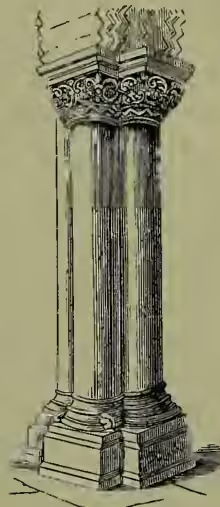
Norman Clustered Pillar.
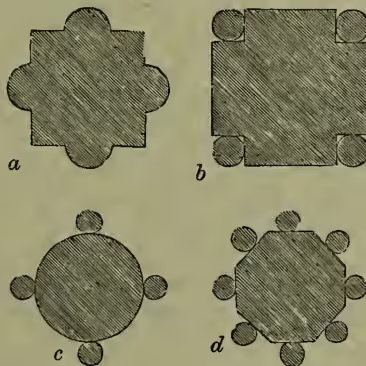
are usually filleted; and some of the mouldings run up into the arch without any cap. In Perpendicular the same idea is further carried out; the mouldings become thinner, and are more frequently run up into the arch without caps. See FLAMBOYANT.