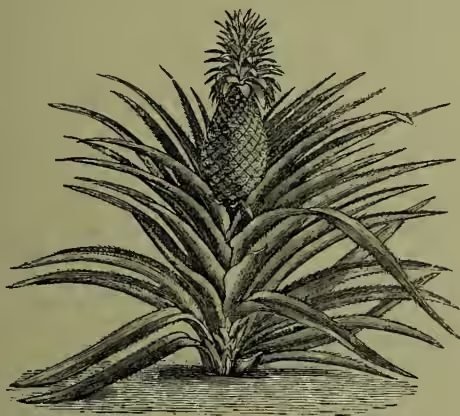
Pine-apple, or ANANAS (Ananassa sativa), a plant of the natural order Bromeliaceæ, highly esteemed, and much cultivated for its fruit. The fruit is a sorosis, formed by the calyces and bracts of a close spike of flowers, becoming succulent and combined. This is the distinctive character of the genus Ananassa. The pine-apple has a number of long, serrated or smooth-edged, sharp-pointed, rigid leaves, springing from the root, in the midst of which a short flower-stem is thrown up, bearing a single spike of flowers, and therefore a single fruit. From the summit of the fruit springs a crown or tuft of small leaves, capable of becoming a new plant; the pine-apple, in cultivation, being propagated entirely by crowns and suckers, as, in a state of high cultivation, perfect seed is almost never produced. The pine-apple is a native of tropical America; it is found wild in sandy maritime districts in the north-east of South America, but it has been very much changed by cultivation. It has also been gradually diffused over tropical and subtropical countries, and not only as a cultivated plant, for it is fully naturalised in many parts both of Asia and Africa. It delights in a moist climate, and consequently does not succeed well in the dry climate of the south of Italy, although the warmth is sufficient. The first particular account of the pine-apple was given by Oviedo in 1535. It was in Holland that it first began to be cultivated in hothouses; but it was introduced into England from that country in 1690, and first cultivated by Mr Bentinck, ancestor to the ducal family of Portland; and its cultivation rapidly became general in the gardens of the wealthy. It is only since the peace of 1815 that it has received similar attention in continental Europe. Great care is requisite in the cultivation of the pine-apple, which without it is generally fibrous and coarse, with little sweetness or flavour, and with it one of the most delicate and richly flavoured of fruits. Its size, too, very much depends on cultivation, but there is also considerable difference in the size of the fruit in different varieties, the largest not being always the most luscious and superior in flavour. The size varies from 2½ lb. to 12 lb. in weight. The pine-apples grown in British hothouses are generally much superior to those of the West Indies, because the latter grow almost or altogether without cultivation: but the importation of pine-apples from the West Indies has now been carried on to a considerable extent, and, as it promises to add to the sources of wealth for these colonies, this has led to greater care in cultivation there, and consequent improvement of quality.
Formerly the culture of the pine-apple in Britain was a costly and extremely tedious process. Since very early after its introduction it has always been cultivated in hothouses specially appropriated to it called pine-stoves, which were heated with smoke-flues, with tanners' bark or oak-leaves and dung for bottom heat. But by the universal adoption of hot water in horticultural heating the labour and cost attendant on those clumsy expedients have been much reduced and better results attained. Along with this there has been brought about a more rational treatment of the plants. Instead of high tropical ground and atmospheric heat being maintained in winter, which resulted in destroying the roots of the plants in the preliminary stages of their growth, and so retarded or deferred their fruiting period, the skilful pine-grower now finds that success is best assured by adopting a minimum of 60° of air-warmth and 75° of bottom-heat at that season. By these and other improvements in treatment superior fruit is obtained in half the time formerly considered necessary. The pine-apple is cultivated in pots or planted out in beds. It is more completely under control in pots than planted out, hence the results are always more certain when it is grown in that way. It is propagated by suckers and by the crowns that surmount the fruit; but, except in the case of varieties which produce the former too sparingly for the requirements of stock, the latter are usually rejected because they do not make so good plants nor fruit so quickly as a rule. The varieties of the pine-apple that are worthy of being cultivated in Britain are few. For producing superior fruit in winter the Smooth Cayenne and Black Jamaica are two of the best and most reliable, and the Queen, of which there are several sub-varieties, is the most highly esteemed for summer fruiting. Turfy, fibrous, sandy loam that has lain in a stack for nine or twelve months is an excellent soil for the pine-apple. A spirituous liquor (Pine-apple Rum) is made from the pine-apple in some warm countries. The use of the fibre of the pine-apple is noticed in the articles BROMELIACEÆ, FIBROUS SUBSTANCES. For Pine-apple Oil, see BUTYRIC ETHER.