Pine (Pinus), a genus of trees of the natural order Coniferae (q.v.). Pinus is distinguished by noncocious flowers, and woody cones with numerous two-seeded scales, the scales having an angular truncated apex. The leaves are linear and very narrow, growing in clusters or in pairs, and surrounded by scarious scales at the base. To this genus belong many noble and useful trees. They mostly grow in mountainous or other exposed situations, and their narrow leaves are admirably adapted to evade the force of winds, which produce in the tops of pines a peculiar sound, much noticed by the ancient poets, more soft and continuous than in trees of richer foliage. Most of the pines are more or less social, one kind often covering a considerable tract; some of them clothing the sides and even the summits of mountains with magnificent but sombre forests; some growing in lower situations, on otherwise unproductive sandy grounds, as the Pine Barrens of North America. The pines growing in the most barren soils, or in the coldest climates and most exposed situations, are often very small, and, although very unlike any other shrubs or bushes, are scarcely to be called trees. Pines are widely diffused over the northern hemisphere, being found on mountains within and near the tropics, and in the colder temperate and the arctic regions descending to the level of the sea.
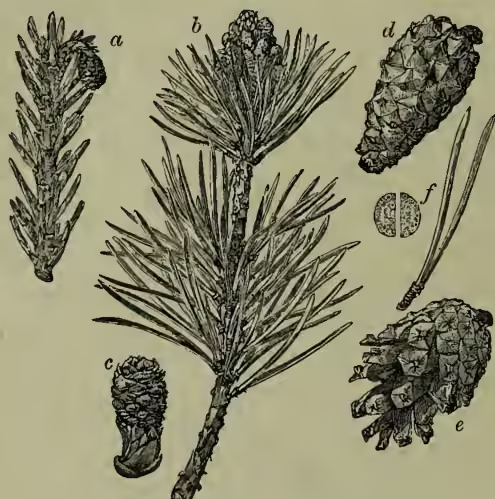
The Scotch Pine, commonly but erroneously known as the Scotch Fir (P. sylvestris), is the only species indigenous to Britain. It has leaves in pairs, about an inch and a half long, the cones about the same length, obtuse, and with unarmed scales. On very poor soils and at great elevations it is reduced to a kind of shrub, but in favourable situations it becomes a lofty tree. A plank five feet and a half in diameter has been obtained from a Scottish forest. The Scotch pine is of quick growth, but has been known to attain the age of 400 years. Its head is somewhat conical or rounded, and the lower branches die off as the tree grows, leaving the older trees bare of branches for the greater part of their height; but it is more apt to send off large branches than most of the Conifera. There are still native forests of Scotch pine at Braemar and elsewhere in the Highlands of Scotland; and even in the south of Scotland noble trees are to be seen which, probably, were not planted by man. The Scotch pine is not indigenous to the south of England, but, having been introduced, is spreading rapidly and spontaneously, along with the Pinaster, in some of the heaths and other unfertile tracts. Immense forests of it exist in some countries of Europe, in some of which it is mingled with the Spruce Fir. In the middle and north of Europe and of Asia it is found even in plains near the level of the sea, especially where the soil is somewhat sandy; in the south of Europe it grows only on mountains. Its timber is highly valuable, being very resinous and durable, and is the Red Deal or Red Pine used in house and ship carpentry. There is very great difference, however, in the timber of Scotch pine growing in different soils and situations, rich soils and sheltered situations being unfavourable to the quality of the timber, which becomes white, soft, and comparatively worthless; and there exist several varieties of Scotch pine, some of which yield timber very superior to others. Many plantations in Britain have, unfortunately, been made of inferior kinds. One of the best varieties is that which forms the northern Scottish forests, often designated Braemar Pine by nurserymen. It is remarkable for its very horizontal branches, and is therefore sometimes called P. horizontalis. The Scotch pine is not only valuable for its timber, which is available for some purpose at every stage of its growth, but on account of other products. Common Turpentine is obtained from it, and much Tar, Pitch, Resin, and Lampblack (see these heads). Oil of turpentine is sometimes distilled from the cones, and even from the leaves; the leaves have also been used for the manufacture of Pine-wool (see FIBROUS SUBSTANCES, Vol. IV. p. 606). The resinous roots are dug out of the ground in many parts of the Highlands of Scotland, and, being divided into small splinters, are used to give light in cottages instead of candles. Fishermen, in some places, make ropes of the inner bark, which is applied to a very different use, when most soft and succulent in spring, by the Kamchatdales and Laplanders, being dried, ground, steeped in water to remove the resinous taste, and used for making a coarse kind of bread.
The Dwarf Pine (P. Pumilio) is found on the Alps and Pyrenees, its trunk often lying on the ground, although sometimes it appears as a bush or low tree. The leaves are in pairs, very like those of the Scotch pine, but a little longer; the cones
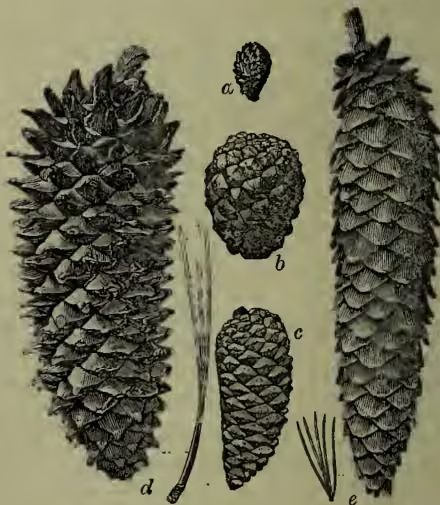
Cones of (a) Pinus montana; (b) P. pinea; and (c) P. Pinaster. Cones and needles of (d) P. coulteri; and (e) P. Lambertiana. All about natural size. are also similar. From the young shoots an oil resembling oil of turpentine is obtained by distillation, which is a kind of universal medicine among the peasantry of Hungary, as is also the resin spontaneously exuding from the tree, which is known as Hungarian Balsam. The Black or Austrian Pine, or Black Fir (P. nigricans, or P. austriaca), is another species closely allied to the Scotch pine, but remarkable for its very long leaves. It is a native of Austria. It abounds in resin more than any other European tree. To the same group of pines belongs the Seaside or Taurian Pine (P. Pallasiana, maritima, or taurica), which also affords resin in great quantity, and of a very pleasant odour. It is found in many parts of the south of Europe. Its timber is of little value; but great part of the turpentine of the Landes and other maritime districts of France is obtained from it. It yields also part of the Burgundy Pitch of the apothecaries' shops. The Aleppo Pine (P. halepensis), a native of the south of Europe, Syria, &c., is a very graceful tree of moderate size, with leaves in pairs and slender. It yields a liquid resin or turpentine, which is extracted from it in Provence and elsewhere, and sold as Venice Turpentine. The wood is extensively used in the Levant for shipbuilding. The Laricio (P. Laricio) has leaves in pairs, lax, and 4 to 8 inches long, cones 2 to 4 inches long, with the scales slightly pointed. It is often called the Corsican Pine. It grows on the shores of the Mediterranean Sea, and is valuable both for its timber and for its resinous products. In the island of Corsica it frequently attains the height of 140 feet. It grows well in sandy soils, and has been made particularly useful for preventing the drifting of the sand, and turning to account the otherwise useless tracts between the mouths of the Garonne and the Adour in France, thus also preserving valuable lands which the sand threatened to overwhelm. The Pinaster or Cluster Pine (P. Pinaster) is another of the most important European species. It has cones in whorls of 3, 4, or even 8 together, 4 to 6 inches long, leaves in pairs, and very long. It is found on the shores of the Mediterranean, and also in the Himalayas and in China. It has been used in France to a great extent, in the same way as the Laricio, for covering waste sandy tracts. The timber is of inferior quality, but great quantities of resin are procured from it. It yields Bordeaux Turpentine. The Pyrenean Pine (P. pyrenaica) is a majestic tree, a native of the Pyrenees, and producing very fine timber. The Calabrian Pine (P. brutia) somewhat resembles the Pinaster. The Stone Pine (P. pinea), a tree with a broad umbrella-shaped head, a form often seen also in the Scotch fir, forms a characteristic feature of the scenery of the Mediterranean. It is the Pinie of the Germans, the Pignon of the French. The leaves are in pairs, 4 to 5 inches long, the cones very large, ovate, and obtuse. The seeds, which do not ripen till the fourth year, are large, abound in a fixed oil, and when fresh, have a sweet taste resembling that of almonds. They are used in Italy and other countries in the same way as almonds and pistachio nuts for the dessert, in various dishes, also in emulsions, &c., under the names of pinies, piniolos, and pignons. The use of them, however, is almost entirely confined to the countries in which they are produced, as they very soon become rancid. They are sometimes imported into London in the cone, in which way they can be kept longer, but the cost of importation is much increased. The wood of this tree is very useful and beautiful. It yields resinous products only in small quantity. The Cembra Pine, or Swiss Stone Pine, which grows in the central parts of Europe and the south of Siberia—a stately tree, with the lower branches more persistent than they are in most pines, and rigid leaves in groups of three to five—also produces eatable seeds (Cembra Nuts). The Cembra Pine yields a pellucid, whitish oil, resembling oil of turpentine, and known as Carpathian Balsam.
North America produces many species of pine, some of them very beautiful and very valuable. Besides those long known, and which are found in the states and colonies near the Atlantic, a number of the noblest species of this genus have, since the commencement of the 19th century, been discovered in California and the north-western parts of America. The Red Canadian Pine (P. resinosa) is found from Canada to the Pacific, but does not reach far south in the United States. It is the Yellow Pine of Canada and Nova Scotia. It delights in dry and sandy soils, and attains a height of 70 to 80 feet, with a diameter of 2 feet at the base, the trunk continuing of uniform diameter for two-thirds of its length. The leaves are in pairs, and are congregated towards the extremities of the branches. The timber is highly esteemed for strength and durability, and furnishes excellent planks for shipbuilding. It is also used for masts. Somewhat resembling this in botanical characters is the Scrub Pine, or Gray Pine (P. Banksiana), generally only 3 to 10 feet high, which begins to appear in the northern parts of the United States upon high mountains, and is interesting as an arctic species, extending farther north than any other. The Yellow Pine (P. variabilis, or P. mitis) abounds in the Atlantic states from New Jersey to Virginia. It is a tree 50 to 60 feet high, 15 to 18 inches in diameter at the base, with leaves 4 to 5 inches long, usually in pairs, but sometimes in threes upon the younger shoots. The timber is very extensively used for shipbuilding, and is largely exported to Great Britain. At Liverpool it is known as New York Pine. The Jersey Pine, or Scrub Pine (P. niops), abounds in the lower parts of New Jersey, and thence to the south-west. The leaves are in pairs, 1 to 2 inches long, the cones armed with strong spines. The tree is rarely 30 or 40 feet high. Great quantities of tar are made from it in Kentucky. The Pitch Pine (P. rigida) is a native of the northern and middle parts of the United States, often growing in great miry swamps, and attaining a height of 70 to 80 feet, and a diameter of 2 feet at the base. The leaves are in threes, varying much in length, as the cones do in size. Immense quantities of it are used for fuel. Tar and lampblack are sometimes made from it. The Lobolly or Old Field Pine (P. tæda) grows in dry and sandy soils in the lower parts of the southern states, often occupying lands exhausted by cultivation. Vast tracts never cultivated in the southern states are Pine Barrens, in great part covered with this species of pine. It attains a height of 80 feet and upwards, and has a wide-spreading crown. The leaves are 6 inches long, in threes, sometimes in fours on young branches; the cones 4 inches high, with strong spines. The timber is not of much value. The Long-leaved Pine, or Southern Pine (P. palustris, or P. australis), is perhaps the most important of North American forest trees. It furnishes the greater part of the tar, resin, pitch, and turpentine used in the United States. The timber is also very valuable, and is much used for shipbuilding. In England and the West Indies it is known as Georgia Pitch Pine. The tree attains a height of 60 to 70 feet, and a diameter of about 16 to 18 inches; the leaves are in threes, and about a foot long, the cones 7 to 8 inches long, and 4 inches in diameter, with small spines. The seeds are sometimes eaten. The White Pine (P. strobus), called in Britain the Weymouth Pine, from its having been largely planted by Lord Weymouth, attains a height of 150 feet, and a diameter of 5 feet and upwards. It has lax sub-triangular leaves in groups of five, and pendulous cones 4 to 5 inches long, with thin smooth scales. It is frequently planted in Britain and on the continent of Europe for its beauty. In its native country it abounds chiefly from lat. 47° to lat. 43°, and southward to the Alleghanies. The timber is not strong, but easily wrought and durable. Of the species belonging to the north-western parts of America one of the most magnificent is P. Lambertiana, which is found on the Rocky Mountains between lat. 40° and lat. 43°, chiefly on sandy soils. It attains a height of 150 to 200 feet, and a diameter of 7 feet and upwards, almost to 20 feet. The trunk is remarkably straight, and destitute of branches for two-thirds of its height; the leaves in fives, the cones upwards of a foot long. The timber is white, soft, and light; and the tree produces great quantities of a pure amber-coloured resin, which, when the wood is partly burned, is changed into a somewhat saccharine substance, used by the Indians as a substitute for sugar. The seeds are eaten either roasted or pounded into coarse cakes. P. flexilis is found on the Rocky Mountains, near the head-waters of the Arkansas, and occurs almost to the limit of perpetual snow. It has a dense crown formed of numerous and remarkably flexible branches. The leaves are in fives. The seeds are used as food by hunters and Indians. P. ponderosa, another native of the Rocky Mountains, is a magnificent tree, remarkable for the heaviness of its timber, which almost sinks in water. The leaves are in threes, and 9 to 14 inches long. P. Sabiniana, P. Coulteri, and P. insignis are also noble species from the west of North America.
The Himalayas abound in pines, some of which rival in magnificence those of North-west America. The Bhutan Pine (P. excelsa), much resembling the Weymouth Pine in its botanical characters, and attaining a height of 90 to 120 feet, abounds in Bhutan, although it is not found in the neighbouring countries of Sikkim and Nepal. The wood is highly valuable, being durable, close-grained, and so resinous as to be used for flambeaux and candles. The Cheer Pine (P. longifolia) of India is a tree of remarkable and most graceful appearance, with leaves in threes, very long, very slender, and generally pendulous. It is abundant on the crests of hills in the lower Himalayas, growing at a lower elevation than the other pines. It is cultivated in some parts of India as an ornamental tree. It is much valued for its resin. The wood is used in India as a substitute for European deal. The Khasia Pine (P. khasiana) is peculiar to the Khasia Mountains, and has very much the general appearance of the Scotch pine. P. Gerardiana, a species with leaves in threes, is a large tree, a native of Nepal. The seeds are eatable. The mountains of India and the north-western parts of America produce numerous other species; Mexico has a number of very fine ones peculiar to itself; the mountains of St Domingo have one; the Canary Islands have one; China and Japan also have some. Most of those which have been named, and a number of others, are now readily to be procured in nurseries in Britain, although some of them only at prices which prevent any attempt at extensive plantation. Some wealthy noblemen and gentlemen devote a portion of their grounds to a collection of different kinds of pine, called a Pinetum. A few foreign species have become pretty common in plantations. Most of the pines are quite hardy in Britain, but this is not the case with the Cheer Pine and some of the Mexican species. The name pine is often popularly extended, and even in scientific works, to other Conifera; many trees called pine being properly treated as Fir.
PINE-TIMBER.—This term is in general use for the timber of the pine-tribe (see CONIFERÆ), and is not confined to that of the genus Pinus, but embraces the wood of species of Abies, Larix,
Araucaria, Dammara, &c. From the Baltic ports come red wood and white wood. The former is yielded by the Scotch Fir (Pinus sylvestris), and the latter by the Spruce Fir (Abies excelsa). These two, with the Larch (Larix europæa), yield the greatest part of the pine-timber of Europe. Next in importance to these is the pine-timber of the British North American colonies, which is chiefly yielded by the Weymouth Pine (Pinus strobus). This wood is best known in America as white pine, but in Great Britain and in commerce generally it is called yellow pine. Commercially it is the most important timber of Canada and the eastern states of America. The yellow pine of this part of America is the Pinus mitis, also a valuable timber-tree. Red pine, usually called northern red pine (Pinus resinosa), is found from Canada to Pennsylvania; it is intermediate for durability between white pine and pitch pine. The celebrated pitch pine of the eastern states of America is the product of Pinus rigida. It is used for ships' masts and yards, and for purposes requiring great strength and durability, in both of which qualities it excels most others of its kind. The kinds above mentioned are those which constitute the greater part of the pine-timber used in ship and house building, carpentry, &c. in Great Britain and the eastern side of America. In France the timber of the Corsican Pine (Pinus Laricio) and the Seaside Pine (Pinus Pinaster) are greatly used. In Central and Southern Italy the pine-timber is chiefly yielded by the Stone Pine (P. pinea) and the Calabrian Pine (P. bruttia); that of Spain is from the Pyrenean Pine (P. pyrenaica). In Germany, and especially in Austria, the Black Pine (P. austriaca) furnishes the greater portion; but the fine-grained, soft white pine, or deal, so much used for sounding-boards of musical instruments, is the wood of the Silver Fir (see FIR). The trade in this timber is very great, for not only do the Germans use it almost exclusively in their vast toy manufactories and for lucifer matches, but considerable quantities are exported. The finest is cut in the forests of Bohemia, where large establishments are formed for dressing and preparing the wood for various purposes.
Several other kinds of pine-timber are imported into Europe, but those mentioned form the great staples of the timber-trade. The chief value of this class of timber-woods is in the combination of lightness and strength with softness of texture and ease in working with ordinary tools; they constitute, in fact, the principal materials of European and American builders, and are more used than all other kinds of wood together. Much confusion prevails as to their common designations, for in Britain alone fir, pine, and deal are terms applied to all and each of them, according to the caprice of the individual. The first two names are used because the material is derived from one or other of those genera; but the last is a misnomer altogether, as the term deal belongs only to pieces of fir or pine timber cut to particular sizes: they are 3 inches in thickness, 9 inches broad, and of variable length; if of less width, they are called battens. See TIMBER.