Pins. The earliest kinds of pins, or of spikes serving the same purpose as pins, were probably thorns or the small bones of fish and other animals. Among the remains found on the sites of the prehistoric lake-dwellings of Europe there are numbers of bone pins, some of a rude and others of an elegant form. The great majority of the pins in these 'finds' are, however, of bronze; but a few of copper and one of iron have also been discovered. It is estimated that 10,000 pins have been collected at the lacustrine stations of Switzerland alone. They seem to have been chiefly used as hair-pins, though no doubt they were also employed to fasten the dress, and for other purposes. The forms of these ancient pins are extremely varied, and in the numerous cases where they have ornamented heads the patterns are often curious and beautiful. A few have double stems like modern hair-pins, and three found at Peschiera are exactly the same in form as the 'safety pins' which have come largely into use in recent years. Many of the single stemmed ones are baluster shaped—i.e. they are thicker at some places than at others. A good many both of bone and of bronze have a head formed of a loose ring in an eye. Some have bulbous heads (these occasionally being of amber) very like the scarf-pins of the present time. For numerous illustrations of these ancient pins, see Munro's Lake-dwellings of Europe (1890).
Among ancient articles for the toilet found in Egypt some pins with gold heads occur, and ancient Roman bronze pins and bone hair-pins, with ornamental heads, have been found at Pompeii. As regards modern pins, it was about 1840 that the solid-headed kind now in common use took the place of the older form of pin, which had a globular head of fine twisted wire made separately and secured to the shank by compression from a falling block and die. These old pins had the disadvantage of frequently losing their heads. They were made by manual labour in such a way that each pin passed through the hands of fourteen different persons (see DIVISION OF LABOUR).
Solid-headed pins are made by an improved form of a machine which was patented in England by an American, named L. W. Wright, in 1824. But before this machine was perfected enough to do its work properly many thousands of pounds were expended upon it. Pins are made by the modern machine in this way: Pincers draw from a reel of wire a length sufficient to make a pin, which is at the same time straightened by passing between fixed studs. The pin length is seized by lateral jaws, from which a portion of the wire is left projecting. A snap head die next advances to partially shape the head; the jaws or grippers then release it, and the pin is pushed forward again about a twentieth of an inch, when the head gets another squeeze of the die. These movements of the machine are repeated once more to finish the head, and the wire is then cut to the length of a pin. The headed blanks drop into a receptacle and arrange themselves in the line of a slot formed by two inclined and bevel-edged bars. The opening between the bars is just wide enough to let the shank of the pin fall through, so that by the action of the machine the blanks become suspended by the head in a row along the slot. When the blanks reach the lower end of the inclined bars they are caught, still hanging downwards, between two parts of the machine (one of which has a suitable movement), and passed along, rotating as they move, in front of a cylindrical cutter, with sharp grooves on its surface, so that it acts like a file, and points the pins. The annexed figure from the Engineer of June 3, 1887, shows this part of the machine, which makes pins at the rate of 160 per minute.
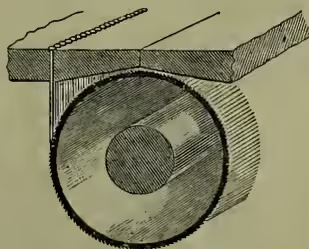
Ordinary pins are made of brass wire, and when these are finished by the machine they are cleaned of grease and other matters by boiling them in weak beer. The pins are next coated with tin, or 'coloured,' as it is called. In this process alternate layers of pins and grain-tin are placed in a copper pan, to which water is added, along with some argol or crude tartar (bitartrate of potash). When heat is applied a solution of tin is produced from which the metal is deposited on the surface of the pins, giving them their silvery white colour. The tin surface is afterwards brightened by shaking them in a bag or barrel with bran or sawdust. Pins are 'papered' by a self-acting machine not less ingenious than the one by which they are made.
For mourning pins iron wire is used, and these are either 'blued' by heating them in a muffle till the proper tint is obtained, or made black by coating them with a suitable varnish, which is afterwards hardened by stoving the pins. The finest and most costly pins are those made of hair-like wire for insect collectors. 'Blanket' pins are about inches long, and various sizes between inch and ths of an inch in length are made for domestic use. Safety pins with the point resting in a loop, now so much used in the nursery and for other purposes, were, as already stated, made in prehistoric times; at least pins of exactly the same form were. The manufacture of pins is largely carried on at Birmingham, and to a less extent at London, Warrington, Stroud, and Dublin. They are also extensively manufactured in the United States—chiefly in Connecticut.