Pipe-fish, a family of remarkable fishes in the same (Lophobranch) order as the Sea-horses. The body is elongated like a thin pipe; the jaws are prolonged in a tubular toothless snout; the muscular development is slight; the skin is covered with an armature of hard plates; the gills are in the form of tufts, and the branchial aperture is very small. The eggs are carried about and hatched by the male, usually within a capacious pouch formed from two folds of skin on the ventral surface of the tail-region. One of the commonest British species is the Great Pipe-fish (Syngnathus acus), which is sometimes found in deep water, and sometimes at low tide among the seaweed in rock-pools. The specimens commonly seen are from 1 foot to 18 inches in length. It may be seen slowly moving about, with curious contortions, poking its long snout into every crevice in search of food, and sometimes assuming a vertical position with the head downwards, boring into or stirring the sand.
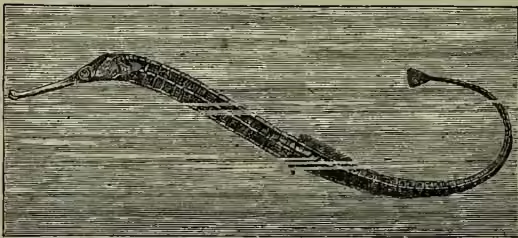
One of the commonest American pipe-fish is Siphonostoma peckii, which lives among the eel-grass of the coast.
The name Pipe-fish is sometimes given also to the fishes forming the family Fistularidæ, or Flute-mouths, of which one of the most remarkable is the Tobacco-pipe-fish (Fistularia tubaccaria). But these are large marine sticklebacks, and have only a superficial resemblance to the true pipe-fish.